





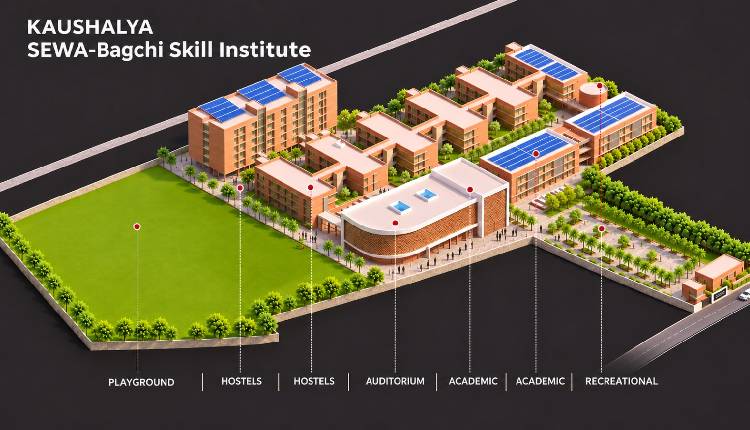
Bhubaneswar: In a major push for women-led skilling, the Self-Employed Women’s Association (SEWA) will break ground on Monday for ‘Kaushalya’ — one of the country’s largest residential skill institutes dedicated to women from the informal sector.
Spread over 8.15 acres at Manipur in Sanand, the state-of-the-art campus is designed to prepare young women for the future of work and Industry 4.0. Once operational, it will train 1,000 women every year through 20 technical laboratories, four digital labs and specialised simulation yards.
The institute will primarily cater to 40% of SEWA members who are in the 18-35 age group across the country. Developed in collaboration with ITEES, Singapore, the training will cover six high-growth sectors — electric vehicle maintenance, solar technology, high-tech electronics repair, healthcare, hospitality, and beauty and wellness.
The ambitious project is backed by the Bagchi Foundation, founded by noted philanthropists Susmita Bagchi and Subroto Bagchi. Subroto Bagchi is the co-founder of Mindtree and former chairman of Odisha Skill Development Authority.
Recalling her long association with SEWA, Susmita Bagchi said, “My association with SEWA began more than 30 years ago when I discovered the organisation through a Chikankari exhibition. In 2023, after meeting SEWA leaders through Ahmedabad University, our conversations on women’s skilling gained momentum and ultimately evolved into the SEWA-Bagchi Skill Institute initiative.”
According to a press release, the Foundation chose SEWA for its shared vision, execution capacity, scalability and strong governance model.
It is pertinent to mention that Susmita Bagchi is also the former chairperson of Odisha’s Mo School Abhiyan and a board member of the Social Stock Exchange.
Emphasising the need for future-ready skills, SEWA’s Reema Nanavaty said, “India is throwing up so many opportunities. How do you make them future ready? We call it future of work for young informal sector women workers. How do you equip them with relevant skills so that younger women in the informal sector find better, decent and dignified work.”