



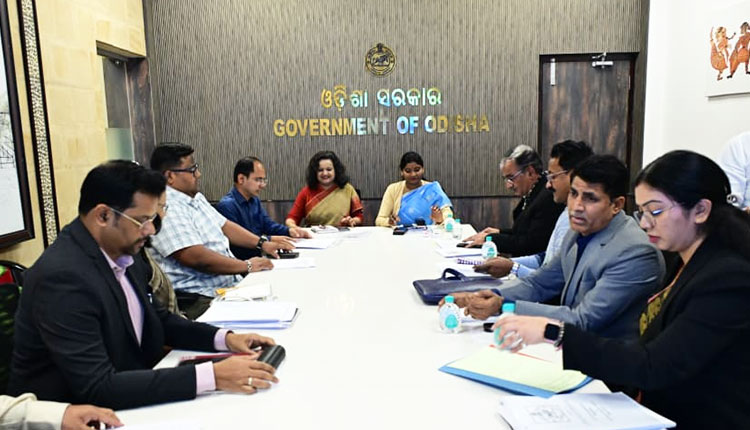
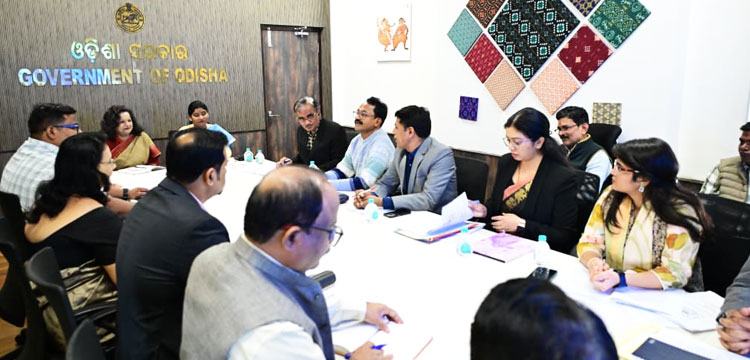
Bhubaneswar: A high-level review meeting on welfare schemes for Scheduled Tribes (STs) was held at the Lok Seva Bhawan conference hall on Monday in the presence of Chief Secretary Anu Garg and Asha Lakra, Member of the National Commission for Scheduled Tribes (NCST).
During the meeting, the NCST member reviewed the implementation of various central and state-sponsored schemes aimed at the socio-economic development of tribal communities in Odisha. Detailed discussions were held on the progress, challenges, and outcomes of key initiatives being implemented by the State Government.
The meeting was attended by B. Parameswar Rameshwaran, Commissioner-cum-Secretary of the Department of Scheduled Caste, Scheduled Tribe Development, Minority & Backward Classes Welfare, along with senior officials from the Panchayati Raj & Drinking Water Department, Revenue & Disaster Management Department, and other concerned departments.
A major focus of the review was on central schemes related to tribal education, particularly the provision of quality residential education. The Commission laid emphasis on strengthening infrastructure and safety in residential institutions, including the appointment of female matrons in girls’ hostels, construction of boundary walls, and availability of adequate toilet facilities. The functioning of Ashram Schools, Eklavya Model Residential Schools (EMRS), and Sevashrams across the state also came under review. Officials informed that a total of 1,765 schools are currently operating under the department.
The Departmental Secretary also apprised the Commission of the State Government’s progress in the implementation of individual and community forest rights. It was informed that by October 2025, applications for 7.32 lakh individual forest land rights had been received, of which 4.64 lakh rights have already been granted.
Issues related to the Protection of Civil Rights Act, 1955 and the Scheduled Castes and Scheduled Tribes (Prevention of Atrocities) Act, 1989 were discussed at length. The implementation of the Panchayats (Extension to Scheduled Areas) Act (PESA) also featured prominently in the deliberations, with the Commission stressing the need for greater involvement of tribal communities in its effective execution.
In addition, discussions were held on key livelihood and development initiatives such as PM-JANMAN, the Chief Minister’s Tribal Livelihood Mission, the Particularly Vulnerable Tribal Groups (PVTG) Livelihood Mission, and the Dharati Aba Scheduled Tribe Village Upliftment Campaign. The meeting underscored the importance of coordinated efforts among departments to ensure inclusive and sustainable development of tribal populations in the state.