



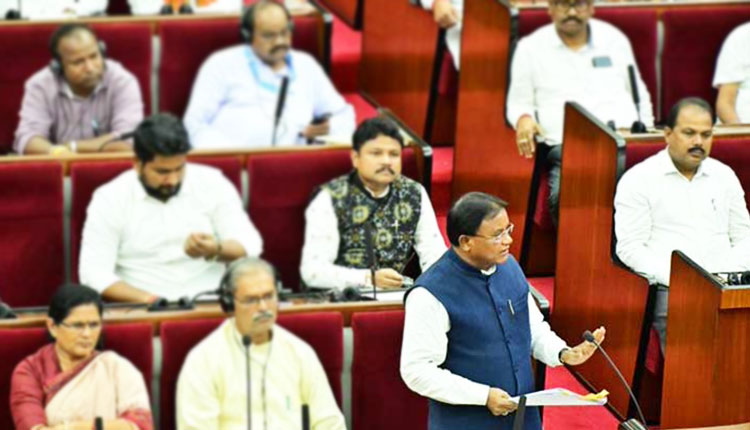
Bhubaneswar: The Odisha Assembly on Monday passed the Supplementary Budget of ₹17,440 crore for the financial year 2025–26, with Chief Minister and Finance Minister Mohan Charan Majhi asserting that the allocations reflect the government’s commitment to inclusive development, fiscal discipline, and long-term economic transformation.
Responding to the debate on the supplementary demands, Majhi said the additional expenditure—of which ₹13,716 crore is program expenditure—has been carefully designed to accelerate welfare initiatives, infrastructure creation, and social sector reforms outlined in the main budget of ₹2.9 lakh crore passed earlier this year.
Majhi reiterated that the state’s financial health remains robust, highlighting that Odisha continues to maintain a revenue surplus of 1.3%, while keeping its Debt-to-GSDP ratio at 11.9% and interest payment burden at just 2.2%. He described Odisha’s economic management as “the best among all states”, contrasting it with what he termed as poor fiscal practices in some Congress-ruled states.
A significant portion of the supplementary funds has been earmarked for key sectors including Food & Consumer Welfare (₹4,329 crore), School & Mass Education (₹2,000 crore), Health & Family Welfare (₹1,159 crore), Agriculture and allied sectors (₹1,673 crore), and Women & Child Development including Mission Shakti (₹1,557 crore). Majhi said these provisions underscore the government’s focus on farmers, women, and students.
Reaffirming the government’s overarching goal to build a “Vikshit Odisha” by 2036 in sync with the national vision of a “Vikshit Bharat 2047”, the Chief Minister emphasized the role of infrastructure in driving growth. He cited Odisha’s capital expenditure outlay of ₹65,120 crore—6.11% of GSDP, the highest in the country—and pointed to fast-tracked approvals of major road, rail, and semiconductor manufacturing projects supported by the Centre.
Majhi also defended the government’s approach to paddy procurement, assuring farmers that no eligible farmer would be deprived of selling paddy, and announced additional allocations for the procurement system and PDS subsidies. He asserted that schemes such as Subhadra Yojana, Madho Singh Scholarship, and Krushak Samriddhi Yojana will significantly boost household incomes and welfare.
On social sectors, the Chief Minister highlighted the government’s push for world-class primary education through the upcoming Godabarish Mishra Adarsha Schools and detailed expanded allocations under PM-Poshan, Samagra Shiksha, and maternal and child welfare schemes. In the health sector too, he noted provisions for the National Health Mission, new medical PG courses, and affordable tertiary care under the Gopabandhu Jan Arogya Yojana.
Majhi also laid out the government’s plan to connect all villages with reliable electricity, drinking water, and roads within the next two years under “Mission Power”, adding that the supplementary budget carries additional allocations to push this goal.
He criticised the previous government’s “24 years of incomplete development”, arguing that many villages still lacked basic facilities such as roads and drinking water. The Chief Minister maintained that the present administration is committed to transparent recruitment, efficient governance, tribal empowerment, and promotion of Odia language and culture.
The Chief Minister said the funds would be crucial for sustaining development momentum and ensuring that Odisha reaches the ranks of the top five states in India by 2036.