





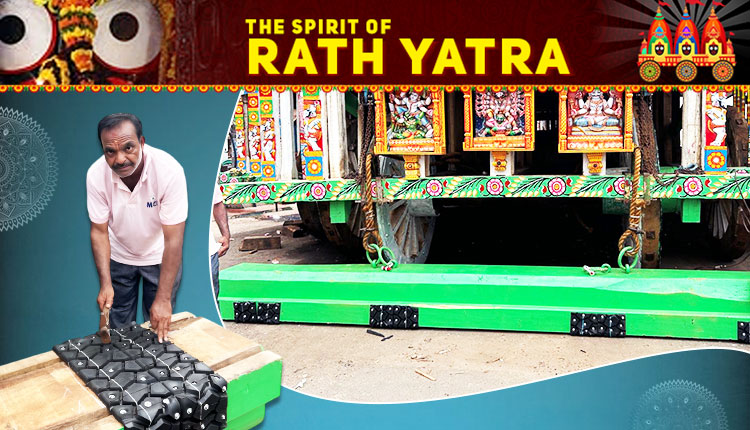
Sambalpur/Bhubaneswar: Every year, lakhs of devotees gather in Puri to witness the grand Rath Yatra of Lord Jagannath, Lord Balabhadra and Devi Subhadra. While the towering wooden chariots and the sea of devotees capture everyone’s attention, few notice the silent engineering effort that helps keep the annual festival safe.
For nearly two decades, seven retired engineers and technicians from western Odisha have been working quietly to improve the braking system of the three chariots. Their contribution has strengthened the traditional wooden braking mechanism, making it more effective, especially during rain.
The initiative began in 2007 when retired Mahanadi Coalfields Limited (MCL) mechanical engineer Aswin Kumar Mishra attended the Rath Yatra. He noticed that even after the wooden brakes were applied, the giant chariots continued to roll for several feet before stopping.
With thousands of devotees walking close to the chariots, Mishra felt the delay could pose a safety risk. Instead of treating it as an unavoidable part of tradition, he decided to find a practical solution.
Back in Sambalpur, he joined hands with fellow retired MCL employee Jaggu Benia. Soon, Prashanta Benia, Trilochan Badhai, Dhaniram Bagh and two other retired colleagues became part of the mission. Together, they combined their engineering knowledge with their devotion to Lord Jagannath.
After receiving permission from the Shree Jagannath Temple Administration (SJTA), the team introduced its first improved braking system in 2008. The initial design, made with ordinary rubber sheets and nails, could not withstand the enormous weight of the chariots. Rather than giving up, the team continued experimenting and improving the design every year.
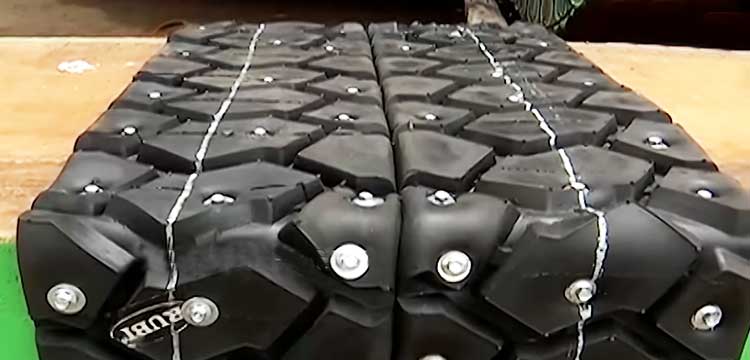
Their first major success came in 2010 with the use of specially designed large-headed nails and heavy-duty rubber sheets. The modification reduced the distance travelled by the chariots after the brakes were applied, improving safety during the procession.
The engineers continued their research by studying how rain affected the braking system. Based on years of observation, they introduced another major improvement for Rath Yatra 2026.
This year, they replaced the earlier plain rubber with specially prepared bit rubber. The braking units were also treated with waterproof chemicals and fitted with self-screws and specially designed nails to provide a stronger grip on wet roads and reduce slippage.
“Our only aim has always been to improve safety for the devotees while preserving the traditional system of the Rath Yatra,” Mishra told Ommcom News.
According to him, the new braking system has significantly reduced the movement of the chariots after the brakes are applied, even during rainfall.
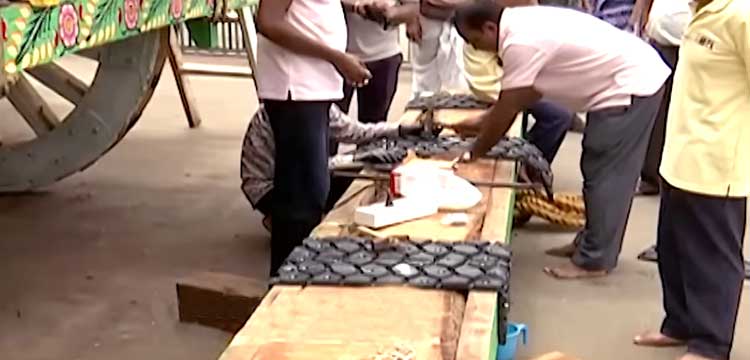
“In previous years, the chariots could still move nearly two to three feet after braking in the rain. The new bit rubber has greatly reduced that movement and prevents slipping,” he said.
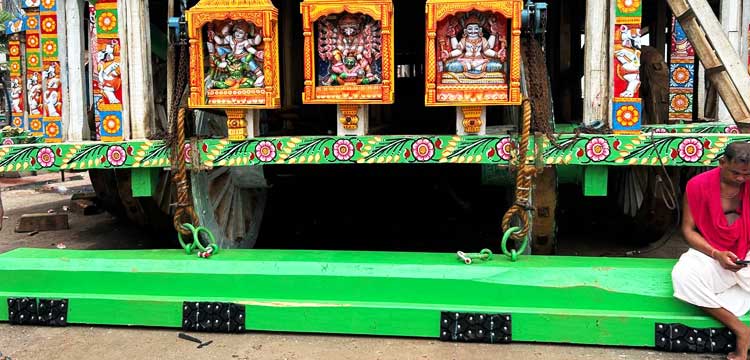
Each braking unit measures about eight inches in width and 33 inches in length and is made from a combination of rubber, nylon and cotton. Eight to ten such units are installed beneath each chariot on a 16-foot wooden brake beam, which is operated manually through a chain-pulley mechanism.
Installing the braking system is a demanding task. The seven-member team spends nearly three days fitting the units beneath all three chariots before the annual festival.
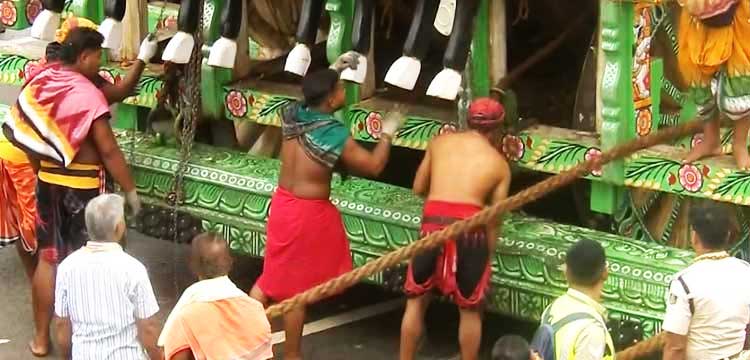
Despite the importance of their work, the engineers have never accepted any payment. They bear the cost of materials themselves, with additional support coming from well-wishers.
“For us, this is not a project. It is ‘seva’ to Lord Jagannath,” Mishra said.
While millions celebrate the spiritual grandeur of the Rath Yatra, the dedication of these retired engineers often remains unnoticed. Yet, year after year, their selfless service has become an important part of one of the world’s largest religious festivals, ensuring that tradition and technology work together for the safety of lakhs of devotees.