


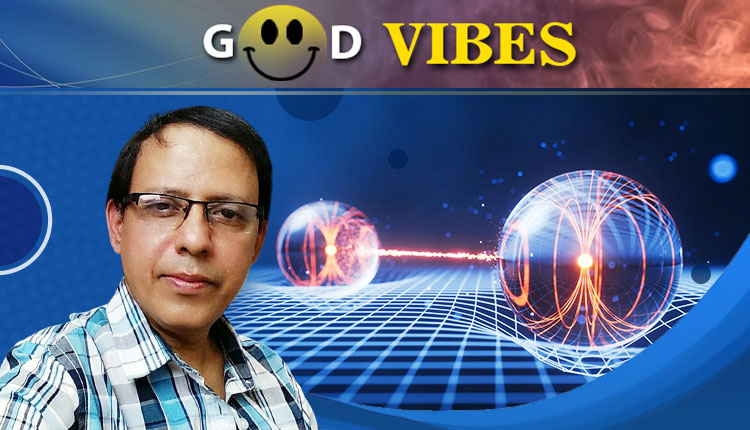
Bhubaneswar: In the quiet lanes of a remote village in Odisha’s Ganjam district, where evenings arrive early because homes go dark without electricity, a young boy once sat chasing light—both literally and in spirit. That boy was Arun K. Pati. While other children returned home at dusk, he carried his books to the panchayat office veranda, where a single electric bulb burned like a small sun in an otherwise shadowed village. Under its pale glow, sitting on the cold floor, he dreamed of a universe far brighter than his surroundings.
Today, the world knows him as one of the top 1% of scientists globally, a leading figure in quantum physics, the Father of Indian Quantum Computing, and the man who recently discovered the ‘Quantum Acceleration Limit’—a rule hidden in nature’s deepest layers. But his story began not in a laboratory, but beside a lantern that flickered more than it shone.
Prof. Arun K. Pati was born in the remote village of Kokalunda, near Bellaguntha, and grew up in a small village near Aska, Ganjam. His father worked in the Veterinary Department, while his mother was a homemaker. Despite coming from a middle-class family with limited financial means, his parents instilled in him the values of learning and perseverance from an early age. He completed his primary and secondary education in his village, studied at Hari-Hara High School in Aska, earned his Bachelor of Science at Aska Science College, and completed his MSc in Physics from Berhampur University. Later, he pursued a PhD in Quantum Theory at the University of Mumbai, followed by an EPSRC postdoctoral fellowship at Bangor University, UK.
Discovering a Passion for Physics
Prof. Arun K. Pati’s early interests were not in physics. He was drawn to painting, Odia literature, poetry, movies, and music. He dreamed of becoming a poet, actor, or music director. However, during his BSc, a new world opened for him: modern physics. He learned about wave-particle duality—the concept that every particle behaves both like a wave and a particle. This idea fascinated him and ignited his curiosity to explore the deeper mysteries of the quantum world.
During his MSc at Berhampur University, Prof. G. S. Tripathi played a pivotal role in encouraging him to pursue physics seriously. After completing his MSc, he was selected for the Training School Program at BARC, Mumbai, and later joined as a scientist in the Theoretical Physics Division. His focus from BSc days had always been on quantum mechanics. However, at BARC, few scientists engaged in fundamental research, and he was often asked to work in reactor physics—an area that did not interest him. Undeterred, he chose his research topics independently and authored papers on his own, navigating a path that was challenging by any standard.
Struggles and Determination
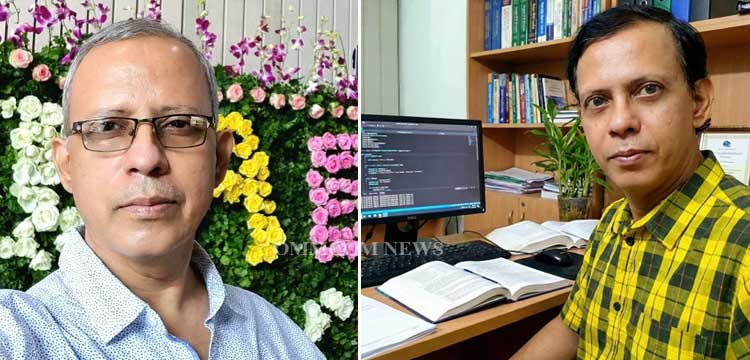
In a conversation with Ommcom News, Prof. Pati recalled his early struggles and the challenges he faced in pursuing quantum research.
“Until my BSc, we did not have electricity at home. I used to study by lantern light or occasionally under the single bulb at the Panchayat office veranda. It was only when I joined the Berhampur University hostel that I had access to electric light—it was quite a change for me,” he said.
He also spoke about the professional challenges he faced. Seniors at BARC questioned his focus on quantum theory and quantum computing, arguing that he should work on applied research to “benefit the nation directly.” He faced demoralisation, delays in promotion, and even restrictions on attending conferences.
“For nearly a decade, it was a very challenging period. But I continued my research in quantum theory and quantum computing. Doing research in quantum physics and quantum information came at a cost, but I never regretted it,” he added.
Despite all odds, Prof. Pati showed perseverance. “Over the last 35 years, I have kept my ideas alive. Every idea takes me a step closer to understanding Nature’s truth,” he said.
Global Recognition and Pioneering Research
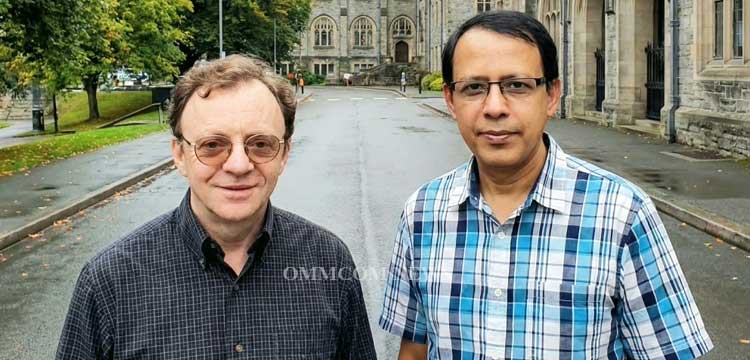
After completing his PhD, he received the prestigious EPSRC postdoctoral fellowship at Bangor University, UK, where he worked with Prof. Samuel L. Braunstein, a world leader in quantum computing. Between 1998 and 2000, Arun made several groundbreaking discoveries in quantum information and computing, including the no-deletion theorem, remote state preparation, geometric phases for mixed states, and novel quantum cloning machines. He describes this period as the most productive years of his career.
After returning to India, he worked at the Institute of Physics (IOP) Bhubaneswar (2001–2010) and later at the Harish-Chandra Research Institute (HRI), Allahabad. There, along with Prof. Ujjwal Sen and Prof. Aditi Sen De, he established one of India’s largest research groups in quantum computing. He stayed at HRI until the end of 2022, later serving as Head of the Centre for Quantum Science and Technology at IIIT Hyderabad. Currently, as Director, he plans to strengthen the Centre for Quantum Technology (CQuTe) at KIIT University, Bhubaneswar—one of the major quantum research hubs in Eastern India.
The Quantum Acceleration Limit
For decades, scientists understood the Quantum Speed Limit (QSL), which defines the maximum speed at which a quantum system can evolve. Prof. Arun K. Pati asked a deeper question: if quantum states have a maximum speed, do they also have a maximum acceleration? In other words, just like a car has limits not only on speed but also on how fast it can accelerate, could nature impose limits on how quickly a quantum system can change its speed?
After years of research, he formulated the Quantum Acceleration Limit (QAL). This law of nature states that quantum systems not only have a maximum speed of evolution but also a maximum acceleration—the fastest rate at which that speed can increase. The discovery provides a deeper understanding of quantum dynamics and is critical for quantum computing, quantum control, quantum communication, and quantum sensing. Engineers can now design devices that are faster, more stable, and more efficient, ensuring operations accelerate without errors.
Prof. Pati explains, “While traditional quantum speed limits define the maximum speed of a quantum state, the QAL sets a limit on how fast that speed itself can increase. It reveals that nature restricts not only the pace of quantum evolution but also how abruptly that pace can change. This insight opens new avenues in quantum control, computing, and fundamental physics.”
Currently, the QAL remains a theoretical concept but can be tested with existing quantum devices such as superconducting qubits, trapped-ion systems, nitrogen-vacancy centers in diamond, and ultracold atomic platforms. Industries like quantum communication, healthcare, defense, computing, and materials science could potentially benefit from its application.
Accolades and Achievements
Over his 35-year career, Prof. Arun K. Pati has made groundbreaking contributions to quantum computation and quantum information. Some of his key discoveries include the No-Deletion Theorem, No-Hiding Theorem, No-Masking Theorem, Remote State Preparation, and Stronger Uncertainty Relations.
His research has been published in prestigious journals such as Nature, Science, Scientific American, and Nature Asia.
Prof. Pati has received several notable awards, including the Indian Physical Society Award for Young Scientists (1996), Indian Physics Association Award for Young Physicist of the Year (2000), Samanta Chandra Sekhar Award (2009), and the Distinguished Alumni Award from Berhampur University.
He is an elected Fellow of the Indian Academy of Sciences, Bangalore, and the National Academy of Sciences, Allahabad. He also consistently ranks among the top 2% of scientists worldwide.
Message to Young Students
Prof. Pati believes that India’s rise in global quantum research is real and accelerating. Institutions like KIIT and NISER are nurturing talent, building research facilities, and fostering global collaborations. He urges the Odisha government to provide dedicated funding, build quantum labs, encourage collaborations, and create talent development programs.
To young students across India, he said, “Every great discovery starts with curiosity and persistence. Ground yourself in mathematics and physics—they are essential tools for unlocking the mysteries of the universe. Confusion is often the first step toward true understanding, so question the ‘WHY’ behind concepts rather than just memorising formulas.”
From Lamplight to Global Recognition
Prof. Arun K. Pati’s journey—from studying by a flickering lantern in a small Odisha village to leading breakthroughs in quantum science—exemplifies determination, curiosity, and passion. His life story inspires countless young minds to pursue science, challenge boundaries, and dream beyond their immediate surroundings. It is a testament to how resilience, hard work, and unwavering focus can transform even the humblest beginnings into global achievements.