


United Nations: Delaying Security Council reforms would cause “more human suffering and misery”, the G4 nations have warned while presenting a model for early action to restructure the UN’s highest decision-making body.
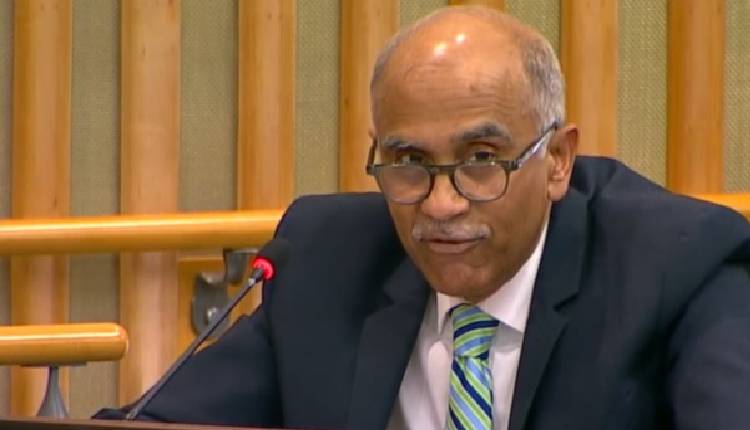
With “countless innocent lives” lost every day to ongoing conflicts, “we must collectively make every moment count”, India’s Permanent Representative P. Harish said on behalf of the G4 at the Inter-Governmental Negotiations (IGN) for Security Council reforms on Wednesday.
The G4 is made up of India, Brazil, Germany, and Japan, who advocate together for reforming the Council and also mutually support each other for permanent seats on a reformed body.
“The world is going through unprecedented times,” and the UN’s credibility and efficacy are being questioned because of its inability to deal with raging conflicts, he said.
“For decades, status-quoists have been posing hurdles and impeding forward movement. In so doing, they contribute to the failure of the Security Council,” Harish said.
The IGN, as the reform process referred to, faces roadblocks from a small group of countries that call themselves the Uniting for Consensus (UfC) and use procedural tactics to prevent the adoption of a negotiating text that would allow progress in negotiations.
Gianluca Greco, the deputy permanent representative of Italy, which leads the group that includes Pakistan, insisted that there should first be consensus on all issues before there can be a text laying out the reforms.
He also reiterated the UfC’s raison d’etre, preventing expansion of permanent membership.
Harish said the G4 is categorical that “negotiations on the basis of a text, which stipulate clearly laid out milestones and timelines, are central” to the IGN process.
As a stepping stone to this goal, he said the “G4 remains committed to working towards a consolidated model as this could be the precursor for text-based negotiations”.
The consolidated model would pool together the suggestions from all UN members and present them in a manner to help the negotiations.
Harish laid out the G4’s concrete model for reforms covering all categories and geographies.
The Council’s size must go up from the present 15 to 25 or 26, with six of them new permanent seats, he said.
Reflecting the “contemporary geo-political realities” is a “fundamental principle” behind the G4 model, he said.
For this, two of the six new permanent seats should go to the African region, two to the Asia Pacific, and one each to Latin America and Western Europe, he said.
Implied in this model is India and Japan getting the Asia Pacific seats, Brazil the Latin American seat, and Germany the one for Western European countries.
One or two of the new non-permanent seats would be allocated to Africa, and one each would go to the Asia Pacific, Latin America and the Eastern European Group, Harish said.
Within the non-permanent category, “due consideration” should be given to the Small Island Developing States to ensure their adequate and continued representation, he said.
The G4 is against introducing new seats based on religion, he said.
He did not specify the religion, but suggestions have been floated to reserve seats for Islamic countries.
Harish said, “Proposals to introduce new parameters, such as religious affiliation, run counter to established UN practice and add considerable complexity to an already difficult discussion”.
He took a dig at the UfC, without calling it out by name, for opposing permanent seats for Africa, which is backed by most countries.
“G4 has specified its formula to address the historical injustices against Africa,” he said.
“One cannot say they support addressing such injustices and, at the same time, oppose the expansion in the permanent category” for Africa, he said.
Japan’s Permanent Representative, Yamazaki Kazuyuki, said that the Asia Pacific region is underrepresented in the Security Council.
It has only one-fifth of the seats — one permanent seat and two non-permanent seats – even though the region has 54 UN members and more than half of the world’s population, he said.
(IANS)