



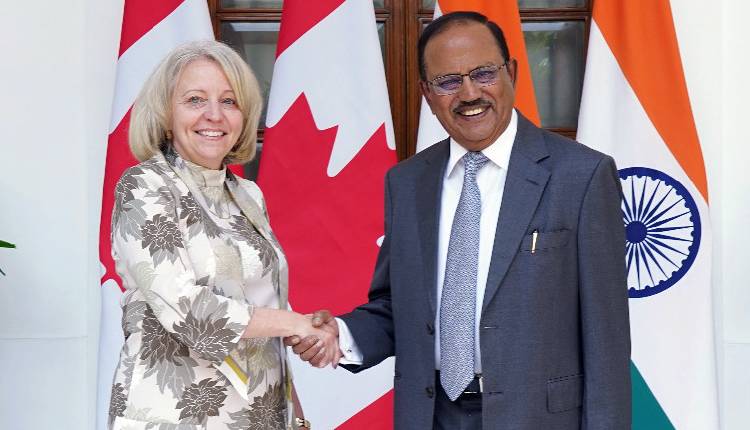
New Delhi: National Security Advisor (NSA) Ajit Doval’s recent trip to Canada has come at a critical inflection point. As Pakistan’s ISI continues to attempt reviving Khalistani militancy in Punjab, this engagement with his Canadian counterpart Nathalie Drouin is more than just reconciliatory diplomacy – it is a move which has the potential to fundamentally alter the transnational architecture sustaining Khalistani extremism. The meeting, described in strategic circles as “constructive” and “fruitful”, marks a shift from estrangement to security cooperation. For the Khalistan movement, which has for long used Canada as an operational hub, this resetting of ties portends significant challenges.
Canada has been a safe haven for the Khalistani network, with masterminds of targetted killings in Punjab operating from Toronto and Vancouver with relative impunity. Diaspora-based Khalistani groups have used Canadian soil to issue threats against India, orchestrate targetted killings in Punjab and sustain drug cartels that funnel narcotics and arms across the border from Pakistan. The Khalistani extremist-criminal nexus is sophisticated, with the drug trade funding the separatist movement and ably supported by Pakistan’s establishment. Diaspora vote-bank politics and lobbying efforts of the community in Canada have created an environment where security considerations have been compromised for electoral arithmetic.
The highlight of the NSA Doval-Drouin meeting is the agreement to share real-time intelligence across four domains – Khalistani extremism, drug trafficking, cyber threats and cross-border smuggling. Expected to be a shift from reactive monitoring to proactive interdiction, this real-time intelligence sharing intends to target the Khalistani network by identifying key operatives, fundraisers and radicalisers and their financial flows; countering narco-terror threat by targetting drug trafficking; tracking cyber threats, including online radicalization; and tracking Sikh extremism with clear distinction between legitimate diaspora issues and separatist mobilization.
The strategic implications are substantial and it represents a functional mechanism to disrupt networks that thrive on transnational anonymity. Intelligence cooperation removes the gap that had previously allowed planning on Canadian soil for execution in Punjab, and it poses an operational challenge for Khalistani extremist planners, especially those based in Pakistan. For India, the ability to access Canadian intelligence in real time could prove decisive in acting against operatives who have long evaded accountability. The key, however, lies in the kind of political will in Ottawa that extends beyond NSA-level commitment – a caveat that cannot be overstated in terms of the complexities in Canadian domestic politics.
The immediate impact of this visit would be in several areas.
Real-time intelligence sharing would allow agencies in Canada and India to track Khalistani operatives and there would be an increase in surveillance, arrest and disruption of modules in Canada and India, thereby constricting Khalistani operations.
Enhanced surveillance renders fundraising and recruitment riskier while potential arrests will deter extremists. Logistical challenges of moving funds, arms and personnel too become difficult and crackdown on drug cartels and arms smuggling would affect the financial base of Khalistanis, making it difficult for them to revive militancy in Punjab.
The narrative battle shifts as reduced platforms for pro-Khalistan propaganda will not only allow moderate Sikhs to regain the narrative but also focus on addressing Punjab’s real issues such as the drug menace and unemployment.
Blocking radicalization pipelines targetting Sikh diaspora youth can lead to a paradigm shift, revealing how Khalistani networks are exploiting legitimate grievances.
In the medium term, this could result in a reduction of support for militancy in the diaspora. In the long term, this could result in a weakening of Khalistanis across the globe, though there is a geographic threat of the ISI trying to expand into the UK, US, and Australia. India can capitalise on this breakthrough and build a broader coalition against the transnational Khalistani infrastructure. India expects Canada to distinguish between legitimate diaspora activism and extremist activity that undermines bilateral relations. If Canada begins to restrict extremist propaganda, it could limit the global reach of Khalistani ideology and the recruitment of disaffected youth in Punjab.
The timing of this security reset is important given intelligence assessments that the ISI has set in motion a major plan to revive the Khalistan movement in Punjab. As in the past, the Pakistani strategy hinges upon exploiting the Sikh diaspora for operational depth, allowing for plausible deniability while fuelling low-intensity conflict through external sanctuaries. Intelligence sharing directly undermines this model. By closing off the Canadian sanctuary, India forces the ISI to operate with increased risk and reduced strategic depth, undermining the transnational dimension of Pakistani hybrid warfare.
Realistic assessment demands acknowledgment of hurdles. Canadian electoral politics and diaspora vote bank considerations may undermine the implementation process. While the independence of the judiciary could be a constraint for the executive, resource allocation remains uncertain. The trust deficit may also affect the operationalization of the process. The key issues are: Will this diplomatic reset translate into operational degradation of the pro-Khalistani network threatening India’s security. Will the cooperation survive electoral cycles? Can the Canadian government withstand domestic lobbying of diaspora groups and will there be administrative buy-in beyond the NSA level?
NSA’s visit to Canada was not merely a diplomatic engagement; it was a strategic intervention aimed at disrupting the transnational ecosystem sustaining Khalistani extremism. By resetting ties and institutionalizing intelligence cooperation, India and Canada are sending a clear message: Khalistani activities will no longer be tolerated under the guise of diaspora politics. Converting diplomatic breakthrough into operational impact will, however, require sustained political commitment from Ottawa and continued intelligence sharing. Short and mid-term indicators will be arrests, freezing of assets, drug seizures and deportation of extremists.
For the pro-Khalistani ecosystem, this resetting of security ties by India and Canada represents a major worry. Their safe havens will shrink, their funding streams are under threat, and their propaganda faces increased scrutiny. For India, it is a step towards securing Punjab against attempts to revive militancy and narco-terrorism. For Canada, it is an opportunity to disrupt the pro-Khalistani networks that have operated with impunity and reaffirm its commitment to global security practices.
The battle against Khalistani extremism is far from over, but the NSA Doval–Drouin meeting marks a turning point. If followed through with sustained cooperation, it could significantly disrupt the extremist network that has long exploited diaspora politics to destabilize Punjab.
(Kanchan Lakshman is a Delhi-based national security analyst. Views expressed are personal)