


Kathmandu: As Nepal voted to determine its people’s representatives in a high-stake election held on Thursday, an entrepreneur and social media enthusiast ploughed a unique furrow to prove election campaign need not be expensive to win a favourable mandate.
“Election campaign can be done cheap; I’ve proved that by keeping the total expenses limited to around Rs 5 lakh Nepalese rupees (about 3.1 lakh Indian rupees),” Asheem Man Singh Basnyat claimed, an independent candidate from Kathmandu 1.
This is about a fifth of the maximum campaign spend officially allowed for candidates that ranges from (Nepalese) Rs 25 lakh to Rs 33 lakh, where his Parliamentary constituency of Kathmandu-1 falls in the category with the lowest ceiling.
Perhaps the profile of this Parliamentary constituency has helped the 35-year-old tech entrepreneur launch a unique poll campaign on his maiden attempt at the hustings.
According to Basnyat, it is the only Parliamentary constituency in Nepal which entirely comes under the Kathmandu Metropolitan area.
Every other constituency is either Metropolitan, Municipal, or even rural-municipal area, so that makes it core urban.
It is also the smallest constituency in terms of landmass with 48,489 registered electors where “in the last two elections, the winner got a little north of 6,000 mandates and it’ll be around that number this time too,” he added.
The 35-year-old holds a Masters in conflict, peace, and development studies and is a regional director at Pathao, a ride-hailing app that was introduced in Nepal by Basnyat and his friends in 2018.
The app has since emerged as a leading ride-sharing and on-demand delivery platform.
“I’ve always been vocal about empowering youth, job creation, digitalisation, and other things been part of our life, more so after the Covid pandemic struck six to seven years ago,” he said.
Before his formal entry into politics, the young entrepreneur took legal recourse to introduce e-commerce in Nepal during the Covid lockdown.
“So, my activism started with seeking legal options for allowing e-commerce to operate in that period,” Basnyat said.
“Historically, parties and candidates use a lot of print media space, workers which cost a significant part of their total expense. But I chose to concentrate on social media since it has been crucial in the last five to seven years where I’ve been very active on such platforms and so are all the businesses that I run,” he added.
“It’s not about putting advertisements, but contents that would organically reach hundreds of thousands. It all started with a video where I declared my candidature and it was picked up soon by a lot of media, including social media channels,” Basnyat added.
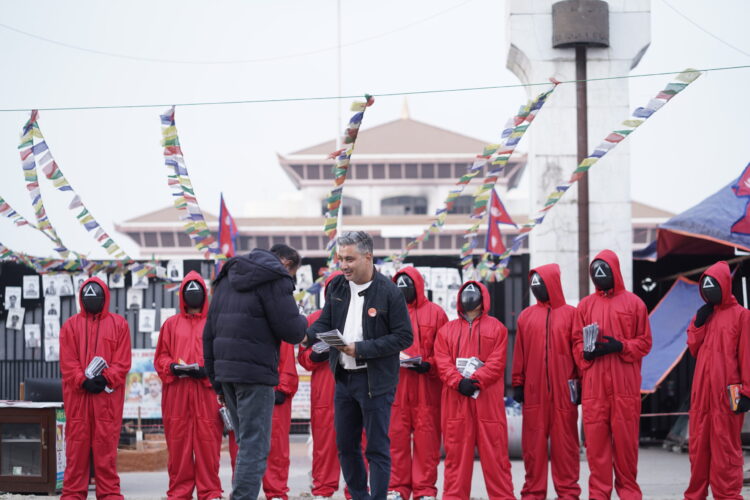
“But the pivotal point was when I got Squid Games masks from India, dressed up 10 people wearing the games’ outfits and then made them walk around the streets of Kathmandu without informing it as a part of my campaign,” he said.
He hit upon the idea which came where, during a door-to-door campaign, when he knocked at a door, the reaction was “Oh! Another one has just come!”.
It was then that chose to make the voters seek him and “The Squid Games characters made them come out of their houses to find out what was going on”.
“Incidentally, they had the triangle on their masks, which is also my election symbol. I also had the Squid Games characters drive around in a pick-up truck. It made people kind of curious to know what was happening,” Basnyat said.
And the replica of the characters featured in the Korean game made popular by streaming service apps cost him a total of (Nepalese) Rs 18,000.
“I acquired the masks from India, which cost me (Indian) Rs 199 each and the costume came for about (Nepalese) Rs 1,500,” he shrugged, adding, “But it had many media platforms running stories about my campaign.”
Spending Rs 5 lakh to acquire some 6,000 votes, will it work? The answer now lies sealed in ballot boxes.
(IANS)