



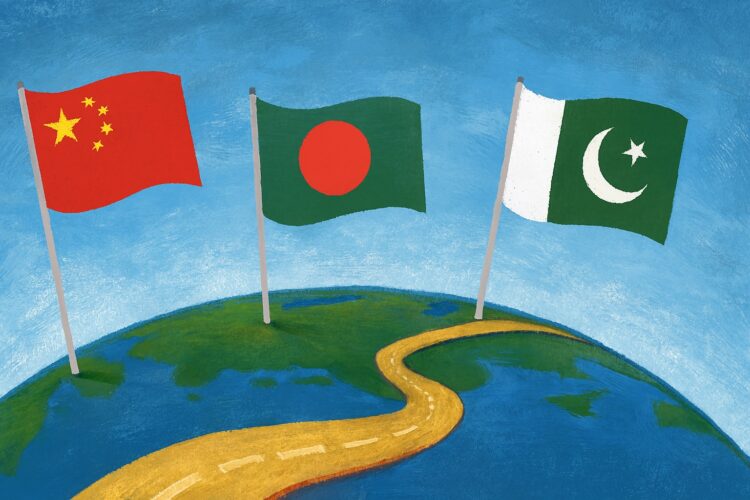
New Delhi: Pakistan’s recent push to deepen a trilateral cooperation with China and Bangladesh can at most give Beijing a chance to further broaden its Belt and Road Initiative (BRI), where Islamabad is already reeling under huge debts.
The initiative is more likely to produce limited, issue specific arrangements for developing connectivity corridors or targeted trade facilitation rather than a formal, institutionalised bloc.
Reports suggest that Islamabad is currently facing a USD 30 billion debt burden to Beijing under the ambitious China-Pakistan Economic Corridor (CPEC) project. Most of these projects remain incomplete amidst major economic, security, and environmental challenges.
In Bangladesh, BRI projects include the Rooppur Nuclear Power Plant, several port and connectivity projects, the Karnaphuli Tunnel, and multiple power sector and infrastructure contracts.
Reports on Beijing’s financial footprint in these projects vary, with one assessment putting its investment at about USD 7.07 billion, while Chinese contractors have won nearly USD 23 billion worth of jobs in construction.
China’s ambassador to Bangladesh had stated that Beijing released about USD 4.45 billion for 35 projects under the BRI, which may not reflect the full universe of China linked contracts and investments outside the initiative.
For Pakistan and Bangladesh, the aim could be to broaden this framework and expand into a South Asian alternative that excludes India.
Meanwhile, China is also the largest supplier of arms and equipment to the armed forces in both countries.
Thus, developing ties with India’s immediate neighbours is of significant strategic value for China, hyping threat perception to the South Asian giant from three sides.
For Islamabad and Dhaka, the triad improves diplomatic and strategic position vis-à-vis a far superior country. From Bangladesh’s perspective, greater cooperation with Beijing and Islamabad provides a perceived handle in its current rift. However, to what extent Bangladesh risks antagonising New Delhi is yet to be seen.
The formation of this geopolitical triangle may be traced to their first summit held in China’s Kunming on June 19. For some time, Islamabad has been witnessing a gradual alienation from the South Asian Association for Regional Cooperation (SAARC), formed in 1985 with India, Pakistan, Bangladesh, Sri Lanka, Nepal, Bhutan, and the Maldives; with Afghanistan joining in 2007.
The platform has been almost inactive since India decided to boycott the Islamabad summit following Pakistan’s involvement in the 2016 Uri terror attack. Two years before that, Pakistan had blocked an agreement for allowing cars and trucks to travel across South Asia, like in Europe.
Islamabad also threw its spanner in a similar attempt at regional railway collaboration.
With a combined population of over two billion, trade in South Asian makes only USD 23 billion, according to a World Bank report.
Meanwhile, India is also part of other regional organisations like the Bay of Bengal Initiative for Multi-Sectoral Technical and Economic Cooperation (BIMSTEC), which excludes Pakistan. BIMSTEC includes Bangladesh, Bhutan, India, Myanmar, Nepal, Sri Lanka and Thailand, where the total population is about 1.73 billion. It accounts for a total trade of some USD 1.95 trillion.
The question against the backdrop now is not whether the new grouping is politically and diplomatically attractive, but whether it is operationally feasible and what its wider geopolitical consequences would be for South Asia.
(IANS)