



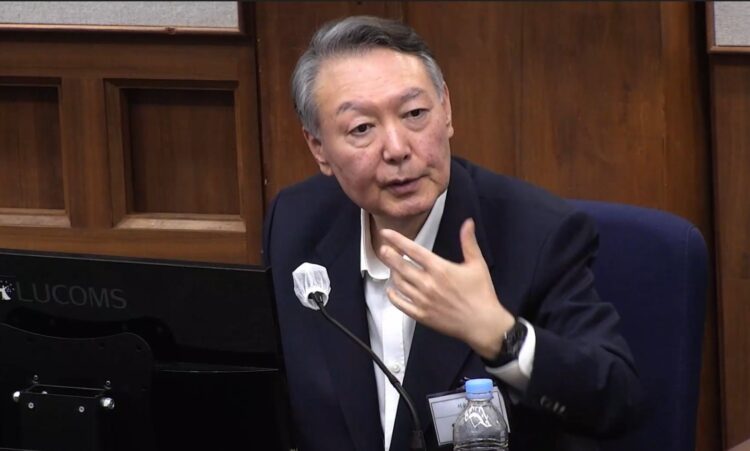
Seoul: The final hearing of former South Korean President Yoon Suk Yeol’s insurrection trial was held Friday amid keen interest in the level of punishment he will face, including the possibility of the death penalty.
The trial, which kicked off in February after Yoon was indicted on charges of leading an insurrection through his December 3, 2024, declaration of martial law, will conclude after the hearing that began at the Seoul Central District Court at 9:20 a.m.
The session will also be the final hearing in the insurrection trials of former Defence Minister Kim Yong-hyun, former National Police Agency chief Cho Ji-ho and five others, who are accused of playing a key role in an insurrection through their involvement in the brief execution of martial law.
All eight defendants, including the jailed former president, were in attendance.
A final hearing typically consists of the prosecution’s final opinion and sentencing recommendation, the closing arguments of the defendant’s lawyer and the defendant’s final statement.
In Yoon’s case, special counsel Cho Eun-suk’s team will likely request one of three types of punishment allowed by law for the ringleader of an insurrection — the death penalty, life imprisonment or life imprisonment without forced labor.
Legal sources anticipate the court’s sentencing will come in early February, Yonhap news agency reported.
Yoon is charged with conspiring with the former defence minister and others to stage a riot with the aim of subverting the Constitution by illegally declaring martial law in the absence of war or an equivalent national emergency.
In particular, he is charged with mobilizing troops and the police to seal off the National Assembly compound and prevent lawmakers from voting down his decree, and ordering the arrest and detention of the National Assembly speaker and the then leaders of the ruling and main opposition parties.
Yoon became the first sitting president to be indicted with physical detention in January last year.
He was released in March following a court order that canceled his arrest but was taken into custody again in July on additional charges related to his martial law attempt.
The courtroom where Friday’s hearing was held is the same place other former leaders were tried for various offenses, including former Presidents Chun Doo-hwan and Roh Tae-woo, who in 1996 received sentencing recommendations of the death penalty and life imprisonment, respectively, for their roles in a 1979 coup that installed Chun in power in 1980.
Amnesty International has categorized South Korea as a death penalty abolitionist in practice as the punishment has not been carried out since December 1997.
(IANS)