


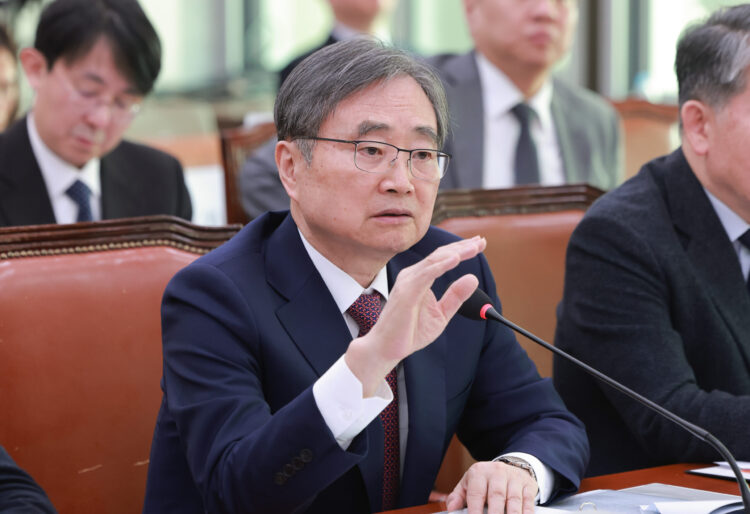
Seoul: South Korean Foreign Minister Cho Hyun sidestepped questions Tuesday on whether the United States had formally asked South Korea to deploy warships to the Middle East as Seoul faces pressure after US President Donald Trump urged allies to send naval vessels to protect the Strait of Hormuz.
Cho gave vague answers during a parliamentary session when asked by lawmakers if the government had received any formal or informal request from Washington about sending troops to the region to aid US military actions against Iran, Yonhap News Agency reported.
“It may or may not be considered a request,” Cho said at the National Assembly. “As for whether there have been discussions with the US about troop deployment itself, it is difficult for me to comment at this time.”
Trump renewed his call Monday (US time) for South Korea, Japan and other allies and partners whose “economies depend on” the vital waterway to join US efforts to keep the shipping route open, saying the US has long provided security protection to those countries.
Trump’s remarks were seen as reinforcing pressure on allies and partners to help his country secure the strait. Trump said he wants to see how countries “react” to the US request.
US Secretary of State Marco Rubio apparently echoed the call during his phone talks with Cho late Monday, highlighting the importance of cooperation to ensure security in the strait and stabilize the global economy and international oil prices, the foreign ministry said earlier.
“My clear position is to maintain a certain degree of ambiguity externally while, internally, acting in accordance with the Constitution and relevant laws, keeping foremost in mind the national interest and the safety of our people,” Cho said.
He said he is likely to meet one-on-one with Rubio for further discussions in Paris next week, where he has been invited to attend the Group of Seven foreign ministers’ meeting.
Lawmakers from rival parties voiced concern that Seoul could be pressured to join the war against Iran, risking its economy heavily dependent on oil imports from the region. They said any potential US request to deploy troops or naval vessels should require parliamentary approval under the Constitution.
“Section 1 of Article 5 of the Constitution stipulates that the Republic of Korea shall endeavor to maintain international peace and renounce all aggressive wars,” Rep. Kim Sang-wook of the ruling Democratic Party (DP) said. “Since the current war between the US and Iran could be viewed as a war of aggression, dispatching troops without careful consideration could be in violation of the Constitution.”
DP Representative Yoon Hu-duk also warned that responding to a missile or drone attack while escorting vessels would effectively constitute participation in the war, which under the Constitution would require public consent and ratification by the National Assembly.
Speaking on local broadcaster SBS, Hong Ihk-pyo, the senior presidential secretary for political affairs, stressed that the government will respond cautiously to Trump’s request.
“Our government must carefully deliberate the issue of sending combat troops in connection with the current situation in the Middle East,” he said. “While the close security alliance remains a pillar of the South Korea-US relations, it is also clearly an alliance in which both sides need to show mutual respect and consideration.”
(IANS)