






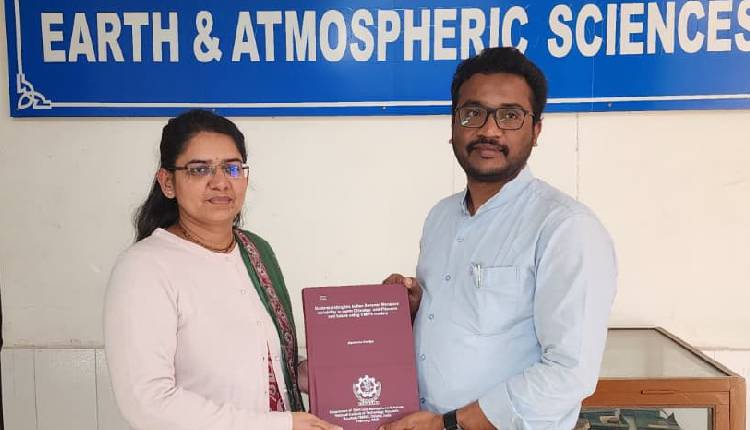
Rourkela: Scientists from the National Institute of Technology Rourkela have investigated how the Indian Summer Monsoon may respond to global warming. Their findings have been published in the International Journal of Climatology.
The Indian Summer Monsoon contributes about 80 percent of India’s annual rainfall and supports the livelihoods of hundreds of millions of people, especially those dependent on agriculture. Consistent monsoon rainfall is critical for food production, water resources, and economic stability—not only in India but across South Asia.
As global temperatures rise due to climate change, studies conducted worldwide have produced conflicting results. Some suggest that increasing temperatures may reduce rainfall, while others indicate that monsoon rainfall could intensify. Given the monsoon’s significant impact on human livelihoods, it is crucial to understand how the Indian monsoon might respond.
To address this knowledge gap, Nagaraju Chilukoti, Assistant Professor, and Karishma Dahiya, Research Graduate, from the Department of Earth and Atmospheric Sciences at NIT Rourkela, collaborated with Raju Attada, Associate Professor, Department of Earth and Environmental Sciences, IISER Mohali. They analysed monsoon behavior during warmer periods in Earth’s past to gain insights into its potential future behavior.
The research team used climate models to compare two warm periods: the mid-Pliocene epoch and the projected climate of the late 21st century (2071–2100) under a high-emissions scenario.

The mid-Pliocene, a subdivision of the geologic timescale spanning approximately 3.3 to 3.0 million years ago, is frequently studied to understand potential future climate change. Many aspects of Earth’s climate during this period resemble conditions projected under ongoing global warming, making it a valuable analog for assessing future climate responses, including changes in temperature, sea level, and atmospheric circulation.
During the mid-Pliocene, global temperatures were about four degrees Celsius higher than pre-industrial levels. Current climate projections indicate that similar warming could occur by the end of this century. Using this as a reference, the researchers studied how the Indian Summer Monsoon responds to a warmer climate.
The study found that monsoon rainfall over India was higher during the mid-Pliocene, and a similar increase is expected in a warmer future climate. However, the mechanisms behind the increase differ in each case. During the mid-Pliocene, stronger winds and more active atmospheric circulation drove the higher rainfall. In the future scenario, the increase is expected because a warmer atmosphere can hold more moisture.
Explaining the findings, Nagaraju Chilukoti said, “The past is the key to the future. By examining the mid-Pliocene warm climate, we gain crucial insights into how the Indian Summer Monsoon may respond to ongoing global warming. Our team observed that a warmer climate will likely increase atmospheric moisture over the Indian Ocean and the Indian landmass, which could strengthen the transport of moisture toward India. We also noted that the peak monsoon rainfall month may shift from July to August. These findings are important for climate preparedness, agriculture, and water management in India and surrounding regions.”
Next, the research team plans to study the influence of large weather systems that form far north of India on regional rainfall patterns.
A better understanding of rainfall patterns can help government authorities and forecasting agencies improve early warning systems for floods and droughts. This knowledge can also assist farmers in planning crop cycles and irrigation if rainfall timing or intensity changes.
Additionally, the study can support policymakers in managing water resources in major river systems such as the Ganges and Brahmaputra, and improve disaster preparedness and urban planning in flood-prone areas.
Overall, this research promotes informed decision-making across multiple sectors and underscores the importance of continued scientific investigation into regional climate systems to anticipate future changes and their potential societal impacts.