






Rourkela: Researchers at the National Institute of Technology Rourkela (NIT Rourkela) have developed an AI-enabled system that can track human sleep postures. This technology is valuable in healthcare settings, as it provides a non-intrusive way to monitor patients while maintaining their privacy, even when they are covered with a blanket.
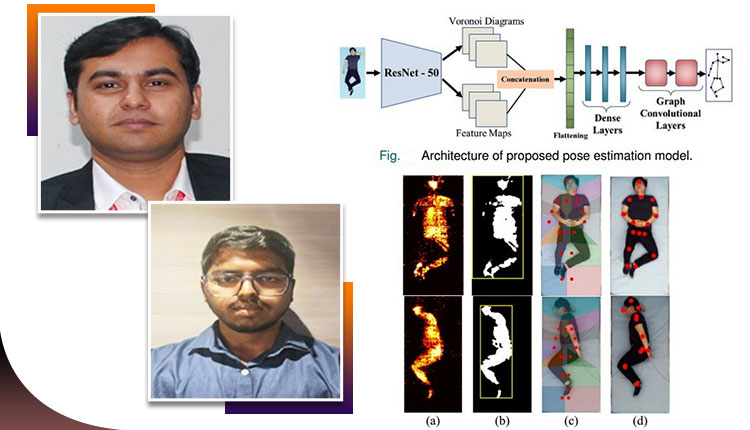
The findings of this research have been published in the IEEE Sensors Journal. The paper is co-authored by Saptarshi Chatterjee, Assistant Professor, Department of Electronics and Communication Engineering, along with his B.Tech student Shiladitya Mondal at NIT Rourkela, and Debangshu Dey, Assistant Professor, Department of Electrical Engineering, Jadavpur University.
Studies worldwide indicate that poor sleeping posture can lead to long-term health issues by placing sustained, uneven pressure on the spine, joints, and nerves for hours at a time. Even physically active individuals can develop chronic musculoskeletal pain, spinal degeneration, obstructive sleep apnea, nerve damage, poor digestion and acid reflux, and arthritis. For bedridden patients, poor posture may cause serious complications, including pressure ulcers or bedsores.
Currently, patient posture monitoring is mostly done manually, which can be inconsistent and prone to human error. Wearable sensors are another option, but they are often expensive and uncomfortable. Camera-based systems exist as well, but they face challenges such as low lighting, obstruction from blankets, and privacy concerns, making them less suitable for continuous monitoring.
To address these issues, Saptarshi Chatterjee and his team developed an AI-based system that uses three types of sensors:
- Long-wave infrared imaging sensor: Tracks body heat to monitor sleeping posture without capturing visual images, even under a blanket.
- Depth sensor: Captures body shape and posture.
- Pressure sensor: Measures how body weight is distributed on the bed.
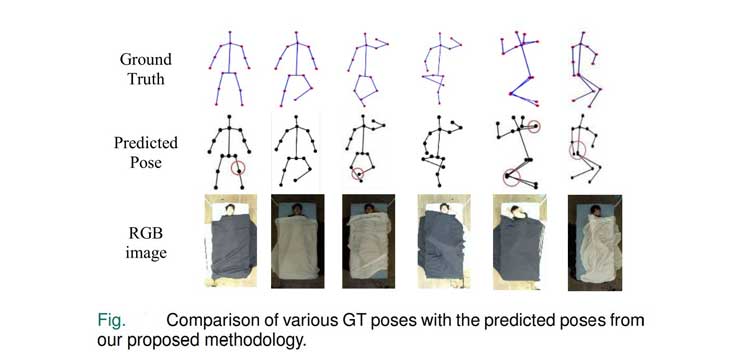
To process data from these sensors, the team developed a generative AI model that creates a clear representation of the human body, along with a graph-based neural network to identify the postures of different body joints.
Speaking about the system, Saptarshi Chatterjee said, “Our system leverages generative AI along with a fusion technique combining long-wave infrared, depth, and pressure map data to detect sleeping postures without directly using RGB images. The model performs effectively even under challenging conditions such as low lighting and varying types of coverings.”
By combining heat-based imaging, body shape data, and pressure information, the system delivers highly accurate results. Laboratory experiments show that this no-contact model achieves approximately 98% accuracy, making it reliable for real-world use.
The automated nature of the system can reduce caregivers’ workload while allowing continuous monitoring. At the same time, because it does not rely on visual imaging, it helps protect patient privacy.
Regarding real-world applications, Chatterjee added, “The system can be directly embedded in beds to monitor the sleeping conditions of hospital patients, elderly individuals, and those suffering from sleep apnea.”
As an integrated module with multi-modal imaging systems, the approximate cost of the technology is Rs 30,000, with potential for further reduction through mass-scale development.
The research team plans to extend this technology to identify health issues associated with specific incorrect sleep postures, as well as other related diseases.
With further refinement and real-world testing, this technology could move closer to practical deployment across healthcare settings. Its scalability and adaptability also open possibilities for wider applications beyond hospitals, including home-based care.