





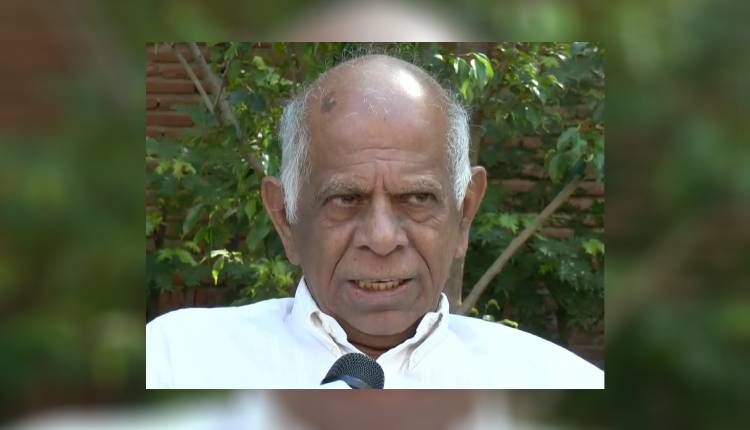
New Delhi: In the wake of escalating tensions between the US and Iran, foreign affairs expert K.P. Fabian has weighed in on the strategic implications of recent US actions, particularly the announcement of deadlines and threats over the Strait of Hormuz.
Fabian suggested that the US strategy reflects a pattern of public signalling, “The purpose is quite obvious. President Trump believes that the rest of the world can be threatened, whether it is Greenland or tariffs. However, in the case of Greenland, he learned, albeit late, that threats do not always work. Similarly, with tariffs, he is gradually learning the same lesson, as seen when the Supreme Court ruled that he was exceeding his powers.
“That said, there are still other legal provisions he can use to impose tariffs. He has now decided to impose tariffs on sectors such as farming, where there is considerable flexibility. But fundamentally, the intention remains to threaten.”
Fabian warned that Iran cannot be easily intimidated, saying: “What must be understood, however, is that Iran cannot be easily threatened. Iran is what one might call a ‘civilization state.’ If you consider the legacy of the Persian Empire and look at its geography, it is not just a typical nation-state.”
“President Trump seems to believe that by eliminating a number of top leaders, Iran will surrender. This assumption has proven incorrect. Leadership can be replaced, you can eliminate individuals, but you cannot eliminate an ideology,” he told IANS.
On the international front, Fabian emphasised that Iran is likely seeking clear protocols for global engagement, particularly regarding the strategic Strait of Hormuz: “While Iran may not have explicitly stated it, one could hope it adopts a strategic approach. The term ‘checkmate’ itself comes from Persian origins. It would be beneficial if Iran issued a public statement regarding the Strait of Hormuz.”
“For instance, Iran could state that there was free passage before February 28, when the aggression began. If the aggression stops and assurances are given that it will not resume, then the Strait of Hormuz will remain open for free passage. Naturally, Iran might impose a fee to cover the costs of maintaining security, especially given the threat of American and Israeli attacks.
“In this context, Iran is reportedly working on a protocol with other coastal states, such as Oman, and preliminary steps have already been taken,” he added.
According to Fabian, Iran should make such a clear statement, but it has not done so yet. While Pakistan and China have issued a five-point note, it remains somewhat vague and lacks practical value. What is needed is a clear and direct statement from Iran.
The difficulty, however, is that Iran’s leadership may find it challenging to issue such a statement while facing insulting rhetoric from Trump. The Iranian public might interpret such a move as a sign of weakness or surrender in response to threats. Nevertheless, Iran should take a broader, more strategic view. It would be wise to issue such a statement as soon as possible.
Fabian’s analysis also criticised US decision-making in the conflict, highlighting the role of Intelligence and international alliances.
“How many times has President Trump told the whole world that he has painted himself into a corner? This is the opinion of Time magazine, The New York Times, and many others. Let’s look at the bigger picture. Trump joined a war that was started by Netanyahu. According to eminent scholars like Professor John Mearsheimer of the University of Chicago, he has walked into a war he cannot win,” he said.
“If he believed that Iran would surrender on day one or day two, it appears that Mossad made that assessment and passed it on to Trump through Netanyahu. Trump, going against the advice of his Intelligence officials, such as Tulsi Gabbard, and the military at the Pentagon, seems to have accepted Netanyahu’s position. As a result, he is now in a difficult situation,” he added.
He also mentioned that having a leader like Trump, who is short-tempered and prone to questionable judgment in a position of immense power, with vast resources at his command, is very dangerous.
Fabian’s insights underline the complexity of the US-Iran standoff and the challenges of using public threats as a foreign policy tool.
(IANS)