





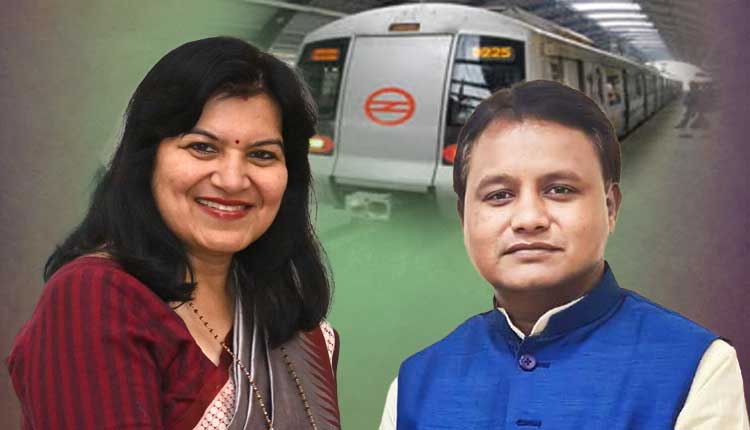
Bhubaneswar: Bhubaneswar Lok Sabha MP Aparajita Sarangi has formally appealed to Odisha Chief Minister Mohan Charan Majhi to revisit the State Cabinet’s decision to suspend the Bhubaneswar Metro Rail project, calling it a critical issue of public interest for the rapidly urbanizing capital region.
She described the abrupt closure as a matter of major public interest and conveyed the popular sentiment in favour of the much-needed urban transport initiative.
In the letter, Sarangi highlighted the rapid urbanization and population growth in Bhubaneswar in recent years, which have led to severe traffic congestion and increasing pressure on the existing public transport systems. She noted that the city is almost at a tipping point and urgently needs a high-capacity, cost-efficient, and modern public transport solution.
According to her, the Metro Rail is the most viable long-term option that can transform mobility not only in Bhubaneswar but also in the adjoining areas of Cuttack, Jatni, and Khurda. The project, she added, would provide better and accessible transport facilities to senior citizens, women, children, students, working professionals, vendors, and differently-abled persons.
Recalling her consistent advocacy, the MP mentioned that she had written to the then Chief Minister Naveen Patnaik on September 26, 2022 (letter No. MPAS/ESTT/2022/2610) urging the start of the Metro Rail project in Bhubaneswar and Cuttack. She also visited the office of Bhubaneswar Metro Rail Project Ltd. (BMRPL) on November 30, 2024, reviewed the progress, and found the officials and their setup impressive.
On her X handle, Sarangi posted that she had spoken directly to CM and requested him to kindly consider revisiting the State Cabinet decision suspending the Metro Rail project for Bhubaneswar. She added, “Some projects are done for public good and not for profit.”
In her letter, Sarangi argued that some of the reasons cited for the premature closure of the project do not appear to be based on a factual analysis of the actual need. She pointed out that the projected population growth and urban expansion around Bhubaneswar, along with the way the twin cities of Bhubaneswar and Cuttack have merged and the development extending towards Khurda, make a strong case for a Metro Rail system.
Emphasizing the government’s vision, she stated that positioning Bhubaneswar as one of the most investor-friendly cities and a major tourist destination requires a modern urban transportation system. The Metro would enhance the experience of tourists by providing easy access to key landmarks such as Lingaraj Temple, Khandagiri-Udayagiri, Dhauli Shanti Stupa, Nandankanan Zoo, and ISKCON Temple. It would position Bhubaneswar as a forward-looking, investment-friendly city, support the vision of Viksit Odisha, catalyze economic activity, create employment opportunities, and improve the overall quality of life for citizens. She stressed that it is a shared responsibility to make Bhubaneswar, Cuttack, and Khurda truly modern, smart, and future-ready cities.
The MP further contended that a capital city should lead by example rather than lag behind. She noted that meeting strict population criteria or financial feasibility alone cannot be the reason to reject such a project. Metro Rail is already operational in 18 cities, including several Tier-2 cities, under construction in 16 cities (some in extension mode), and in the planning stage in 12 others. She enclosed a list of 34 cities categorized as A, B, and C, pointing out that not all of them meet the 20-25 lakh population requirement. She questioned why Bhubaneswar and the surrounding areas should lag behind, especially when the combined population of Bhubaneswar, Cuttack, and Khurda is likely to exceed the threshold.
On the financial front, Sarangi humbly submitted that around Rs 274 crore have already been spent from the state exchequer. Shelving the project would lead to incidental expenses, and restarting it after 10 to 15 years could result in a cost escalation of 2 to 4 times the current estimated amount due to inflation. She reminded that many development projects, including Metros across India, are taken up in larger public interest rather than for immediate profit. None of the Metros in the country were implemented expecting instant profitability; all are subsidized by the respective state governments.
She also referred to the address by Odisha’s own Hon’ble President of India on the eve of the 79th Independence Day, where she hailed the increasing number of cities adopting Metro Rail as a modern solution to urbanization challenges, and questioned whether her own state should be deprived of this initiative.
Sarangi reiterated that the Metro Rail project is not just about transportation — it is a catalyst for job creation, economic stimulation, and urban development. Shelving it would mean missing out on these multiplier effects. At a time when the world is focusing on sustainable urban living, withdrawing from a clean, electric Metro system appears counter-intuitive. She also noted visible public support for the project in Bhubaneswar and warned that ignoring this desire and demand risks weakening public trust in development promises.
The MP humbly urged the Chief Minister to revisit and reconsider the State Cabinet decision taken on April 4, 2026. She offered her full assistance as Member of Parliament, including facilitating communication with relevant Central government departments, securing approvals, and exploring funding from the Centre to ensure the project moves forward. In conclusion, she thanked the Chief Minister for his leadership and dedication to Odisha’s progress and expressed hope for a positive response.