





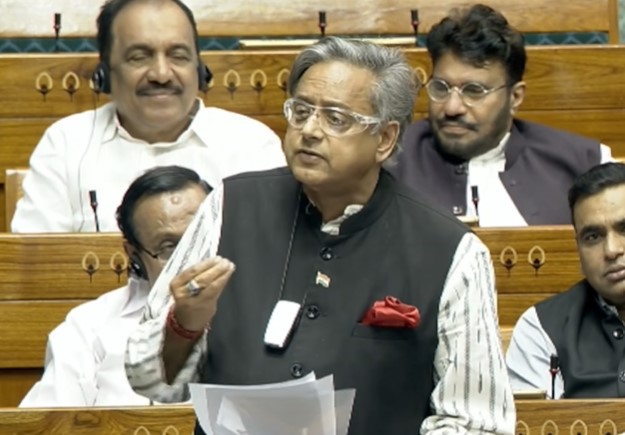
New Delhi: Congress leader Shashi Tharoor on Friday warned in the Lok Sabha that the proposed delimitation exercise could amount to “political demonetisation,” cautioning against linking it with women’s reservation and calling it a matter affecting the “very soul of our democracy.”
Addressing the House, Tharoor said, “This is a matter of the very soul of our democracy.”
“For decades, women’s reservation has long been promised, discussed, and partially delayed. Today, we stand at a threshold where there is a remarkably unanimous political consensus in favour of women’s reservation. Every major party in the House recognises that the time for tokenism is over and the era of equal partnership must begin, and yet I find us deeply perturbed by the legislative exercise.”
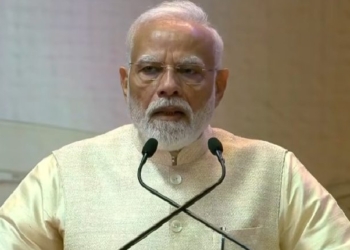
Referring to the government’s position, Tharoor said, “The PM said the government has brought Nari Shakti a gift of justice, but he has tethered the implementation of women’s reservation to the expansion of Parliament based on the 2011 Census and the exercise of delimitation.”
He argued that the provision could be implemented immediately without linking it to a complex process.
“Women’s reservation is ready for harvesting; it can and should be implemented immediately based on our existing parliamentary strength. To link it to delimitation is to hold the aspirations of Indian women hostage to one of the most contentious and complex administrative exercises in our nation’s history. Delimitation is not mere bureaucratic rearranging of maps; it is a profound shift in political power,” Tharoor said.
“Linking women’s reservation to it effectively holds the aspirations of Indian women hostage to one of the most contentious political exercises in our history. It carries risks that could strain the fabric of our federalism,” he added.
In a sharp remark, Tharoor said, “You have proposed delimitation with the same haste you showed on demonetisation, and unfortunately, we all know what damage that did to the country. Delimitation will turn out to be political demonetisation. Don’t do it.”
Tharoor stressed the need for wider consultation, saying, “We must be candid about what is at stake. Constituencies are redrawn based on either current population figures or the 2011 Census. Delimitation requires serious discussion.”
Highlighting regional concerns, he said, “The balance between states, particularly southern states like Tamil Nadu and Kerala, which have diligently implemented national goals of population control and invested in inclusive human development, and those states mainly in the North who have not, under future delimitation, states that have failed to curb population growth would be rewarded with greater political weight. We must ask if this is the message we wish to send, that governance excellence leads to political irrelevance.”
He further added, “The third factor is the balance between the states that are engines of our economy, contributing more to the national pool than they receive, and those that are net recipients of central funds. Delimitation would further marginalise the voices of those states.”
“We risk creating a tyranny of the democratic majority,” he added.
(AINS)