





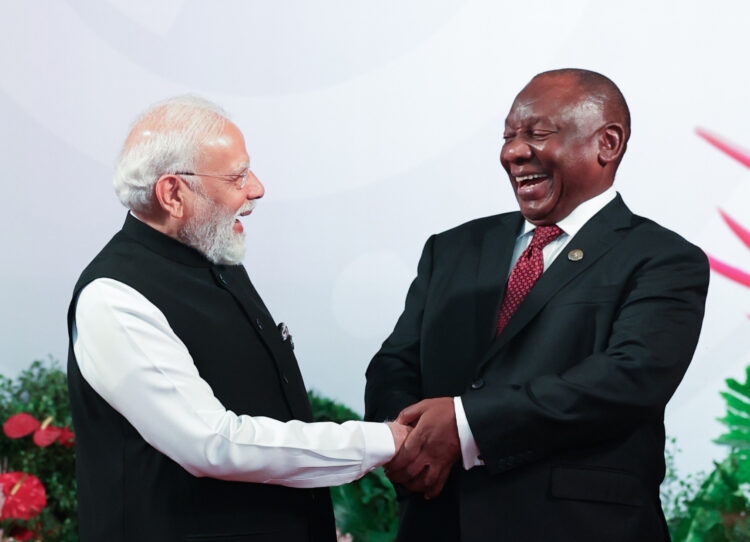
New Delhi: The fourth India-Africa Forum Summit next month could mark the beginning of a more “deliberate, resilient, and equal partnership” between two of the world’s most significant rising powers, a report said on Tuesday.
Writing for India Narrative, Nairobi-based journalist Zuri Amondi said that on May 31, leaders from across Africa and India will gather in New Delhi, for the fourth India-Africa Forum Summit — the first in over a decade — calling it renewal rather than routine diplomacy with transformative potential already emerging.
The summit’s theme, “IA SPIRIT — India Africa Strategic Partnership for Innovation, Resilience, and Inclusive Transformation”, she said, reflects the ambition clearly.
Amondi stated that the case for a deeper partnership has gained focus amid global disruption, underscoring the urgency for stronger collaboration.
“The ongoing crisis in the Persian Gulf has sent tremors through energy markets worldwide. For Africa’s import-dependent economies, rising fuel costs cascade quickly into higher food prices, transport costs, and pressure on already-stretched public finances. For India, the crisis has exposed the risks of excessive dependence on West Asian energy — nearly half its crude oil imports and the bulk of its LNG pass through the Strait of Hormuz. Both sides, facing the same volatile world from different angles, have strong reasons to look to each other,” she detailed.
Highlighting the shift in the African energy landscape, Amondi said India, as a major energy consumer seeking to diversify its supply sources, offers a stable and growing market for African oil and gas producers such as Nigeria, Angola, and Algeria.
“Long-term energy agreements could provide these countries with more predictable revenues while also incentivising investments in infrastructure and production capacity. These are supply chains that bypass the Hormuz chokepoint entirely. African maritime routes — including, if necessary, the Cape of Good Hope — offer India logistical alternatives that are less vulnerable to regional conflict. In a world of concentrated supply risks, geography has suddenly become a very valuable asset,” she mentioned.
Beyond energy, Amondi emphasised that the complementarity runs deep, noting that Indian pharmaceutical companies have set up manufacturing units across African countries, including Nigeria, Kenya, and South Africa, expanding access to affordable healthcare.
“Indian pharmaceutical exports to Africa stood at $3.8 billion in 2023, with significant potential to expand affordable healthcare solutions across the continent. This is not charity — it is a partnership. African patients gain access to medicines they could not otherwise afford; Indian manufacturers gain growing markets and local manufacturing footholds. Everybody wins,” she stated.
Emphasising the growing cooperation between India and Africa, Amondi said, “Bilateral trade has exceeded $100 billion, and there is a credible roadmap toward $200 billion, with the relationship moving toward value addition, digital services, and green growth.”
(IANS)