






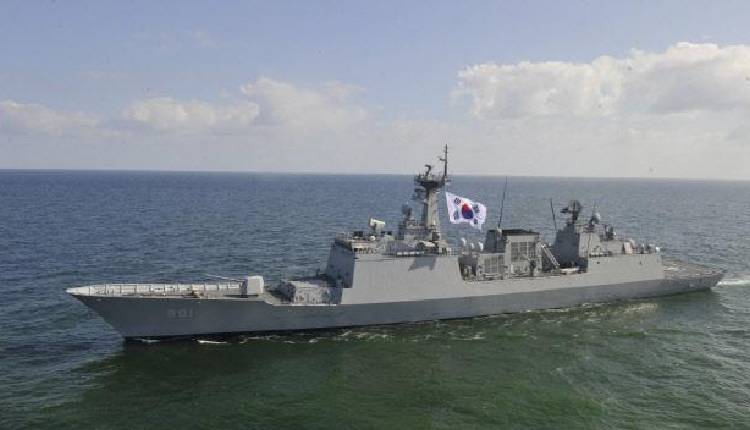
Seoul: South Korea on Friday finalised a plan to acquire US Standard Missile-6 (SM-6) shipborne missile interceptors by 2034, in a bid to boost its missile defence capabilities, the state arms procurement agency said.
The Defence Project Promotion Committee, a decision-making body for arms procurement under the Defence Acquisition Program Administration (DAPA), approved the 530 billion-won (USD 351.5 million) project to acquire the SM-6 long-range ship-to-air missile interceptors and related equipment, the agency said.
An SM-6 interceptor is an advanced defence missile interceptor for warships that can track and destroy a wide range of incoming threats, Yonhap news agency reported.
It has a maximum range of 460 kilometres, with an altitude of up to 36 km, and is built to directly track targets with its own radar, allowing ships to deal with multiple threats at the same time.
The military plans to equip the 8,200-ton Aegis destroyer ROKS Dasan Jeong Yakyong, which is scheduled to enter service later this year, as well as the ROKS Daeho Kim Jong Seo, another vessel of the same class, with the SM-6 interceptors.
The SM-6 interceptors will also be installed on the already-deployed ROKS Jeongjo the Great through future capability upgrades.
“The project is expected to enhance ship-to-air defence capabilities of Aegis destroyers against enemy anti-ship ballistic missiles, aircraft and cruise missiles, as well as improve their anti-ballistic missile defence,” the DAPA said.
In November 2023, the United States approved a USD 650 million sale of up to 38 SM-6 missiles and related equipment to South Korea through the government-to-government Foreign Military Sales program.
Friday’s announcement by DAPA suggests that the acquisition may have been scaled back from the earlier plan. The timeline for the acquisition has also been revised to 2023-34, from the original 2023-31 schedule.
The committee also approved a research and development (R&D) plan for a new military communications satellite system to replace older satellite and ground equipment.
The plan calls for developing and acquiring a dedicated geostationary military communications satellite and related ground infrastructure through an R&D program led by the Agency for Defence Development.
The project will run from this year through 2032, with an estimated cost of about 1.27 trillion won.
(IANS)