





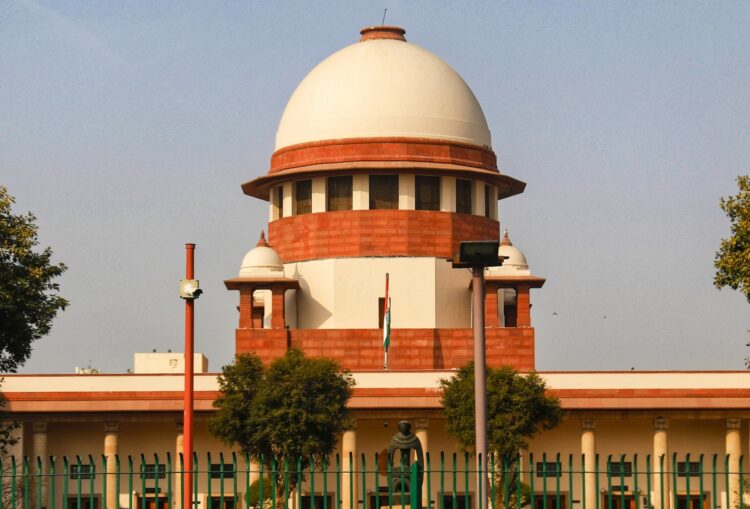
New Delhi: Reiterating the principle of minimal judicial intervention in arbitration matters, the Supreme Court on Wednesday ruled that High Courts should ordinarily refrain from interfering with arbitral tribunal orders passed under Section 16 of the Arbitration and Conciliation Act during the pendency of arbitration proceedings.
A bench of Justices J.K. Maheshwari and Atul S. Chandurkar was dealing with an appeal filed by mine owner, Tarini Prasad Mohanty, against a judgment of the Orissa High Court’s division bench, which had set aside a single-judge order directing impounding of agreements allegedly insufficiently stamped.
The dispute arose out of an agreement for the sale of iron ore executed in 2004 between the mine owner and Sunflag Iron and Steel Company Limited, followed by supplementary agreements.
During arbitration proceedings, the mine owner raised an objection under Section 16 of the Arbitration and Conciliation Act, contending that the agreements were insufficiently stamped and amounted to “conveyance” under the Indian Stamp Act, requiring higher stamp duty.
The arbitral tribunal rejected the objection in May 2024, holding that the agreements were “agreements to sell” and not “conveyance”, and had been properly stamped.
The mine owner then moved the Orissa High Court under Articles 226 and 227 of the Constitution.
A single-judge bench entertained the writ petition, termed the arbitrator’s findings “grossly erroneous and perverse”, and directed impounding of the agreements for payment of proper stamp duty.
However, the division bench later reversed that decision, holding that the single judge had exceeded writ jurisdiction by entering into the merits of the contractual dispute.
Upholding the division bench’s view, the apex court said that once arbitration proceedings have commenced, parties must ordinarily wait until the final award is passed and then avail remedies under Section 34 of the Arbitration and Conciliation Act.
Referring to earlier Constitution Bench rulings, the Supreme Court observed that objections relating to stamping of agreements fall within the jurisdiction of the arbitral tribunal itself.
“The object of minimising judicial intervention while the matter is in the process of being arbitrated upon, will certainly be defeated if the High Court could be approached under Article 227 or under Article 226 of the Constitution against every order made by the Arbitral Tribunal,” the Justice Maheshwari-led Bench said.
It further clarified that non-stamping or inadequate stamping of an agreement is only a “curable defect” and does not render the agreement void.
“The effect of not paying duty or paying an inadequate amount renders an instrument inadmissible and not void. Non-stamping or improper stamping does not result in the instrument becoming invalid,” the judgment reiterated.
It held that the arbitrator was fully empowered to decide the stamping objection, and merely because an error may have been committed on merits, it could not be treated as a case of inherent lack of jurisdiction warranting writ interference.
It added that the single-judge Bench should not have entered into an interpretation of the agreements while exercising writ jurisdiction, particularly when arbitration proceedings were still pending, and evidence was yet to be led before the arbitral tribunal.
“We would, thus, restrict ourselves to recording a conclusion that the learned Single Judge was not justified in exercising writ jurisdiction under Articles 226 and 227 of the Constitution for examining and thereafter setting aside the order passed by the learned Arbitrator under Section 16 of the Arbitration and Conciliation Act,” the Supreme Court said.
Dismissing the appeal, the Justice Maheshwari-led Bench clarified that the issue regarding stamping of the agreements remains open and may be raised by the aggrieved party at the stage of challenge under Section 34 of the Arbitration and Conciliation Act after conclusion of arbitration proceedings.
(IANS)