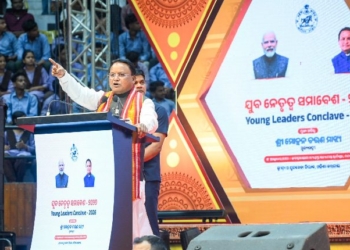






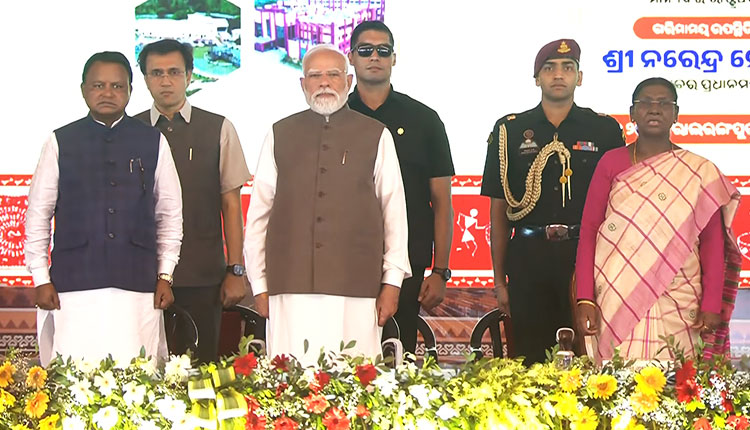
Mayurbhanj: President Droupadi Murmu and Prime Minister Narendra Modi on Saturday jointly inaugurated and laid the foundation stone for development projects worth Rs 47,600 crore during a programme in Mayurbhanj district.
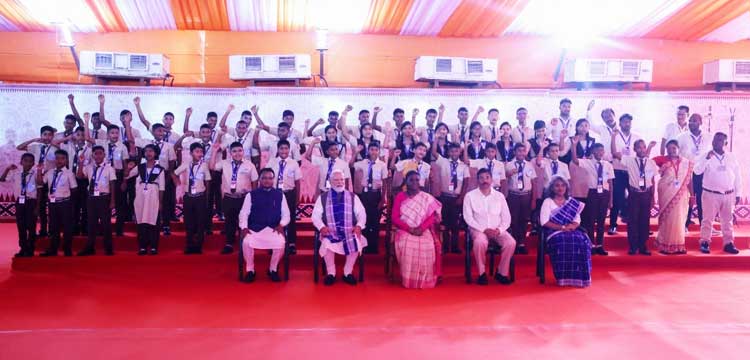
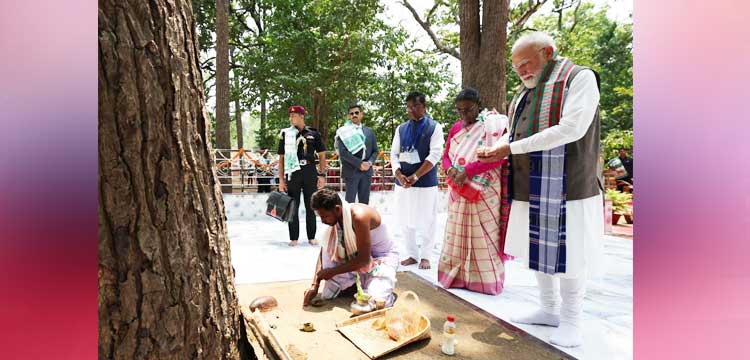
The event was held at Rairangpur as part of celebrations marking two years of the state government. Both leaders also visited Pahadpur village, where they offered prayers at the sacred groves of Santhali Jahera and Ho Jahera and interacted with students at a local school and Skill Centre.
Prime Minister Modi said Odisha is witnessing rapid transformation across sectors and reiterated the Centre’s focus on the development of eastern India under the “Purvodaya” vision.
Greeting the people of Odisha, he noted that the state is currently immersed in a festive spirit, with the recently concluded Raja Festival and preparations underway for the sacred Rath Yatra of Lord Jagannath, including the renowned Baripada Rath Yatra in Mayurbhanj.
Congratulating the people of Odisha on the completion of two years of the BJP-led government in the state, Prime Minister Modi said, “The double-engine government is accelerating the state’s development journey and transforming the lives of ordinary citizens through welfare schemes, investments, industrial growth, and employment opportunities.”
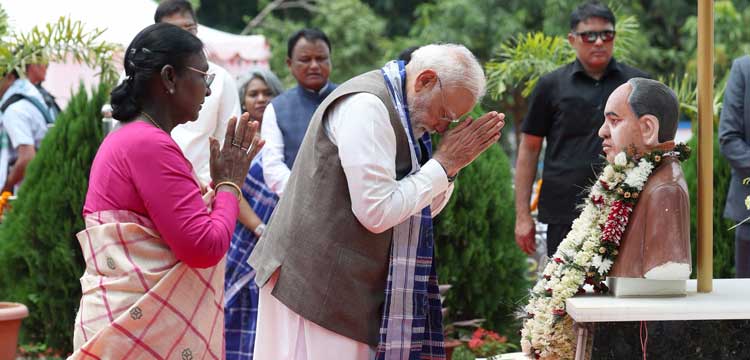
The Prime Minister paid tribute to eminent personalities of Odisha, including Pandit Raghunath Murmu, creator of the Ol Chiki script for the Santali language, Damayanti Besra, and Charan Hembram. He highlighted the Government of India’s efforts to promote and preserve the Santali language and culture, including the publication of the Constitution of India in Santali.
Extending heartfelt birthday greetings to President Droupadi Murmu, Modi described her rise from the soil of Mayurbhanj to the highest constitutional office of the nation as a matter of immense pride for Odisha and the country. He praised her dedication to public service, humility, and commitment to nation-building. Recalling his visit to Pahadpur with the President, he spoke about interacting with students at educational institutions established under her guidance. “President Murmu’s inspiring presence is instilling confidence and ambition among children, particularly those from tribal, underprivileged, and marginalised communities,” Modi emphasised.
In a major announcement, the Prime Minister stated that Pahadpur village will be developed as a solar village, ensuring solar power generation in every household. Drawing a parallel with Odisha’s iconic Sun Temple at Konark, he expressed confidence that Pahadpur would emerge as a model solar-powered village for the nation.
Highlighting the achievements of the Odisha government under Chief Minister Mohan Charan Majhi, the Prime Minister noted that the state is witnessing rapid progress across sectors. He reiterated the Central Government’s vision of “Development of Eastern India for the Development of India” and emphasised that the “Purvodaya” policy is unlocking the immense potential of eastern states.
He added that the Centre and State governments are working together to fully harness these strengths through record investments in railway infrastructure, highways, economic corridors, ports, energy, semiconductors, green energy, and modern industries. Modi underscored that transformative projects worth approximately Rs 47,000 crore would significantly improve connectivity, public services, economic opportunities, and the quality of life for the people of Odisha. Odisha is emerging as a gateway to growth and prosperity in eastern India and will play a pivotal role in India’s journey toward becoming a developed nation.
The Prime Minister further emphasised that the government is transforming Odisha’s abundant resources into opportunities for growth and prosperity. He highlighted initiatives such as Utkarsh Odisha, aimed at attracting large-scale investments and fostering industrial development across the state. Under this initiative, Odisha has already received investment proposals worth nearly Rs 20 lakh crore, while several mega projects exceeding Rs 3.5 lakh crore are currently under implementation. Sustained efforts are being made to create an industry-friendly environment through holistic development.
The Prime Minister informed that more than Rs 6,000 crore is being invested in the power sector, while urban development is being accelerated through the Samruddha City Scheme. He expressed confidence that these initiatives will deliver significant results in the coming years. Highlighting the strength of the double-engine government, he said that governance is being taken directly to the people, ensuring that citizens do not have to run from office to office to resolve their problems. As a result, the aspirations of youth, women, farmers, and ordinary citizens are increasingly being fulfilled.
Modi highlighted several key welfare initiatives of the Odisha government, including paddy procurement at Rs 3,100 per quintal for farmers, financial assistance to over one crore women under the Subhadra Yojana, implementation of Ayushman Bharat to expand healthcare access, support for tribal students through the Madho Singh Haat Kharcha Yojana, and the reopening of all four gates of the Shri Jagannath Temple in line with devotees’ sentiments. He also commended the recent cleanliness campaign conducted across the region, describing the initiative of “Welcoming through Cleanliness” as highly praiseworthy.
Speaking about tribal welfare, the Prime Minister recalled his long association with tribal regions and acknowledged President Droupadi Murmu’s years of service among tribal communities. He noted that tribal areas had historically remained deprived of basic services and infrastructure, making tribal development a top priority of his government. The Dharti Aaba Janjatiya Gram Utkarsh Abhiyan has brought coordinated improvements in health, education, roads, and housing in tribal villages.
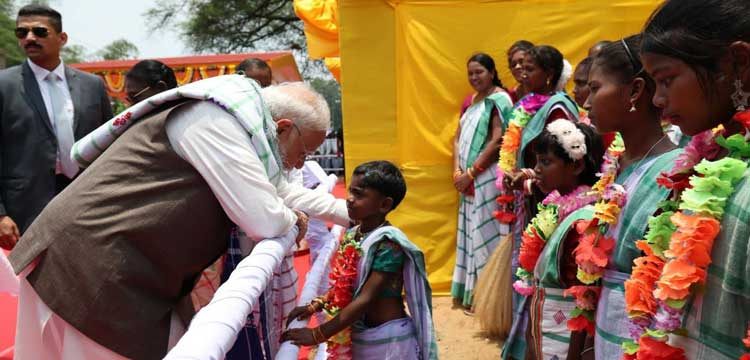
He stated that the PM JANMAN Mission emerged from discussions with President Murmu and is specifically designed for Particularly Vulnerable Tribal Groups (PVTGs), ensuring that government services reach even the most marginalised tribal communities directly at their doorsteps.
Underscoring the importance of education and employment opportunities for tribal youth, he said that nearly 500 Eklavya Model Residential Schools have already been established across the country, while around 750 schools have been sanctioned. More than 1.5 crore tribal students have received scholarships at pre-matric and post-matric levels. Modi also announced that approval has been granted for the establishment of an additional Jawahar Navodaya Vidyalaya in Mayurbhanj district.
Addressing healthcare challenges faced by tribal communities, he pointed to diseases such as sickle cell anaemia, which have posed serious concerns in remote regions. The government has launched a nationwide campaign against the disease, distributed more than four crore health cards, and provided Ayushman cards to millions of tribal beneficiaries to ensure access to free treatment. The Jal Jeevan Mission is also bringing safe drinking water to households across the country, including tribal regions.
Looking ahead, the Prime Minister referred to two important milestones: the 100th anniversary of Odisha’s formation in 2036 and the 100th anniversary of India’s Independence in 2047. He said that Odisha’s aspirations and India’s aspirations are aligned, emphasising that a stronger Odisha will contribute directly to a stronger India. He also reminded that International Day of Yoga would be observed on 21 June, describing Odisha as a land deeply connected with knowledge and yoga traditions, and appealed to people across India and the world to participate in Yoga Day.
Concluding his address, Prime Minister Modi congratulated the people of Odisha on the development projects inaugurated and launched during the event, and thanked President Droupadi Murmu for allowing him to visit her karmabhoomi and interact with the people of Mayurbhanj.