





Dahod: As opportunities for science, engineering and medical education expand across Gujarat’s tribal belt, Chief Minister Bhupendra Patel on Wednesday said students from remote tribal areas are increasingly gaining access to professional courses and careers that were once difficult to pursue due to limited educational infrastructure.
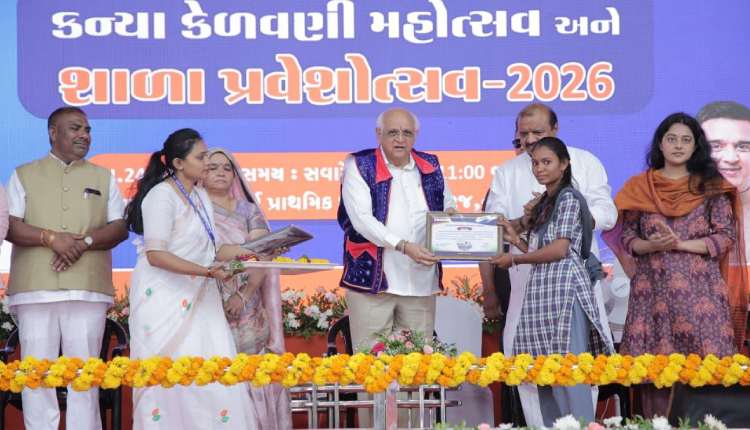
Addressing gatherings during the second day of the 24th ‘Shala Praveshotsav’ (school enrolment drive) in Dahod district, Patel enrolled more than 300 children in schools at Moti Kharaj, Rahadungari and Gangarda villages and said the initiative launched by Prime Minister Narendra Modi to eliminate illiteracy in tribal areas had transformed into a major movement for educational advancement.
“The School Enrolment Festival started by Prime Minister Narendra Modi to erase the stigma of illiteracy from tribal areas has today become a banyan tree of development in the field of education,” Patel said.
He said the educational aspirations of tribal communities, which had remained unfulfilled for decades, were now being realised.
According to Patel, children who had entered schools through previous editions of the enrolment drive had gone on to become doctors, engineers and pilots, showcasing the long-term impact of sustained efforts to improve educational access.
“Shala Praveshotsav is a massive public campaign for transformation in the field of education along with the holistic development of children,” he said.
Patel said the state government had focused on creating modern educational infrastructure and ensuring quality education across rural and remote regions.
“Schools have been equipped with smart classrooms, computer laboratories, internet connectivity and modern science laboratories, allowing students from villages and interior areas to engage with contemporary learning methods and compete in a rapidly changing world,” he noted.
He said several government campaigns and schemes aimed at bringing qualitative changes in education had enabled students to achieve new levels of academic success.
Highlighting efforts to reduce dropouts, Patel said: “Special initiatives were being undertaken to reconnect children who had left school with the education system. Officials and education department staff were visiting the homes of such children, identifying the challenges they faced and encouraging them to return to school.”
The Chief Minister also appealed to parents to become active partners in their children’s education.
“Parents should regularly visit schools and discuss their children’s progress with teachers,” he said, urging families to play a greater role in shaping their children’s futures.
Patel said tribal areas had witnessed significant improvements in access to higher education. “Opportunities for science, engineering and medical education have become available in tribal areas,” he said.
Providing details of government support schemes, Patel said the income limit for scholarship eligibility for tribal students had been increased from Rs 2.5 lakh to Rs six lakh so that more families could benefit.
“Girls studying in Classes 9 to 12 receive assistance of up to Rs 50,000 under the Namo Lakshmi Scheme, while students studying in the science stream in Classes 11 and 12 can receive assistance of up to Rs 50,000 under the Namo Saraswati Scheme,” he said.
Patel added that girls completing Classes 11 and 12 in the science stream could receive combined assistance of up to Rs 75,000 through various government schemes.
Emphasising the importance of equal opportunities for girls, the Chief Minister cited the example of three girls from Kharaj village who had reached the national level in rugby.
“With proper guidance and opportunities, girls can excel in every field,” he said, adding that the achievement had brought pride to both the village and the state.
Patel also highlighted efforts to promote sporting excellence among tribal youth. “Training, equipment and nutrition facilities have also been provided to tribal youth in the field of sports,” he said.
Addressing the role of technology in education, he advised students to make constructive use of mobile phones and television.
“Students should use mobile phones and television appropriately and devote time to studies, reading and educational activities,” Patel said.
He also urged parents to supervise their children’s technology use and provide appropriate guidance. The Chief Minister further called for greater public participation in environmental protection and water conservation initiatives.
Referring to the ‘Catch the Rain’ campaign, he urged citizens to support rainwater harvesting and groundwater recharge efforts. He also appealed for participation in the ‘Ek Ped Maa Ke Naam’ plantation campaign to increase green cover and strengthen environmental conservation.
During his visit, he planted a sapling on the school premises as part of the campaign.
MP Jaswantsinh Bhabhor said educational standards had improved significantly across the tribal belt stretching from Umargam to Ambaji as a result of the enrolment campaign.
“Under the visionary leadership of Prime Minister Narendra Modi, educational standards have risen across the tribal region from Umargam to Ambaji, and the dropout ratio has declined significantly,” Bhabhor said.
“The earlier indifference towards girls’ education has been removed, and today tribal youth are becoming doctors, engineers and lawyers, bringing pride to society,” he added.
Bhabhor said that under the leadership of Prime Minister Narendra Modi and Chief Minister Bhupendra Patel, quality education had reached remote areas, including Dahod.
He pointed to the construction of a modern English-medium school at Singvad, built at a cost of Rs 23 crore, and said it would provide children in the area with an international-standard education.
The MP also credited the ‘Vanbandhu Kalyan Yojana-2’ with accelerating development in tribal areas. “Chief Minister Bhupendra Patel has given new momentum to the development of tribal areas through Vanbandhu Kalyan Yojana-2,” he said.
Bhabhor said the government was committed to preventing labour migration and noted that projects worth more than Rs 5,000 crore had received in-principle approval to bring Narmada water to the areas of Bariya, Dhanpur, Garbada, Dahod and Jhalod.
He said the irrigation projects would bring a major transformation to agriculture in the region and, together with improvements in education, would help reduce migration and enable future generations of tribal families to become self-reliant.
During the programme, Patel held direct interactions with members of school management committees and parents.
He sought feedback on educational facilities, listened to their expectations and discussed ways to strengthen educational outcomes and expand access to quality education.
(IANS)