





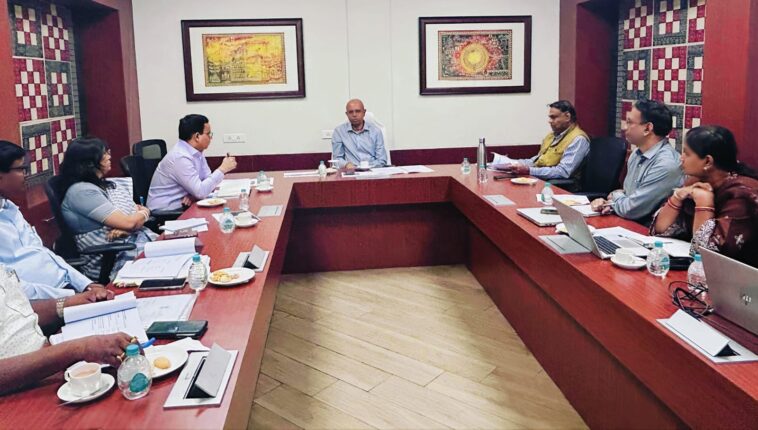
Bhubaneswar: Secretary, Department of Drinking Water and Sanitation, Ashok K.K. Meena under the Ministry of Jal Shakti, Government of India, on Thursday reviewed the implementation of the Jal Jeevan Mission (JJM) and Swachh Bharat Mission (Gramin) in Odisha and lauded the state’s progress in expanding rural drinking water coverage.
During a review meeting held in Bhubaneswar, Meena expressed satisfaction over Odisha’s achievements under the Jal Jeevan Mission and noted that the state government is implementing the programme in line with the objectives and priorities of the national mission.
Emphasising the need for sustainable management of rural water supply infrastructure, he advised the state to further empower Gram Panchayats for the long-term operation and maintenance of drinking water systems. He stressed the importance of expediting the transfer of management responsibilities of water supply assets to Gram Panchayats and Village Water and Sanitation Committees (VWSCs) under the Centre’s ‘Jal Arpan’ initiative.
The Union Secretary also called for greater focus on developing sanitation-related infrastructure under the Swachh Bharat Mission (Gramin) and urged the state to accelerate efforts to achieve Open Defecation Free Plus (ODF+) model status in more villages.
As part of his visit, Meena met Odisha Chief Secretary Anu Garg and held discussions on the progress, implementation challenges and future roadmap of the Jal Jeevan Mission and Swachh Bharat Mission in the state.
Following the review meeting, Meena, accompanied by Panchayati Raj and Drinking Water Department Commissioner-cum-Secretary Girish S.N. and Drinking Water and Sanitation Mission Director Vineet Bhardwaj, visited Puri district to assess the ground-level implementation of rural drinking water projects.
The delegation inspected the Lohapur pipe water supply project in Jagannathpur Gram Panchayat under Pipili block and the Subalpur project in Jashuapur Gram Panchayat. Reviewing the infrastructure and functioning of the schemes, Meena appreciated the efforts of field-level officials and engineers involved in their execution.
He also interacted with local residents to obtain direct feedback on the benefits and impact of the drinking water projects and reviewed the operational status of the water supply systems in the area.
The visit formed part of the Centre’s ongoing monitoring and evaluation of flagship rural water supply and sanitation programmes aimed at ensuring universal access to safe drinking water and improved sanitation facilities across the country.