






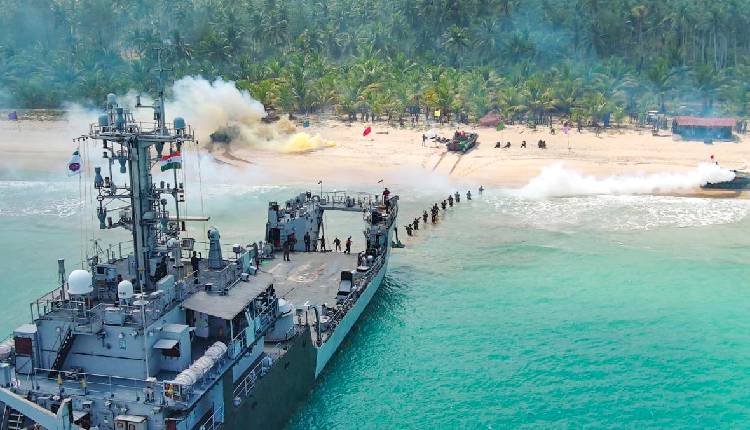
Ottawa: The Great Nicobar project has assumed greater significance in the aftermath of the Iran war, with the Strait of Malacca continuing to serve as a lifeline for East Asia’s energy and economic flows. The project reinforces India’s strategic position at the gateway of the Malacca Strait, a report has stated.
It noted that the ‘Malacca Dilemma’ has been a long-standing concern for Chinese strategists, prompting Beijing to pursue projects such as the China-Pakistan Economic Corridor (CPEC) and China-Myanmar Economic Corridor (CMEC) to reduce dependence on Malacca and secure alternative access to the Indian Ocean.
According to a report in Canada-based Geopolitical Monitor, China represents a structural challenge for India due to the unresolved boundary dispute, while the broader strategic challenge from Beijing continues to intensify despite the recent thaw in bilateral ties.
“The Great Nicobar project will enhance India’s ability to monitor and watch over the Strait of Malacca. Like Iran, India will be able to bring geography into the strategic matrix in the event of a contingency. The project will expand New Delhi’s strategic reach deep into the Southeast Asia, serving as a forward operating base for India’s greater military presence in the Indo-Pacific region,” the report stated.
“In the Indian Ocean geopolitics, forward military presence by a major power on a remote island is a routine occurrence. Britain and the US hold Diego Garcia. France has its military bases in the Southwest Indian Ocean. Australia too holds Christmas and Cocos Islands. The Great Nicobar will join these military sites. After all, for an emerging economy, having a military base on a remote island is a norm of the regional geopolitics,” it added.
The report noted that the project integrates port development, civilian infrastructure, and strategic military objectives. Located at the southern tip of the Andaman and Nicobar island chain between Myanmar and Indonesia, Great Nicobar sits close to the Strait of Malacca, the world’s second-largest oil trade chokepoint after the Strait of Hormuz.
“The project seeks to build a slew of infrastructure: trans-shipment hub, a civil and military airport, gas and solar power plants, and a new township. To be sure, the Andaman Nicobar Islands already host a tri-service military command, and new infrastructure will add another durable layer to these existing facilities. The project will be completed by 2047 in three phases, at an expected cost of $9-11 billion,” the report mentioned.
Emphasising that the project’s strategic significance lies in both economic and geopolitical rationale, the report said the trans-shipment hub is aimed at reducing India’s dependence on major regional deep-water ports such as Colombo and Singapore.
(IANS)