





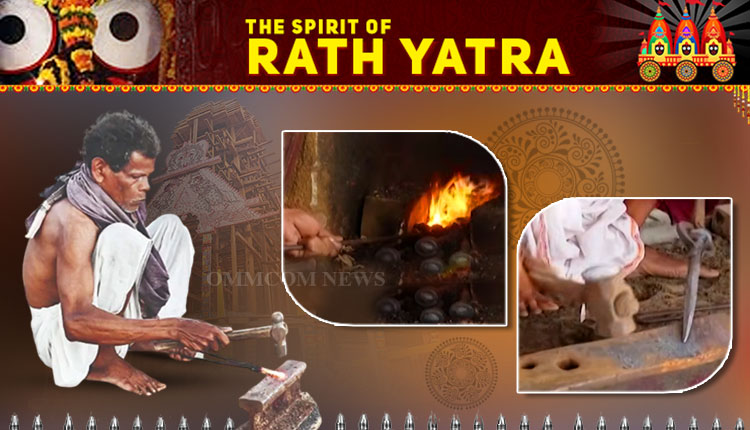
Puri: Long before the towering chariots of Lord Jagannath, Lord Balabhadra and Devi Subhadra roll onto the Grand Road during the annual Rath Yatra, another centuries-old tradition quietly unfolds inside the Dolabedi area of the Shree Jagannath Temple complex. Here, the Kamara Sevaks, the hereditary blacksmiths of the temple, spend nearly two months handcrafting thousands of iron nails and fittings that hold together the three massive wooden chariots.
The services of the Kamara Sevaks begin from the very start of chariot construction. On an auspicious day, the three ceremonial axes forged by the blacksmiths are first touched to the selected timber, marking the formal commencement of the annual chariot-building ritual. From the day after Akshaya Tritiya until Netra Utsav, the lower portion of the Dolabedi is transformed into a temporary Kamarashala, where the rhythmic sound of hammer and anvil becomes an integral part of the Rath Yatra preparations.
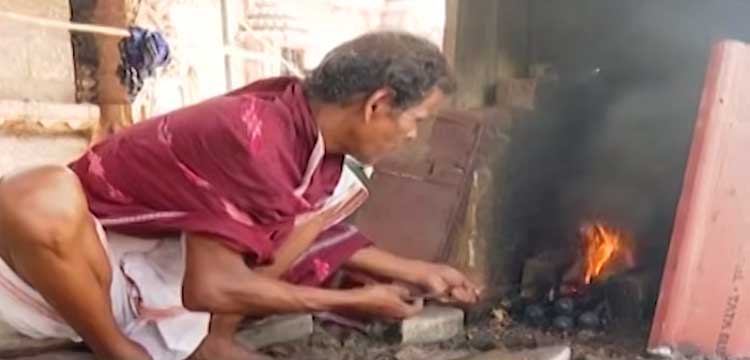
Three separate workshops are established to cater to each of the three chariots. Dasarathi Maharana heads the team working on Nandighosa, the chariot of Lord Jagannath, while Arjuna Maharana leads the blacksmiths assigned to Taladhwaja, the chariot of Lord Balabhadra. Kedar Maharana supervises the work for Darpadalana, the chariot of Devi Subhadra.
Working under the three chief Kamara Sevaks are 17 hereditary blacksmiths, with six assigned each to Nandighosa and Taladhwaja, and five to Darpadalana. Together, they painstakingly prepare around 70 to 75 different varieties of iron nails and fittings needed to assemble the towering wooden structures.
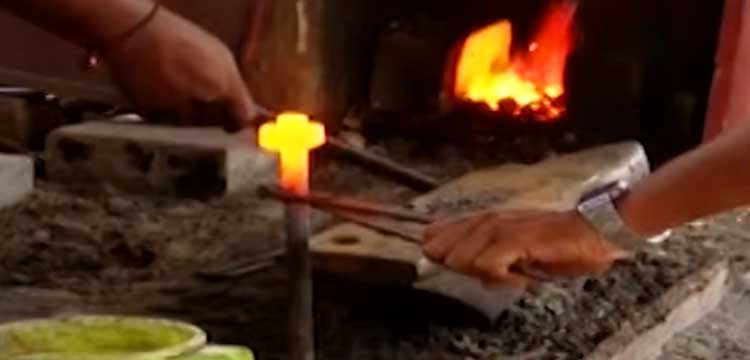
The nails vary significantly in size and purpose. The smallest, measuring about two inches, are used for the base platform of the chariots, while the largest, stretching up to four-and-a-half feet, are known as jangha nails and are used in measuring and securing the thirteen-tiered superstructure. Completing the entire set of iron components requires between 55 and 58 days of continuous work.
According to Kamara Sevak Jagannath Maharana, more than three tonnes of iron are consumed during the annual chariot construction. Since the chariots of Lord Jagannath and Lord Balabhadra are larger, they require comparatively more timber and iron fittings than the chariot of Devi Subhadra.
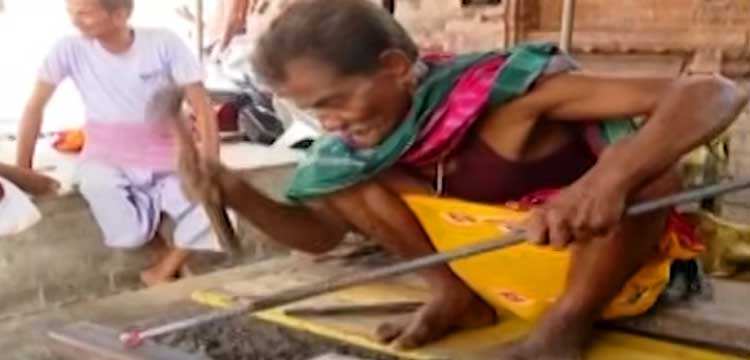
The wheels of each chariot also demand specialised craftsmanship. For every wheel of Taladhwaja, the blacksmiths prepare 32 nails along with four Pandari Chabi, two Pandari and two Bala fittings. Similar sets of iron components are made for the wheels of Nandighosa and Darpadalana.
Each iron fitting bears a traditional name reflecting its specific function in the chariot’s structure. Among them are Arakanta, Pandari, Pandari Chabi, Bala, Muhan Bidi, Danda Bidi, Gargar, Gayal, Chandagayal, Yokha, Kainchi, Bhui, Charaparichha, Katara, Dhamak, Bahuti Pathalia, Singhasona Ray, Jagat Bhushana Sheni, Singhasan Gunthi, Naraj, Shikhara Dambaru, Andharitag, Dhwajabana, Kanchadhamak, Kandachunat, Dhulidanda, Prabha and Singada, each handcrafted according to age-old temple traditions.
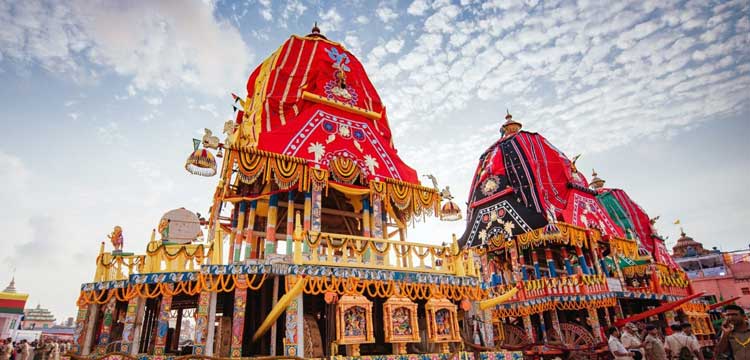
The role of the Kamara Sevaks extends beyond the construction phase. Their services are once again required on Hera Panchami, when Goddess Mahalakshmi symbolically damages Lord Jagannath’s chariot as part of a cherished Rath Yatra ritual, following which the necessary repairs are carried out.
Though their work remains largely behind the scenes, the craftsmanship of the Kamara Sevaks forms the iron backbone of the three sacred chariots. Their hereditary skills, preserved through generations, continue to ensure that one of the world’s largest and oldest religious festivals proceeds in accordance with centuries-old traditions, with every nail forged by hand carrying forward a legacy of devotion and precision.