





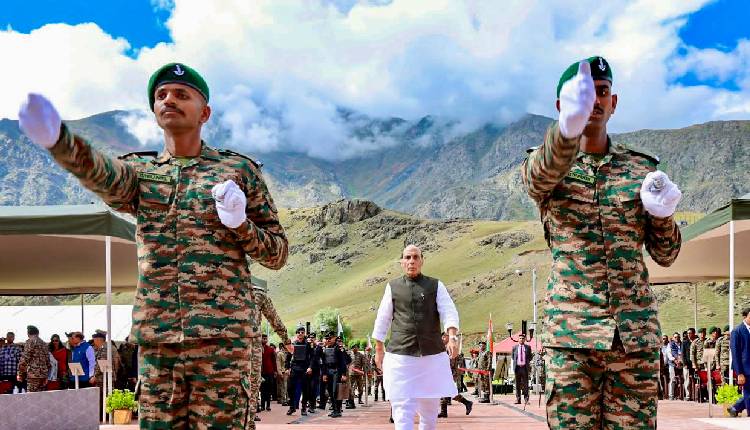
Drass: Defence Minister Rajnath Singh said on Sunday that terrorism has become a part of state policy in Pakistan and the difference between the military and the militant has vanished in that country.
Addressing the 27th Kargil Vijay Diwas commemorations here on Sunday, Rajnath Singh said terrorism is now part of Pakistani state policy and the difference between military and militant has vanished in that country.
“And that is why we have decided not to differentiate between terrorists and those who sponsor them. While India looks for innovation, Pakistan is looking for infiltration; while India designs chips, Pakistan designs terrorism; while we make startups for ecosystem, Pakistan looks for terror ecosystem. Our ways are now separate,” Rajnath Singh said, asserting that the only talks possible with Pakistan are on PoK (Pakistan occupied Kashmir), which is a part of India.
He said Operation Sindoor has completed one year and during that operation India shattered the sponsors of terrorism in Pakistan. “If they try any misadventure, our soldiers will respond befittingly. Any evil step towards our border will be stopped and destroyed,” he said.
The defence minister started his speech by saluting the bravehearts of the Army who gave the supreme sacrifice. “While I salute those brave soldiers, I also greet every Indian citizen on this commemoration day. “Kargil is like a jewel in India’s crown, and it has proved that to keep the dignity and honour of the Tricolour, great sacrifices are needed,” he said.
He said when Pakistani Army intruders occupied high-altitude posts that were lying unoccupied at that time in winter, our soldiers not only excelled those heights, but also exceeded the limits of human endurance. “The Kargil war made history that can never be forgotten. When Naresh Chandra was our ambassador in America, an American army general told him that even the US Marines could perhaps not have achieved what the Indian soldiers did. He said the Indian soldiers continued their uphill march towards the top despite seeing their colleagues fall dead by their side.”
Rajnath Singh said a common citizen cannot understand what it means to fight at 15,000 ft altitude when the temperature drops to minus 40 degrees crisis.
“Our soldiers had a huge strategic disadvantage. Every book on military science said it was impossible to achieve the objective, but our soldiers created a new chapter in military science with their bravery, sacrifice and victory. 546 of our soldiers were martyred, and when their bodies came back to cities and villages, there was a sense of great pride amid the grief in the families,” he said.
“There were newly married brides who lost their ‘Sindoor’ when the ‘Mehndi’ on their hands was still fresh. There were mothers waiting for their sons who lost their vision waiting for their sons. There were children who only saw their fathers in photographs. The ages of those martyrs were 22, 24 and 26. They had thousands of dreams in their eyes, but they sacrificed their dreams and future for the motherland,” Singh said.
“Today, we remember Captain Manoj Pandey and Captain Vikram Batra and many others like them. The stories of their bravery will be told by mothers to children for many generations to come, and that is why Kargil Vijay Diwas is very important for the country. Every Indian citizen may not become a soldier, but he should have the spirit of a soldier alive in him,” the defence minister said.
“Kargil war memorial has names of martyrs who prayed in temples, in mosques, in Gurdwaras and in Churches, but their blood had the same colour, and they gave their blood for their country. I remember the words of Captain Vikram Batra who said, ‘I will either come back holding the Tricolour in my hand or come back wrapped in the Tricolour, but I will come back’. Captain Manoj Pandey said even if death came between him and his objective to achieve victory, he would kill death as well to win the war,” he said
“When Vikram Batra reached the top, he said, ‘Yeh Dil Mange More’. When the government under Prime Minister Narendra Modi took over, we would import 65 to 70 per cent of our defence requirements, and today we manufacture 65 per cent of that equipment in the country. We have indigenous air-to-air defence systems, we have drones and counter-drones, we have air-to-air missiles, INS Vikrant was commissioned recently, but our aim is that Yeh Dil Mange More,” he said.
He said the objective of the government to make India completely self-reliant by 2040 does not only mean economic prosperity, but it also means strategic superiority, cultural and social harmony.
(IANS)