





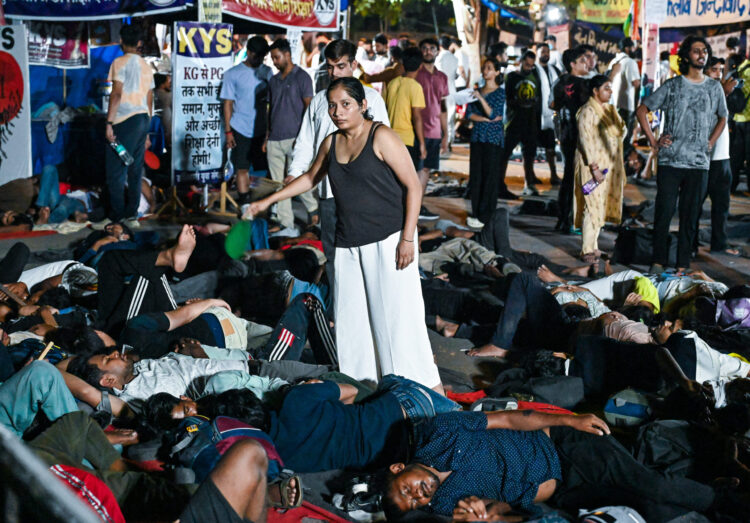
New Delhi: The recent student congregation at Jantar Mantar in New Delhi was not merely a protest over an examination controversy. It was a moment of political and social awakening that deserves to be understood beyond the immediate issue. The students may eventually return to their classrooms, but Jantar Mantar has entered their collective consciousness. It has become more than a place; it has become a symbol.
The phrase Jantar Mantar itself carries a deeper metaphor. While historically it is India’s celebrated astronomical observatory, in popular imagination, the words evoke both jantar (an instrument) and mantra (a force or invocation). Democracy, too, functions through such a combination. Institutions are its instruments, but the people’s voice is its mantra. When the institutions fail to transmit that voice, the mantra returns to the streets.
That is precisely what happened.
Beyond an Examination
The immediate trigger may have been allegations of examination irregularities, but the movement rapidly transcended the issue of one examination. It reflected something much larger—the anxiety of India’s middle class and lower middle class whose dreams are built upon education, merit, and opportunity.
Unlike many earlier political agitations, this movement had no obvious ideological leadership. There was no single political party directing it, no caste mobilisation, no religious slogan defining it. Students travelled voluntarily from small towns and cities across India, often at their own expense. They represented families that have invested everything in education because they believe it is the only path to dignity and social mobility.
When that path appears uncertain, the insecurity becomes existential.
The protest therefore became not merely about an examination but about trust in institutions.
Why Jantar Mantar Matters
Every democracy requires a space where ordinary citizens can be heard before frustration turns into alienation. The Parliament is constitutionally that space. Political parties are expected to amplify public concerns. Ministers are expected to respond. Bureaucracy is expected to resolve problems before they become crises.
When these channels appear inadequate, citizens naturally seek another platform.
Jantar Mantar became that platform.
The significance of this development lies in the fact that thousands of young Indians felt their concerns were not reaching the establishment through normal democratic mechanisms. Their gathering was not an attempt to replace the Parliament. Rather, it was a reminder that democracy cannot be confined within the Parliament alone.
Governments are elected by parliamentary majorities, but they continue to govern through public confidence. Numbers inside the Parliament cannot permanently substitute for communication outside it.
A Different Kind of Student Movement
India has witnessed powerful student movements before. The Navnirman Movement in Gujarat, the Bihar movement led by Jayaprakash Narayan, and numerous regional agitations shaped the country’s political evolution. Those movements arose largely from political and regional contexts.
The present movement carries a different character.
Its foundation is aspiration rather than ideology.
Today’s students are digital natives. They are connected through technology rather than traditional organisational structures. They form communities without regard to caste, religion, or regional identities. Social media enabled mobilisation, but the movement gained legitimacy only when students left their mobile screens and occupied public space peacefully.
This marks a significant generational shift.
Their concerns are practical rather than doctrinal. They are asking simple questions: Will merit matter? Will institutions remain credible? Will education secure employment? Will governments listen?
These questions cut across every social divide.
The Middle Class Cannot Be Ignored
Much of India’s developmental discourse understandably focuses on poverty alleviation and rural development. Yet the aspirations of modern India are largely carried by its middle class.
India’s scientists, engineers, teachers, civil servants, armed forces officers, entrepreneurs, doctors, and innovators overwhelmingly emerge from middle-class and lower middle-class families. These are families that save for education, sacrifice for opportunity and believe in hard work more than privilege.
If this section begins to lose confidence in public institutions, the consequences extend far beyond urban politics.
The middle class does not merely influence elections. It shapes national sentiment, technological innovation, administrative capacity, and economic productivity.
Its anxieties therefore deserve careful attention—not because it is politically louder, but because it remains central to India’s long-term development.
Listening Is the First Duty of Governance
Every government naturally seeks stability and efficient administration. But good governance requires something more than administrative control. It requires constant listening.
Constructive criticism should never automatically be viewed as hostility. History repeatedly demonstrates that societies become stronger when governments hear uncomfortable voices early rather than dismiss them as politically motivated.
During the Emergency, public grievances were often attributed to conspiracies or external influences. History ultimately judged that approach harshly. Democracies flourish not by eliminating dissent but by engaging with it.
This responsibility extends equally to ministers and the bureaucracy.
An administration that merely follows instructions without independent initiative gradually loses contact with public reality. Citizens can sense this distance. Their frustrations accumulate quietly until they eventually surface in unexpected forms.
Jantar Mantar is one such reminder.
The Future Lies with India’s Youth
The greatest mistake would be to see this protest only through the lens of education.
The next major challenge may well be employment.
India’s demographic strength can become either its greatest advantage or its greatest vulnerability. The government alone cannot generate sufficient employment. The solution lies in innovation, entrepreneurship, research and partnerships between academia, industry, and government.
Every university should have innovation and incubation centres where students work on real national challenges—from energy security and artificial intelligence to water management, waste-to-energy technologies, agriculture, and healthcare.
Young Indians should not merely prepare for jobs; they should be encouraged to create solutions.
In emerging technologies such as Artificial Intelligence, India may not match the financial investments of larger economies, but it possesses an enormous advantage in human talent. By focusing on practical applications, ethical frameworks and socially relevant innovation, Indian students can make distinctive global contributions.
The Mantra Must Continue
The true significance of Jantar Mantar is not that thousands gathered there for a few days. Its significance lies in reminding the nation that democracy is ultimately sustained by participation, not silence.
India’s civilisational strength has always rested on diversity of thought, freedom of philosophical inquiry and the acceptance of disagreement. For thousands of years, this civilisation has encouraged dialogue over conformity and debate over unquestioning obedience. Modern democracy in India draws strength from that much older tradition.
The students have now dispersed. The placards have disappeared. The slogans have faded.
But the questions remain.
Jantar Mantar has ceased to be merely a geographical location. It has become a democratic conscience. Wise governments will recognise it not as a challenge to authority but as an early warning system—a place where the pulse of the Republic becomes audible before discontent hardens into distrust.
Conclusion
The recent congregation of students at Jantar Mantar should ultimately be remembered not as a moment of confrontation, but as a powerful affirmation of the resilience and credibility of Indian democracy.
Far from exposing institutional weakness, it demonstrated the remarkable capacity of our democratic system to absorb public sentiment, initiate dialogue and respond with flexibility. The sight of senior ministers personally reaching out to fasting students, inviting them for discussions and responding to their legitimate concerns reflected a democratic culture where the highest levels of government remain accessible to the ordinary citizen.
This is India’s greatest strength.
When institutions or bureaucracy fail to adequately address public grievances, the people still possess constitutional spaces where their voice can travel directly to the highest authority.
Jantar Mantar has evolved into one such democratic bridge — not against the Parliament, but in support of its larger purpose of representing the people. In a world where student movements are often met with prolonged repression or violent suppression, India’s experience offers a different lesson: that dialogue is stronger than force, and responsiveness is stronger than rigidity.
Indian democracy cannot remain confined only to electoral mandates or parliamentary numbers; it draws its enduring legitimacy from continuous engagement with the aspirations of its citizens. Equally, this episode serves as a timely reminder to governments, ministers and the bureaucracy that dissent is not necessarily an act of defiance — it is often the earliest indicator of public expectations and should be interpreted with sensitivity rather than suspicion.
The true strength of governance lies not in silencing criticism but in listening to it with humility. If Jantar Mantar has become the people’s democratic conscience, it is because it reminds every government that the authority to govern is constantly renewed through dialogue, empathy and trust. That is not a weakness of the Republic; it is the living spirit of India’s democracy and one of its greatest civilisational strengths.
The world has seen the strength of India’s democracy through direct dialogue of students from the street to the highest level of governance.
(IANS)