




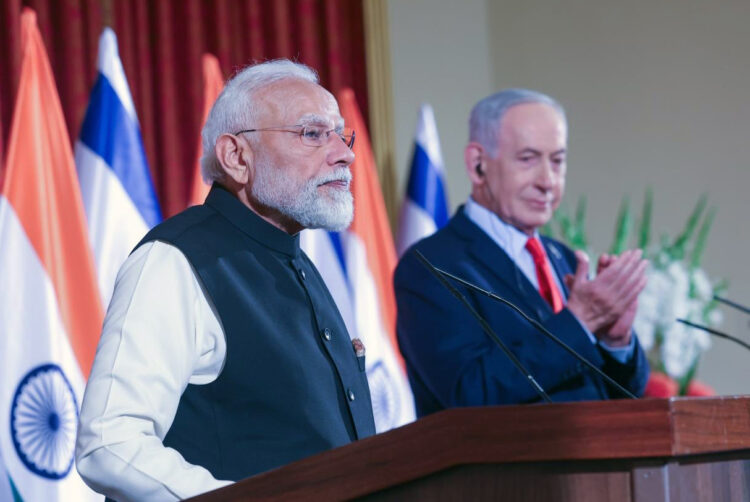
New Delhi: Israel’s Ambassador to India, Reuven Azar, on Tuesday lauded Prime Minister Narendra Modi, hailing the “transformative role” played by him in the development of India.
Recalling PM Modi’s historic address during a Special Plenary of the Knesset in Jerusalem earlier this year – the first by an Indian Prime Minister at the Israeli parliament – the Israeli diplomat, in a special chat with the IANS, said that people of Israel admire the Indian leader, just like he is adored by many other countries in the world.
“There’s no doubt that Prime Minister Modi has played a transformative role in the development of India. You can see it when you live here, when you see the data about the development of India, when you watch the empowerment of the young generation here, the growth rate of the economy, the building of the infrastructure, the reforms, the fact that India now is getting open to the world. And, we’ve seen, first of all in Israel, how Prime Minister Modi was received. I think that his speech in the Knesset was historic, and the people of Israel admire PM Modi like many other countries in the world.”
As the 60-day ceasefire between the United States and Iran ended Monday, US President Donald Trump said that Tehran wants to reach an agreement with Washington but is unwilling to accept the kind of deal he considers necessary.
Trump has claimed that the US had “total control” over the Strait of Hormuz even as Iranian foreign ministry spokesman Esmaeil Baghaei said Monday that Iran and Oman have agreed on the map of the new route for maritime traffic in the strait.
Azar asserted that Iran has been debilitated quite substantially and is trying to “extort the international community” and the United States through their moves in the Straits of Hormuz.
“I think it’s a very unwise move from the side of Iran because of two reasons. The first is that already many countries are engaging in building pipelines that will bypass the Strait of Hormuz. We saw news about a $60 billion project to build a pipeline from Iraq through Turkey and Syria to the Mediterranean. We, of course, know about the East-West pipeline of the Saudis. There’s another pipeline that is planned in the Gulf from all the way from Iraq to the UAE. There is the pipeline that is being upgraded in the UAE itself.
“So, I think that this was one time card that has been used by Iran pretty unwisely. And at the end of the day, it’s not going to produce an alternative, it’s not going to give a victory to Iran to cover over their defeat that is quite substantial, both militarily and also economically,” the Israeli Ambassador told IANS.
Several security analysts in Tel Aviv reckon that Pakistan has sought to turn the recently signed mutual defence pact with Saudi Arabia and Turkey — primarily aimed at deterring a potential Iranian attack on Saudi Arabia — into a broader united Muslim front against Israel and India.
Turkey’s Foreign Minister also compared the collective defence pact to Article 5 of NATO. However, Azar believes that it would be too early to assess implications of the Mecca Joint Defence Agreement signed on August 7.
“It’s difficult to assess at this point. I think that some people are overestimating this. As you know, Saudi Arabia historically has been the rival of Turkey, and we remember very well, not many years ago, the Jamal (Khashoggi) case and how the Turks have been trying to get the Muslim Brotherhood to penetrate Saudi Arabia. So, I think that the current situation has more to do with the increasing threat coming from Iran, and the fact that Iran decided to attack Saudi Arabia unilaterally. But it remains to be seen. We’ve seen in the last few decades different organisations in the region. We haven’t seen that elevating to a level that can be comparable to NATO, but we’ll have to wait and see,” he said.
Experts also believe that the Iran war has created an optical illusion with Islamabad claiming to broker a ceasefire while desperately trying to rebuild its international image tarnished by years of isolation.
However, with no breakthrough still in sight, the MoU has effectively collapsed and so have Pakistan’s attempts to fuel the false narrative of diplomatic triumph.
“I don’t think that Pakistan has been involved militarily. There has been a diplomatic role that has been designated by the United States. So far, that effort is not very successful because we can see that the MoU that was signed a few months back has been breached by Iran, and the IRGC (Iran’s Islamic Revolutionary Guard Corps) decided to attack ships in the strait in contradiction to the agreement that was signed. So it remains to be seen to what extent that country can be useful to anybody,” stated Azar.
(IANS)