




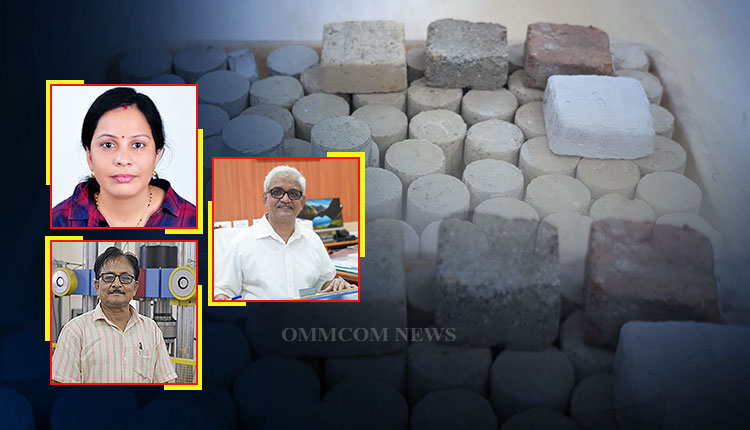
Raurkela: Researchers at the National Institute of Technology Raurkela (NIT Raurkela) have developed a high-strength composite material from coal mining and industrial waste and secured a patent for the innovation.
The technology is expected to provide a sustainable solution for constructing roads capable of withstanding heavy vehicular traffic while addressing the growing challenge of industrial waste disposal.
The patented technology (Patent No. 597749; Application No. 202331070306) has been developed by Prof. K. Umamaheshwar Rao, Professor and Director, Prof. Manoj Kumar Mishra, and Dr. Subhasrita Choudhury, a PhD graduate from the Department of Mining Engineering.
India produces nearly one billion tonnes of raw coal annually to meet its energy and industrial demands. Around 94 per cent of this coal is extracted through surface mining, generating massive quantities of waste materials, including coal mine partings consisting of rocks and other non-coal materials. Conventional disposal of such waste poses significant environmental challenges.
To address this issue, the NIT Raurkela team explored the engineering potential of silica, alumina and clay minerals present in coal mine partings. By combining coal mine partings with fly ash and a suitable binder, the researchers developed a novel composite material with enhanced compressive strength and stiffness. The formulation was optimised through extensive laboratory evaluation to ensure superior performance for road construction.
Prof. K. Umamaheshwar Rao said the technology is particularly suited to coal-mining regions, where roads are subjected to constant movement of heavily loaded vehicles transporting mined materials. Such roads experience repeated stress, resulting in rapid deterioration and high maintenance costs.
Highlighting the significance of the innovation, Prof. Manoj Kumar Mishra said the composite demonstrates the principles of a circular economy by converting two high-volume industrial waste streams into a valuable construction material. Besides reducing the environmental burden of waste disposal, the technology offers an indigenous and sustainable alternative for strengthening road infrastructure.
The research team plans to undertake pilot-scale field trials to assess the long-term durability and performance of the composite under actual traffic and environmental conditions. If successfully implemented, the technology could contribute significantly to sustainable infrastructure development in India’s coal-mining regions while promoting the productive utilisation of industrial waste.