





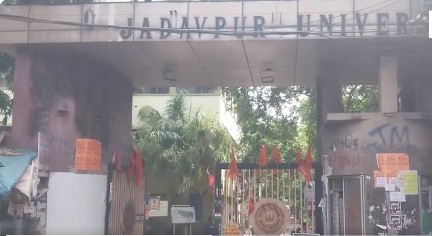
New Delhi: The ongoing protests and vandalism in Kolkata’s Jadavpur University where students following separate political ideologies are alleging the other for such fracas has once again thrown the spotlight on West Bengal’s combustible relationship between campus politics and regime change or the introduction of a new philosophy.
What unfolded on the campus this week, with pitched battles between rival student groups, reflects a long and difficult saga in which the state’s universities have served as microcosms of people’s yearning for “change” when disillusioned by rulers.
This is therefore, not a new phenomenon.
It is another reminder that in West Bengal, campus unions have largely reflected a regime change or the introduction of a new thinking that many students readily accepted against a doctrine that has failed.
Beyond ideology, such unrest also stems from students driven to give vent to anxieties over employment, education reforms, and funding.
Meanwhile, political parties see universities and colleges as extensions of their battlegrounds, and the students as their cadres and some, as future leaders.
Several well-known political leaders, of various hues, have evolved from student politics.
In West Bengal, from the Naxalite militancy of the late 1960s and early 1970s, to the Left Front’s consolidation in 1977, the Trinamool Congress surge in 2011, and now the Bharatiya Janata Party’s (BJP) ascend to power, the state’s education campuses have remained contested ground where political transitions are implemented fiercely.
The turn of the 1960s witnessed Naxalite activism that transformed universities and colleges into a crucible of radical politics.
The violent movement of the time drew students into militant activism, with clashes against police and rival groups becoming routine.
This period turned such campuses of learning into battlegrounds where ideological wars were fought with both words and weapons.
When the Communist Party of India-Marxist-led Left Front swept to power in 1977, its student wing, the Students Federation of India (SFI), quickly entrenched itself across most campuses.
Yet, resistance persisted in some colleges where Congress-backed unions held their ground well into the early 1980s, defying the Left’s dominance.
Such campuses turned into battlegrounds with pitched contests for supremacy between rivals, sometimes with arms.
Leaders of parties with which respective student organisations were affiliated would lend open support with both manpower and weapons, as widely reported those days.
The 2011 transition brought Mamata Banerjee’s Trinamool Congress to power, ending 34 years of Left rule.
On campuses, the Trinamool Congress Chhatra Parishad (TMCP) moved aggressively to displace the Left-affiliated student unions.
Violent clashes again erupted in universities and colleges, echoing the earlier upheavals.
The message was clear every time, that a new regime meant a new union, and the transition would be enforced, even through physical confrontation if needed.
Now, another regime change has happened this year, and students disillusioned with earlier politics and politicians appear to be ready again and seek another “change”.
Older student leaders and members newly associated with this new “change” are seeking another new era in campus politics, but more, the aim is about claiming the intellectual heart of the state.
(IANS)