





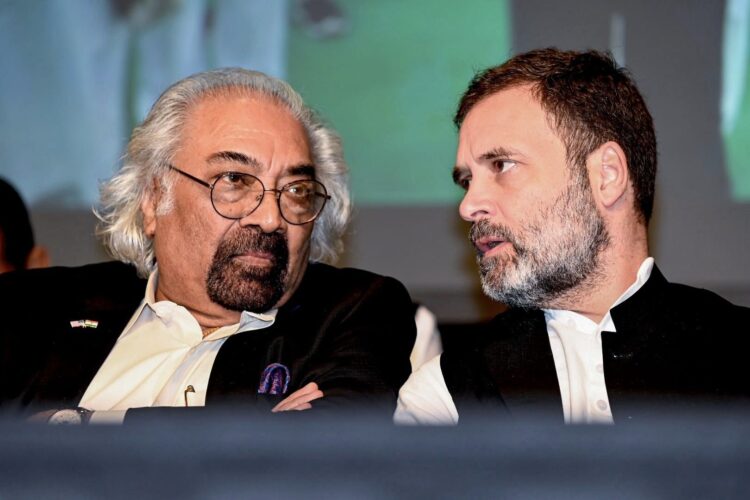
New York: India’s democratic institutions have been “captured” and the judiciary and Election Commission can no longer be considered fully independent, senior Congress leader Sam Pitroda has alleged.
In an exclusive interview with IANS, Pitroda also accused the government of using investigative agencies against its critics and exerting influence over education, civil society and the media.
“So I think institutions have been captured,” Pitroda said after being asked whether he believed the judiciary and Election Commission were independent.
“Let’s look at the track record now. You think election commission is independent in India? I don’t think so,” he said. “Now we can argue about the degree of it.”
Pitroda drew a contrast with the administration of former Prime Minister Manmohan Singh. He said he was unaware of pressure being exerted by the Prime Minister’s Office on constitutional authorities during that period.
“I don’t think during Manmohan Singh time, at least I know, there was any pressure from Prime Minister’s office to anybody. That’s not the way Manmohan Singh operated,” he said.
“He would never make a call to Chief Justice or anybody saying, ‘Hey, just look at this.’ No way. He’ll never send any ED after somebody,” Pitroda added.
Asked whether political influence could also have existed under the previous Congress-led government, Pitroda acknowledged the possibility but said its extent mattered.
“Possible. I don’t know. It’s possible, but it’s the degree of it,” he said.
Pitroda alleged that the appointment of people aligned with the RSS as university Vice-Chancellors had weakened the independence of higher education. He also claimed that space for civil society and critical journalism had contracted.
“We have put vice chancellors who are RSS people. I mean, that means you’re interfering with education, higher education,” he said.
“So institutions are captured, civil society is not allowed to function, media is completely bought out, biased, and those who are speaking against get harassed. Revenge is a way of life. You immediately send ED or somebody,” he alleged.
Pitroda also questioned the health of Indian democracy in the absence of regular press conferences by Prime Minister Narendra Modi.
“How come Prime Minister of India does not have press conference? How can you tolerate that, that you don’t go out to public and have a dialogue saying, ‘This is what I did, this is what we did, this is where we made mistakes, tell me what to do,’” he said.
Pitroda argued that democratic government required consultation, compromise and continuous communication with citizens. He contrasted that model with what he described as an increasingly centralised system.
“There are certain norms of collaboration, cooperation, communication, co-creation. Today, it is command and control. And that is a problem with democracy,” he said.
“Democracy is all about consensus building. Democracy is about give and take. Democracy is not about my way or highway. Democracy is not about fear.”
Pitroda said the drift towards authoritarian methods was not confined to India. He cited developments in the United States, Hungary, China and Russia to argue that governments around the world were increasingly using state power to assert control.
“World over, there is a tendency for authoritarian regime to show their power,” he said. “It is true in Hungary. It is true to some, some extent here. It is definitely true in China and Russia, and it is true also in India.”
(IANS)