
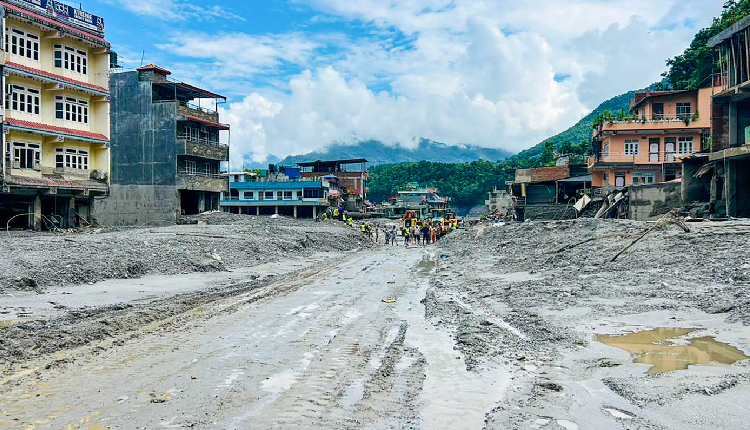
New Delhi: China is deleting videos showing the devastation caused by catastrophic flash floods and mudslides in Tibet, following the glacial collapse on August 26, claimed a report by noted international daily.
A report by The Times of Israel claimed that the glacier collapse triggered a massive surge of mud, rock and water through the Lhende Khola and into the Bhote Koshi and Trishuli river systems, causing extensive destruction along the Nepal-Tibet frontier.
The report said that the disaster had already resulted in significant casualties. By August 28, Nepal had reported 579 deaths, with nearly 1,924 people still missing. On the Chinese side, five deaths and 558 missing people were officially reported in Tibet’s Gyirong County, including 260 foreign nationals. Ten bodies were also recovered from rivers in northern India, it said.
On Sunday, the joint death toll in Nepal and Tibet had reached 750, with over 3,000 people reported missing. Nepal alone accounts for 734 deaths and 2,498 missing.
However, the report focused on the alleged removal of videos showing the scale of destruction on the Chinese side.
According to The Times of Israel, videos of the disaster began circulating on Chinese social media platforms within hours of the floods. Security footage showed a huge wall of mud and debris crashing over buildings at Gyirong Port as people ran for their lives. The report said the location and footage were subsequently verified by international media.
The report cited Bhutanese journalist, who highlighted the removal of flood footage from Chinese platforms and stressed that the material was disaster footage rather than political protest or anti-government activity.
Journalists cited that citizen videos filmed on the Chinese side were being deleted, while footage from Nepal remained widely available.
The report said that what remained on Chinese platforms was largely the official narrative, including information about rescue operations, government statements and President Xi Jinping’s instructions, along with limited details about the extent of the destruction.
It contrasted this with Nepal, where journalists were able to travel to affected areas, speak to survivors and publish photographs and videos showing the devastation.
The report also pointed to restricted foreign access in Tibet, particularly around sensitive border areas, saying this meant the destruction in Nepal could be seen more clearly than what had happened across the border.
It further examined questions surrounding the cause of the disaster. Early reports had suggested that an earthquake may have triggered the collapse. However, the US Geological Survey initially recorded a magnitude-4.4 seismic event but later determined that the signal was generated by the landslide itself rather than an earthquake.
“Satellite imagery showed a huge collapse of glacier and bedrock, followed by an ice-and-rock avalanche that temporarily blocked the river before the natural dam gave way. That still leaves plenty to investigate,” the report said.
The report also referred to questions raised in Nepal over explosive devices washed downstream from the Tibetan side and whether blasting linked to construction or tunnelling could have played a role in destabilising the terrain.
“What were the reported devices? Where did they come from? Were they connected to construction work? Were explosives being used for tunnelling or cutting through the mountains? Were they completely unrelated to the disaster?”
The report mentioned that these are not unreasonable questions.
“Yet the very conditions needed to answer them are missing. Access to the Tibetan side is restricted, foreign journalists face serious limitations and citizen footage is being removed from Chinese platforms. That is precisely how an information vacuum is created,” it said.
The report suggests if Beijing wants the world to accept a particular explanation for the disaster, the answer should not be censorship but evidence.
The river system originating in Tibet does not end there. The Lhende Khola feeds the Bhote Koshi, which flows into Nepal’s Trishuli and eventually becomes the Gandak in India.
The report argued that a government dealing with a natural disaster should not fear citizen-recorded footage but should preserve it. It said the journalists should be allowed to assess the damage, while scientists and independent experts should have access to the terrain and be able to compare satellite imagery, eyewitness accounts and official statements.
According to the report, the pattern emerging from Tibet is instead one of “restricted access, disappearing footage and an overwhelmingly official narrative.”
It said these developments raise concerns about how much of the disaster the outside world can independently assess.
The report stressed that the issue was not merely about individual videos being removed from platforms such as Weibo or Douyin. Rather, it argued that the concern was about “controlling the historical record” of a disaster whose impact has extended across three countries.
(IANS)