





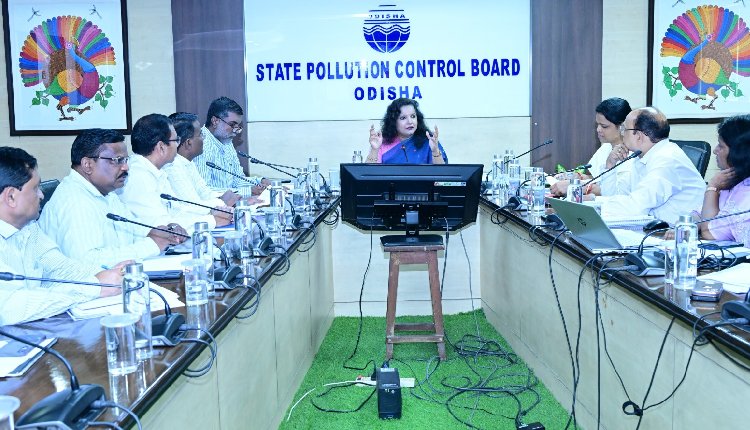
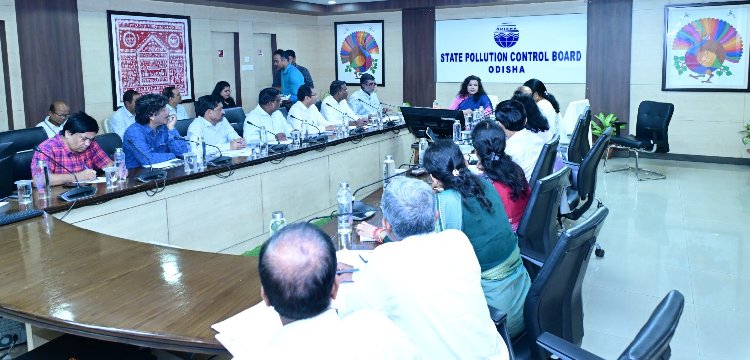
Bhubaneswar: Odisha Chief Secretary and Chairman of the Odisha State Pollution Control Board (OSPCB), Anu Garg, on Monday visited the OSPCB and reviewed various activities of the Board, including its regulatory framework, environmental monitoring, waste management, human resources, current challenges and future course of action.
The Chief Secretary emphasised the need to strike a balance between environmental protection and industrial development with the objective of creating a conducive environment for new investments and industrial establishments in Odisha.
With the rapid growth of sectors such as steel, aluminium, power, mining, petrochemicals and other industries in Odisha, Garg stressed the importance of ensuring that industrial development goes hand in hand with environmental protection.
Discussions were held on strengthening the role and functioning of the Board by moving beyond merely granting permissions and checking regulatory compliance towards establishing a data-driven, technology-enabled and transparent environmental management system.
The Chief Secretary advised that the Board’s future action plan should prioritise policy reforms, strengthening institutional capacity, adoption of modern technology, strengthening laboratory and research infrastructure, waste recycling and reuse, public awareness and human resource development.
She also held detailed discussions with members of the Board on making the functioning of the OSPCB more transparent and efficient.
On the occasion, the Board made a detailed presentation on the existing regulatory framework and its roadmap for the future.
The Chief Secretary stressed the need to make environmental approval and compliance procedures simpler, transparent, predictable, time-bound and technology-driven, with the objective of facilitating new investments and industrial establishments under the Ease of Doing Business framework.
Such measures will enable industries to maintain the required environmental protection standards while creating a more conducive environment for new investments and industrial development in the State.
The Chief Secretary also emphasised that all future initiatives of the Odisha State Pollution Control Board should be aligned with the broader vision of ‘Viksit Odisha 2036’ and ‘Viksit Bharat 2047’.
She advised that environmental protection should be integrated with sustainable economic development, industrial growth, investment, innovation and employment generation.
Highlighting the importance of the circular economy, the Chief Secretary said waste should not merely be viewed as something to be discarded or destroyed. Instead, emphasis should be placed on converting waste into an economic resource through reuse, recycling, resource recovery and value-added production.
She stressed the need for the scientific and systematic management of different categories of waste. Stronger systems for the segregation, collection, processing, recycling and resource recovery of municipal waste, industrial waste, plastic waste, e-waste, construction and demolition waste, hazardous waste and other categories should be developed.
In this context, she emphasised the promotion of the concept of ‘Waste to Wealth’ or ‘Waste to Economy’.
New technologies, enterprises and business models should be promoted to enable materials discarded as waste in one sector to be used as raw materials or useful resources in another sector. This, she noted, can reduce waste while creating opportunities for new enterprises, employment and income generation.
Overall, the Chief Secretary called for a transformative approach that integrates environmental protection, Ease of Doing Business, industrial development, the circular economy and employment generation to achieve the goals of Viksit Odisha and Viksit Bharat.
She also observed that Odisha’s development should not depend solely on the utilisation of its mineral resources. Tourism, she said, would play an important role in the State’s future economic growth.
The Chief Secretary highlighted the important role of the Pollution Control Board in promoting overall development, including tourism and infrastructure development, while ensuring environmental protection.
Member Secretary of the Odisha State Pollution Control Board, Dr Manoj V. Nair, participated in the meeting and made a presentation on the Board’s current challenges and future plans.
The meeting emphasised further strengthening online monitoring, automated data collection, digital monitoring of industrial compliance and data-driven decision-making systems to make pollution control and environmental monitoring more efficient and transparent.
Discussions were also held on modernising the Board’s Central Laboratory, the Coastal Environment Monitoring Centre and laboratories at regional offices, as well as strengthening research activities.
The need to enhance research and technical collaboration with national and reputed research organisations, technical educational institutions and specialised agencies was also discussed.
The meeting also focused on the reuse and recycling of industrial by-products such as fly ash, slag, red mud and phosphogypsum.
It was discussed that waste management should not be limited to disposal and that greater emphasis should be placed on increasing resource utilisation under the circular economy approach. Plans should be developed for using industrial by-products in construction, highways and other infrastructure projects.
The meeting stressed the need to expand public awareness programmes on occasions such as World Environment Day, World Ozone Day, International Day of Clean Air for Blue Skies, Environment Awareness Week, International Coastal Cleanup Day and National Pollution Prevention Day.
Emphasis was also placed on increasing environmental awareness among students in schools and colleges, as well as the general public.
The meeting discussed making real-time information on air quality and water quality readily available and using social media platforms to disseminate messages on environmental protection more widely.
The meeting also emphasised making the approval process for industries and businesses simpler, transparent and time-bound.
Steps have been taken to integrate various approval systems with the single-window online system, along with measures such as online certificate verification and paperless working procedures.
The availability of technical and administrative human resources in the Board, filling vacant posts, promotions and human resource planning based on future requirements were also reviewed.
Emphasis was placed on further strengthening various branches of the Board, regional offices, laboratories, the legal wing and the information technology wing.
The Chief Secretary stressed the need to further strengthen the role of the Odisha State Pollution Control Board in establishing a balance between environmental protection, responsible industrialisation and sustainable development, and in taking Odisha forward as a clean, green and sustainable State.
Other members of the Odisha State Pollution Control Board were present at the meeting and participated in the discussions.