





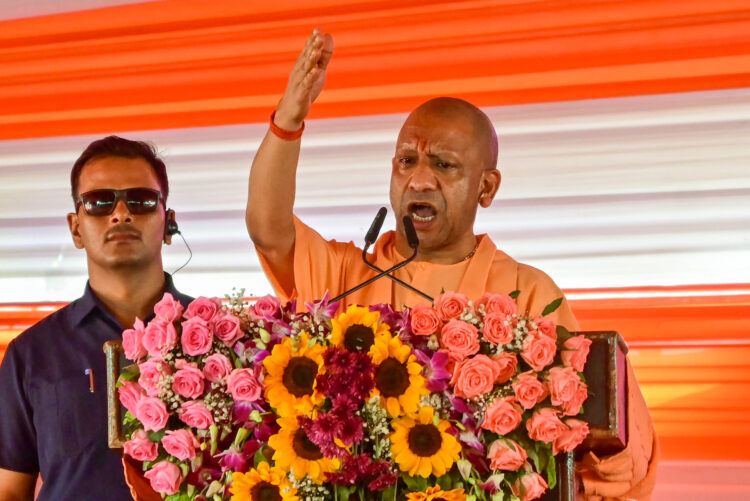
Prayagraj: Uttar Pradesh Chief Minister Yogi Adityanath on Thursday took a swipe at the Lok Sabha Leader of Opposition (LoP) Rahul Gandhi, saying that he should take note of the fact that former Prime Minister late Jawaharlal Nehru was not the only one who went to jail, “even Mahashaya Masuriya Deen Pasi spent nine years behind bars”.
The Chief Minister made the remarks after unveiling a statue of Mahashaya Masuriya Deen Pasi in Prayagraj.
Pasi was a freedom fighter, a member of the Constituent Assembly who played a key role in the abolition of the British-era ‘Criminal Tribes Act’, and a former Member of Parliament.
Taking a jibe at the LoP, the Chief Minister remarked: “Rahul Gandhi should take note that it was not just Nehru who went to prison for the country’s freedom; Masuriya Deen Pasi also served time in jail. Out of his 66–67 years of life, he spent nine years (between 1932 and 1944) behind bars for the cause of independence. Even after his release, he continued his efforts to raise public awareness.”
Chief Minister Adityanath requested a proposal from the Prayagraj Mayor Umesh Chandra Ganesh Kesarwani, saying that the intersection where Pasi’s statue is installed would be named after the freedom fighter.
He added that a prominent institution in Prayagraj will also be named after Pasi and that a grand statue of his will be installed there as well.
“A society can only progress by honouring its tall political figures. By honouring the past, the present can be refined, and a refined present ensures a bright future. Honouring Mahashaya Masuriya Deen Pasi is synonymous with honouring all freedom fighters; no effort will be spared in this regard,” he said.
Mentioning that Masuriya Deen Pasi was born on October 2, 1911, CM Adityanath said: “While the passage of time had caused him to fade from history, the Bharatiya Janata Party (BJP) government—which values both development and heritage—does not allow such great figures to be forgotten. We have unveiled this statue to keep his memory alive.”
The Uttar Pradesh Chief Minister also mentioned that Masuriya Deen Pasi became a member of the Uttar Pradesh Legislative Assembly in 1946, and subsequently, in independent India, he was elected to Parliament four times between 1952 and 1972.
“In 1952, two Members of Parliament were elected from a single constituency, Pandit Nehru and Masuriya Deen ji were elected together. As early as 1952, they raised their voices against oppressive and draconian laws. Following their defeat in the First War of Independence in 1857, the British enacted the ‘Criminal Tribes Act’ in 1871, which humiliated various communities, including the Pasi community. Baba Saheb (Ambedkar) and Masuriya Deen ji fought against this law and eventually succeeded in having it repealed; they then worked to integrate the Pasi, Sonkar, and other marginalised and Dalit communities into the national mainstream, encouraging them to lead lives of dignity,” CM Adityanath said.
The Chief Minister added that the tales of the valour and bravery of the Pasi community are well-known.
“In the 12th century, Maharaja Bijli Pasi constructed 12 forts in and around Lucknow as part of a strategic defence against foreign invaders. When the brave Makka Pasi attained martyrdom while fighting for the nation’s freedom, his wife, the valiant Uda Devi, took charge of the resistance and dealt a severe blow to the British forces, ultimately making the supreme sacrifice herself,” he noted.
He also said that the Uttar Pradesh government has undertaken the restoration of the fort of Maharaja Bijli Pasi in Lucknow.
“The ‘double-engine’ government is also establishing a PAC (Provincial Armed Constabulary) battalion in Lucknow named after the valiant Uda Devi, where a grand equestrian statue of her is being installed. Honour is not the exclusive preserve of any single family; those who championed the cause of the Dalits and the marginalised, and who dedicated their lives to the nation and society, deserve to be honoured,” CM Adityanath asserted.
(IANS)