





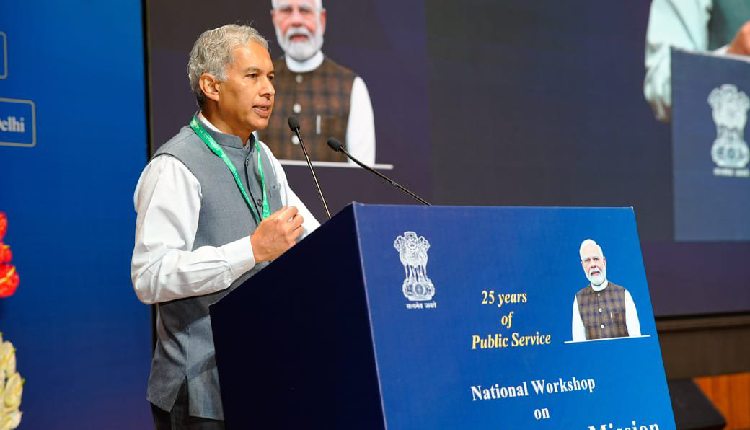
New Delhi: The NITI Aayog Chief Executive Officer (CEO) Anurag Jain highlighted four key lessons from Prime Minister Narendra Modi’s 25 years of leadership, beginning as Chief Minister of Gujarat in 2001, at the national workshop of the think-tank held here on Tuesday.
“First, purpose must take precedence over hierarchical position, shifting the focus from individual leadership to a shared collective mission. Second, service must replace command, with governance centred on reaching the last person in the queue. Third, intrinsic conviction builds resilience, enabling adversity to become an opportunity for societal transformation. And fourth, true empowerment must outlive individual leadership through strong institutions, capable teams and sustainable systems,” the NITI Aayog Chief said.
He underscored that the objective of this NITI Aayog workshop is to document the learnings from 25 years of leadership of the Prime Minister and translate them into institutional knowledge for the future.
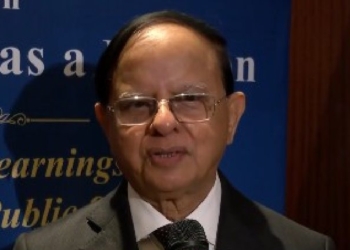
NITI Aayog Vice-Chairman Ashok Kumar Lahiri said, “The role of strong political and administrative leadership is crucial in driving India’s development journey. The transformational vision of our Prime Minister, marks a significant shift in India’s national aspiration to become Viksit by 2047, reflecting the country’s transition towards a developed, prosperous and globally competitive nation.”
He highlighted NITI Aayog’s integrated roadmap for realising this ambition of building a $30-40 trillion economy by 2047, with a per capita income of $15,000-18,000, supported by sustained annual real GDP growth of 7-10 per cent.
Delivering the inaugural keynote address, P.K. Mishra, Principal Secretary to the Prime Minister, said, “India’s governance journey has been marked by defining milestones that demonstrate the power of decisive leadership and the ability to translate vision into action.”
“From swift response to the 2001 Kutch earthquake to the country’s coordinated response to the Covid-19 pandemic, from expanding India’s footprint in the global space economy to the transformative impact of Lakhpati Didi initiative, these actions reflect how strong political will, responsive administration and mission-driven governance can bring about meaningful change in people’s lives,” he added.
The Prime Minister assumed office as the Chief Minister of Gujarat in October 2001 and as Prime Minister of India in May 2014 and has led the government at the state and the Union levels without a break since then.
Throughout this period, PM Modi has held public office as a mission of service. His description of himself as the ‘Pradhan Sevak’ places the citizen at the centre of every office of government, and the principles of ‘Antyodaya’, ‘Jan Bhagidari’ and ‘Sabka Saath, Sabka Vikas, Sabka Vishwas, Sabka Prayas’ have guided the direction of governance at both levels, according to a NITI Aayog statement.
The workshop is the first in a series of five National Workshops.
The deliberations and first-hand experiences shared during the series will be developed into case studies and learning material for civil services training institutes, educational institutions and universities.
Over the course of the series, the learning from these twenty-five years will also be taken forward through research and teaching material that sets out directions for policy and administration in the years leading up to ‘Viksit Bharat @2047’.
More than 900 participants attended the workshop, of whom 250 took part directly in the deliberations.
The participants included Secretaries and senior officers of the Union and state governments, District Collectors of Aspirational Districts, students of educational institutions and universities, and community partners and beneficiaries of national flagship schemes.
The proceedings are also streamed on the iGOT Karmayogi platform and at Central and State Administrative Training Institutes, enabling officers from across the country to participate in the programme.
–IANS