






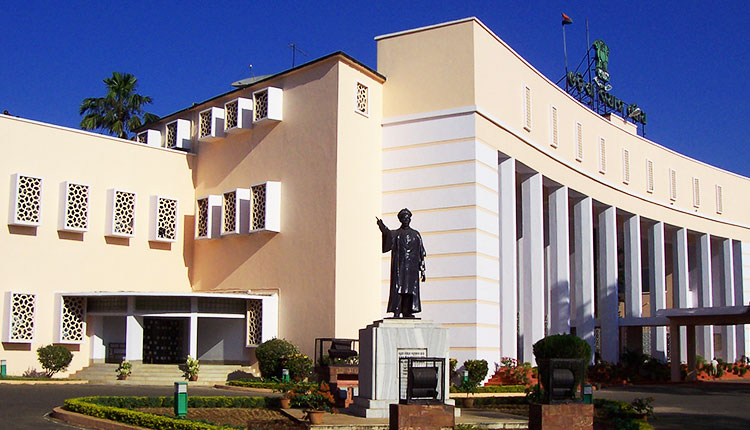
Bhubaneswar: The Odisha Assembly on Monday passed a bill to establish Economic Region Development Authorities, paving the way for coordinated planning and integrated development of multiple urban centres, industrial hubs and infrastructure networks across the state.
The Odisha Development Authorities (Amendment) Bill, 2026, provides a statutory framework for the proposed Bhubaneswar-Cuttack-Puri-Paradip Economic Region (BKPPER) and other economic regions envisaged under the state’s Vision 2036.
These include the Bargarh–Jharsuguda–Sambalpur, Berhampur–Chhatrapur–Gopalpur and Jeypore–Koraput–Sunabeda agglomerations, besides other regions that may be identified by the government for phased development.
Under the amended legislation, an economic region has been defined as a geographical area comprising two or more existing development authorities or local authorities, which the state government may notify for the coordinated and integrated development of economic, industrial, infrastructure and transport networks.
The amendment introduces a new chapter on Economic Region Development Authorities in the Odisha Development Authorities Act. The state government will constitute a statutory authority for every notified economic region.
The Chief Minister will head the authority as its chairperson, while the Housing and Urban Development Minister will serve as its vice-chairperson. Ministers in charge of Finance, Works, Panchayati Raj and Drinking Water, and Planning and Convergence will also be members.
The authority will have representation from senior bureaucrats, district collectors, mayors, heads of municipalities and development authorities, port authorities, and key state agencies, including WATCO, IDCO and IPICOL.
The government may also nominate up to two experts in fields such as regional planning, infrastructure, finance and environmental management.
The chairperson will nominate one MP and four MLAs representing constituencies within the economic region as members on a rotational basis. An officer not below the rank of secretary to the state government will be appointed as the chief commissioner and function as the authority’s chief executive officer.
The authority will be responsible for preparing and implementing a Regional Development Plan, regulating land use and development, planning major infrastructure projects, and coordinating investment and industrial development.
It will also oversee region-wide infrastructure and services, including transport, housing, environmental management, disaster resilience and power transmission.
The legislation empowers the authority to acquire land, develop special economic zones, investment zones, industrial parks and urban centres, levy development and service charges, enter into joint ventures and mobilise funds, subject to the state government’s approval.
Development authorities falling wholly or partly within a notified economic region will be required to function in accordance with the directions of the Economic Region Development Authority.
The Regional Development Plan will have to be prepared within two years of the notification of an economic region.
The plan may cover land use, industrial and investment areas, urban growth centres, highways, railways, port connectivity, mass transit systems, logistics, water supply, drainage, power and digital infrastructure.
It may also include measures relating to environmental protection and climate-resilient development.
The proposed framework is aimed at facilitating integrated planning and coordinated infrastructure development across administrative boundaries, enabling multiple urban and industrial centres to function as parts of a larger economic region.