






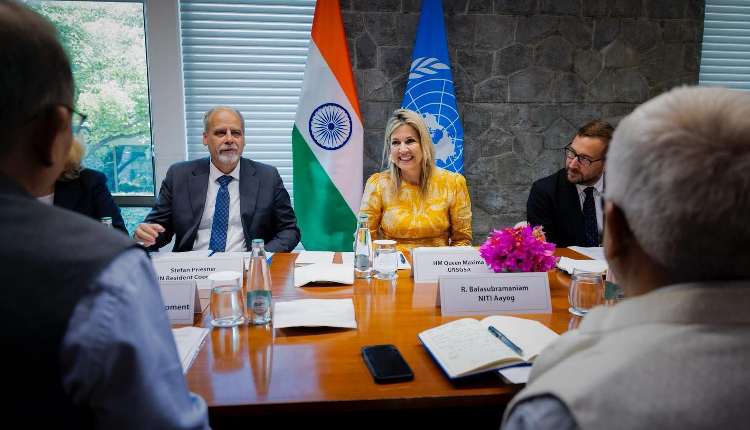
New Delhi: NITI Aayog Member Dr. R. Balasubramaniam on Friday highlighted India’s integrated approach to financial inclusion and financial health during an interaction with Queen Maxima of the Netherlands, the United Nations Secretary-General’s Special Advocate for Financial Health.
Dr. Balasubramaniam shared that India’s financial inclusion journey began with the JAM trinity — Jan Dhan accounts, Aadhaar and mobile connectivity — which laid the foundation for achieving financial inclusion at a population scale. Over the last decade, this framework has enabled the creation of an integrated social protection architecture that has substantially improved financial health for a large section of the population.
Drawing upon his experience of working with rural and tribal communities, Dr. Balasubramaniam said financial health should be viewed in the broader context of economic and social security. He noted that access to financial services alone is insufficient unless supported by essential social protection mechanisms.
He explained that financial inclusion, combined with health security initiatives such as Ayushman Bharat and the Ayushman Bharat Health Account (ABHA), food security through the Public Distribution System, energy access under the PM Ujjwala Yojana, and the expansion of Direct Benefit Transfers and pension schemes, has strengthened household resilience across the country.
The NITI Aayog member emphasised that these interconnected welfare interventions have contributed to improved financial health outcomes by reducing vulnerabilities and enhancing social security for millions of households.
The interaction with Queen Maxima provided an opportunity for India to share its experience of how financial health can be strengthened through the convergence of financial inclusion with health, food, energy and social security measures, creating a more resilient foundation for households and communities.
(IANS)