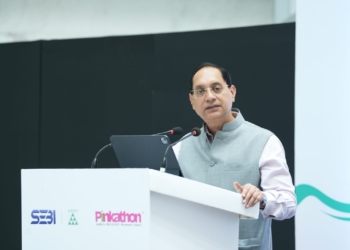







Mumbai: India needs to raise the share of manufacturing in its gross domestic product (GDP) from the current 16-17 per cent to 25 per cent by 2047 in order to become a developed economy, the chairman of the Economic Advisory Council to the Prime Minister (EAC-PM), S Mahendra Dev said on Thursday.
Addressing the CII Financing Summit 2026 here, he said India had the potential to grow at 8-9 per cent, but sustaining this would require an expansion in productive capacity and improvements in productivity.
Dev said an investment rate of around 34-35 per cent of GDP is important to sustain growth over the next two decades. Gross fixed capital formation stood at 31.9 per cent of GDP in 2025-26. He emphasised the need for greater private sector participation, saying public investment in infrastructure could encourage private investment by improving connectivity and reducing production and transportation costs. However, public investment alone would not be sufficient to meet the country’s requirements.
He observed that domestic savings would remain the principal source of financing India’s investment needs. According to revised national income accounts data, gross savings stood at 34.9 per cent of GDP in 2024-25, with the household sector accounting for around 62 per cent of the total.
“Since households account for nearly two-thirds of India’s domestic savings, the way these savings are used has an important bearing on how investment elsewhere in the economy is financed,” he pointed out.
Dev called for diversifying sources of long-term finance, saying banks alone could not meet the financing requirements of India’s development ambitions. “Different investments require different kinds of finance. These requirements cannot all be met through conventional bank lending,” he said, highlighting the role of insurance and pension funds, corporate bond markets and equity markets in financing long-term investments.
He also highlighted that India’s corporate bond market is concentrated with around 85-90 per cent of issuances in the highest-rated securities. Mid-sized companies and lower-rated borrowers, on the other hand, continue to have limited access to the market.
Dev also emphasised the importance of structural transformation in agriculture, manufacturing and services, alongside greater use of technology and digital public infrastructure. He called for improving agricultural productivity through diversification, post-harvest activities and agro-processing, while strengthening farmer producer organisations.
“Political stability, macroeconomic stability and a large domestic economy” were the three factors underpinning India’s resilience while global macroeconomic and geopolitical uncertainty remained a key concern,” he added.
(IANS)