





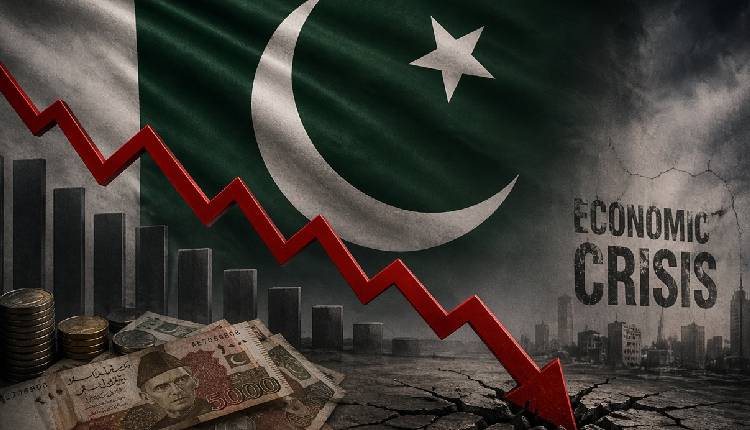
New Delhi: Pakistan’s latest GDP data points to a fragile and uneven recovery, with the economy growing 3.7 per cent in the current fiscal year, below the government’s 4 per cent target and marginally under the nation’s State Bank projection range, a report has said.
The report published in Dawn highlighted that the growth underscores the country’s continued struggle to break out of a prolonged low-growth trap shaped by structural weaknesses, external financing pressures and repeated inflationary shocks.
The economy has expanded to over $452 billion, with per capita income rising slightly to $1,901, it said.
The uptick offers limited real relief to households facing high living costs, stagnant wages and weak purchasing power.
It further noted that sectoral performance remains uneven.
Large-scale manufacturing has rebounded after a period of contraction, while services continue to dominate overall growth, driven largely by consumption and state expenditure rather than productivity gains.
In contrast, the agriculture sector experienced weak performance, despite employing a large share of the workforce.
The industrial recovery is also being viewed as cyclical, emerging from a low base rather than reflecting sustained expansion.
For instance, sharp increases in automobile production follow earlier declines caused by import restrictions and supply chain disruptions, the report said.
The report flagged that the neighbouring country continues to lag in export-led industrial growth, with investment, tax mobilisation and productivity indicators remaining weak.
Despite stabilisation efforts and IMF-backed reforms helping avert immediate crisis risks, long-term growth prospects remain uncertain, according to the report.
In addition, the State Bank of Pakistan has projected tepid growth ahead, contingent on energy prices and geopolitical developments, including ongoing regional tensions.
(IANS)