





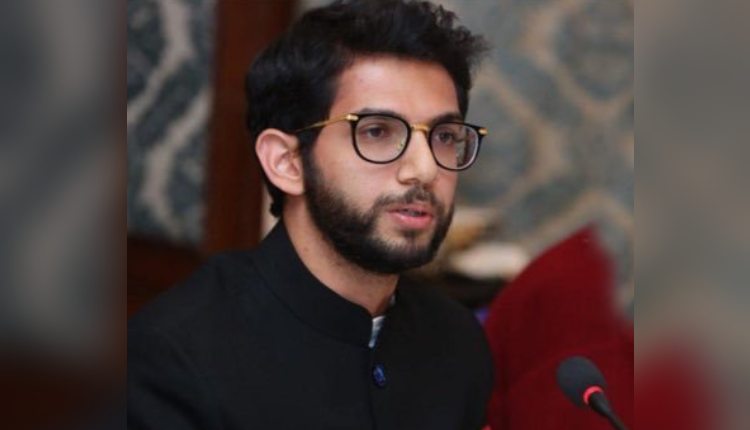
Mumbai: Ahead of Mumbai hosting the prestigious Earthshot Prize Summit and Awards, Shiv Sena (UBT) leader and former Maharashtra Environment Minister Aaditya Thackeray on Thursday launched a sharp attack on the Union government, accusing it of “data fudging,” greenwashing, and failing to provide citizens with the necessities of clean air, water, and food.
Highlighting that almost all of the world’s most polluted cities are currently in India, Thackeray questioned the central regime’s commitment to both international climate treaties and domestic governance.
His remarks come at a critical juncture on the global environmental calendar, with the COP31 climate summit underway in Türkiye and Mumbai preparing to host the Earthshot Prize followed by Mumbai Climate Week.
Thackeray pointed out that a lack of data integrity has masked India’s true standing on global climate indices, masking a reality that is far worse than official rankings suggest.
He noted that political apathy toward the environmental crisis is forcing citizens to protest, and in some cases, migrate in search of basic living standards.
“Most of those who pay direct taxes, and all of those who pay indirect taxes, hoping for these basics, have to spend again on air and water purifiers and sources of food,” Thackeray stated, warning that the deteriorating environment is no longer just a public health hazard, but an economic threat.
He added that businesses and organisations are also relocating out of polluted regions, directly resulting in job losses.
Reiterating a demand he has previously made to the Centre, Thackeray proposed the immediate establishment of a Council of Climate Change, modelled on the Goods and Services Tax (GST) Council, to institutionalise federal cooperation on environmental issues.
The Council should be headed by the Prime Minister and include all State Ministers for Forest and Environment, alongside relevant Union Ministries such as Urban and Rural Development, Energy, Agriculture, Industry, and Roads. The body would meet quarterly to review verified data, targets, and real-time progress, he said.
He further stated that parallel State Councils of Climate Change should be headed by respective Chief Ministers, bringing together all interlinked government departments to track regional climate action plans.
Drawing from his tenure when Maharashtra drafted Climate Action Plans for Mumbai and several other cities, Thackeray insisted that such plans must be formulated and neutrally audited by independent, internationally reputed organisations in a transparent manner.
Reflecting on his experience leading Maharashtra’s Environment and Climate Change portfolio, Thackeray emphasised that environmental governance intersects with nearly every government department and dictates the overall quality of life.
Warning that India stands at a defining threshold regarding its population and demographic dividend, he urged the government to treat climate action as an urgent economic and strategic necessity.
“Timely climate action can be a huge opportunity that, if missed, can be a huge risk socially, politically, economically and in terms of national security,” he concluded.
(IANS)