





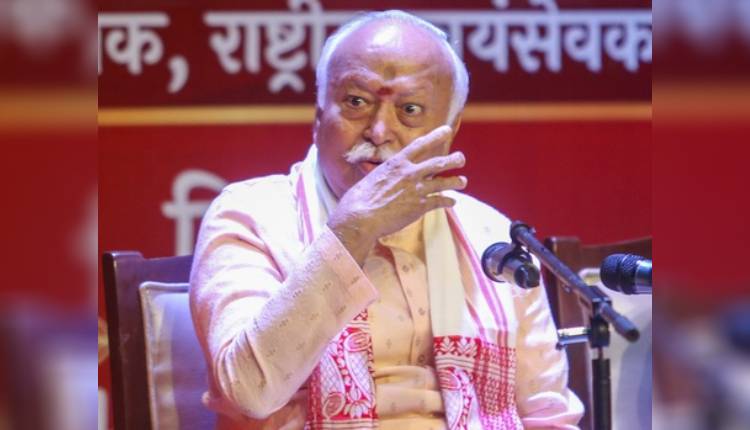
New Delhi: Being a patriotic and proud Indian Muslim, I felt this was a hit job against India. The USCIRF’s latest statement goes far beyond a routine assessment of religious freedom. It targets RSS chief Mohan Bhagwat’s visit to the United States, calls for targeted sanctions against RSS members and Indian officials, and even urges Washington to consider revoking Bhagwat’s visa. USCIRF has also repeated its recommendation that India be designated a “Country of Particular Concern.”
That is an extraordinary political intervention. And the timing is difficult to ignore. India is preparing to host the BRICS Leaders’ Summit in New Delhi on September 12–13, at a time when its economic weight, diplomatic influence and standing across the Global South are expanding rapidly. One does not have to believe in conspiracies to ask whether the timing deserves scrutiny.
India is a thriving economy and one of the most consequential countries of the 21st century. Yet its rise has gone hand in hand with extraordinary religious diversity. The country remains home to one of the world’s largest Muslim populations, millions of Christians, Sikhs, Buddhists and Jains, as well as ancient Jewish and Zoroastrian communities.
Just this week, Muslims across India publicly marked Eid Milad-un-Nabi with religious gatherings and processions, with police providing security arrangements. In Hyderabad, for example, the city police coordinated with organisers ahead of the procession and made security arrangements for the event.
That is the India I see.
The India USCIRF overlooks
One of the most revealing pieces of evidence comes from the Pew Research Center, which surveyed nearly 30,000 Indian adults across the country in 17 languages.
The findings are striking. Ninety-one percent of Indians said they were very free to practice their religion. Among Muslims, the figure was 89 percent; among Christians, 89 percent; Hindus, 91 percent; Buddhists, 93 percent; Jains, 85 percent; and Sikhs, 82 percent. More importantly, 79 percent said people belonging to other religions were very free to practice their faith.
Pew Research Center findings also found that 84 percent of Indians considered respecting all religions very important to being “truly Indian.”
There is another assessment USCIRF’s narrative cannot simply wish away. The Global Minority Report, produced by the Centre for Policy Analysis and reported by The Australia Today, ranked India first among 110 countries for inclusivity towards religious minorities. South Korea, Japan, Panama and the United States followed, while the United Kingdom ranked 54th and the UAE 61st.
India’s Constitution reinforces this pluralistic character. Article 25 guarantees freedom of conscience and the right to profess, practise and propagate religion, while Article 26 gives religious denominations the right to establish institutions and manage their religious affairs.
India’s Muslim community itself reflects this diversity. Sunni and Shia Muslims live across the country alongside Barelvi, Deobandi and Salafi communities, Sufi traditions and numerous independent Islamic institutions. India’s Muslim population exceeded 170 million in the 2011 Census.
So why is the RSS always the target? I am not a Sangh member, nor do I speak on its behalf. But I have often wondered why the organization attracts such sustained external scrutiny. My two cents: perhaps it is precisely because the RSS represents an indigenous political and social outlook that places greater emphasis on Indic identity, self-reliance and resisting external influence. You may disagree, but that perspective deserves to be discussed rather than automatically pathologized.
The Jews and Parsis tell India’s story
Perhaps the strongest answer lies in India’s history.
My Jewish brethren found refuge in India when Jews elsewhere faced persecution. Jewish communities have lived here for centuries, maintaining synagogues, traditions and institutions while becoming part of Indian society.
India’s relationship with the Jewish people is not merely diplomatic. It is civilizational.
The same is true of the Parsis. Zoroastrians fleeing persecution in Persia found a home in India. They did not merely survive; they flourished. Parsis went on to make extraordinary contributions to Indian industry, science, education and philanthropy. The Tata family is perhaps the best-known example.
This is not the history of a civilization that demanded minorities abandon their identity. It is the history of a civilization that gave communities space to preserve it.
Where is the consistency?
This is where USCIRF’s approach deserves serious questioning.
The commission’s own documentation on Pakistan describes severe restrictions on religious freedom, including blasphemy laws affecting Ahmadis and cases involving forced conversions of Christians, Hindus and Sikhs.
Meanwhile, India allows Sunni, Shia, Barelvi, Deobandi, Salafi and numerous other Muslim traditions to operate openly alongside Christian, Sikh, Buddhist, Jain, Jewish and Zoroastrian communities.
There is also a legitimate debate in India over foreign funding and religious conversion. The government regulates foreign contributions through the FCRA, whose stated purpose is to ensure that foreign funding is not used for activities detrimental to the national interest. Government records have also documented complaints concerning foreign-funded organisations and alleged inducement-based conversions.
Reasonable people can debate the policy. But, turning every such regulation into proof that India has no religious freedom is another matter entirely.
The West needs to be clearer about who its genuine friends are. India is not merely another country on a geopolitical spreadsheet. It is a civilization, a constitutional democracy, a rising economic power and a country whose people have repeatedly opened their doors to communities fleeing persecution.
India’s story cannot be reduced to a political accusation. Its Constitution, history, diversity and lived reality all matter.
Friends can disagree. Friends can debate. But, friends should also recognize history.
India’s extraordinary tradition of religious coexistence is far too significant to be erased by a politically charged USCIRF statement.
(The writer is a Strategic Communications and National Security commentator, entrepreneur, and founder of Milli Chronicle UK. He is a columnist, TV panelist, podcast guest and public affairs commentator covering geopolitics, national security, international affairs and strategic narratives.)