



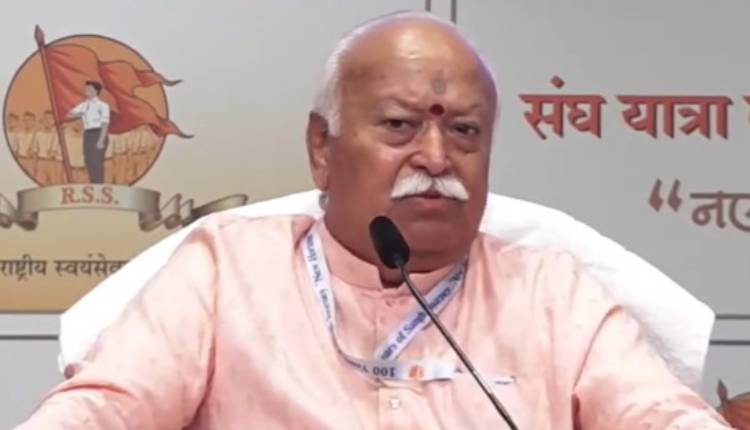
Mumbai: Rashtriya Swayamsevak Sangh (RSS) chief Mohan Bhagwat on Sunday said that conferring the Bharat Ratna on Vinayak Damodar Savarkar, popularly known as Veer Savarkar, would be an “honour for the award itself”, asserting that the Hindutva ideologue has already garnered widespread public admiration.
Bhagwat made the remarks while addressing an event titled ‘100 Year of Sangh Journey – New Horizons’ in Mumbai.
Speaking on the “delay” on the conferment of the award, he said, “I am not part of that committee, but if I meet someone, I will ask why it is being delayed. If Savarkar is given the Bharat Ratna, it will be an honour to the award itself, and its prestige will increase. Even without receiving any honour, he already rules the hearts of the people.”
The demand for awarding Bharat Ratna to Savarkar has been a recurring political issue.
While several leaders and groups have advocated for the country’s highest civilian honour to be bestowed upon Savarkar, the Congress party has strongly opposed such proposals, describing him as a “traitor” over his mercy petitions submitted to British authorities during his imprisonment in the freedom struggle.
The Bharatiya Janata Party (BJP) and Shiv Sena have repeatedly voiced support for granting Bharat Ratna to Savarkar, citing his contributions as a freedom fighter, writer and social reformer.
During his address at the event, Bhagwat also spoke about the organisational approach and philosophy of the RSS, emphasising that the Sangh focuses on instilling “sanskar” or values rather than engaging in aggressive publicity or campaigning.
“Excessive campaigning leads to publicity, which can breed arrogance. One must protect oneself from it. Publicity should be like rainfall: appropriate in timing and quantity,” Bhagwat said, while adding that the RSS has been expanding its outreach initiatives in recent times.
Bhagwat also commented on language use within the RSS, stating that English would not be adopted as the medium of communication for the organisation’s functioning, as it is not an indigenous language.
He clarified that while English is used where required, it is not central to the Sangh’s communication practices.
“We want to collaborate with Indian individuals. Wherever English is required, we are willing to use it.,” he said.
He further stressed the importance of language skills, suggesting that individuals should strive to speak English proficiently.
“People should be able to speak English in a way that native speakers will want to listen,” Bhagwat said.
At the same time, he underlined the need to preserve native languages, stating, “We should master English, but that does not mean we forget our mother tongue.”
Recalling a previous interaction in Bengaluru, Bhagwat mentioned that representatives from several southern states had difficulty understanding Hindi during discussions.
He said that he had responded to their queries in English in order to ensure effective communication, highlighting the organisation’s pragmatic approach towards language usage.
(IANS)