





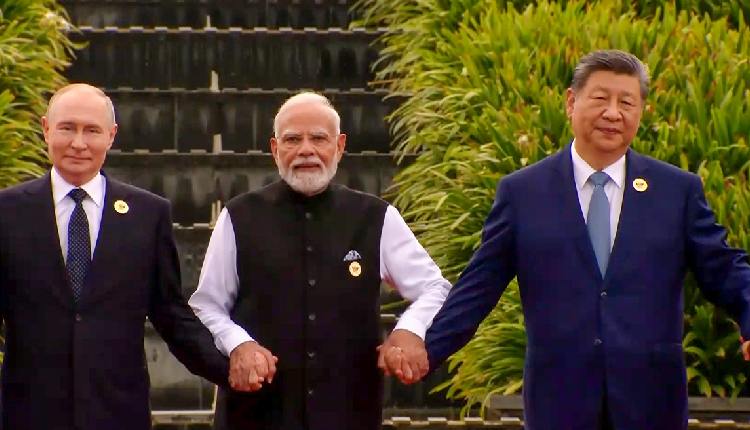
New Delhi: The 2026 BRICS New Delhi Summit has brought a long-dormant geopolitical axis back into the spotlight, with the potential of a Russia-India-China (RIC) platform resurfacing as a dominant force in global affairs.
While severe bilateral border disputes and trade imbalances continue to strain India-China relations, the sheer weight of Western economic pressures has created a powerful incentive for tactical convergence.
The United States’ aggressive imposition of sanctions has pushed Beijing and Moscow to proactively seek common ground with New Delhi on alternative economic frameworks.
In the late 1990s, RIC was conceived as a dialogue mechanism with Russia seeking to bring India and China together to counterbalance Western dominance, but certain limitations of a purely trilateral format soon became evident.
The emergence of BRICS transformed RIC into a broader multilateral platform with global reach. BRICS institutionalises the cooperation envisioned by RIC, providing a structured framework through which the three countries can engage not only with each other but also with other emerging powers such as Brazil, South Africa, and more recently, Iran, Egypt, Ethiopia, and the UAE.
India’s trade with China has expanded, reaching over $150 billion in recent years, but the persistent trade deficit underscores structural imbalances.
Russia, meanwhile, remains a crucial supplier of arms and energy to India, yet its growing dependence on China due to Western sanctions complicates India’s strategic autonomy. While Russia’s balancing role is increasingly constrained by its alignment with Beijing, China’s expanding presence in the Indian Ocean and its close ties with Pakistan challenge India’s regional dominance.
At the same time, BRICS helps to manage the tensions inherent in the RIC axis. India and China, despite their border disputes and strategic rivalry, find themselves cooperating within the platform on issues such as trade, climate change, and reform of international financial institutions.
Russia, on its part, uses BRICS as a way to diversify its partnerships beyond the West, while also acting as a mediator between Delhi and Beijing. In this way, BRICS provides a buffer that allows RIC to function despite bilateral frictions.
The expansion has given the bloc significant demographic and economic weight, representing over 40 per cent of the world’s population and a growing share of global GDP. For South Asia, this means that India’s participation in BRICS amplifies its voice in global governance while offering opportunities for economic integration and development financing.
Islamabad will now follow future developments more closely given Saturday’s New Delhi Declaration. The impact of BRICS on South Asia, on the one hand, creates economic opportunities by opening access to new markets, infrastructure financing, and collective initiatives in technology and energy.
On the other hand, it indirectly shapes the region’s security environment by echoing RIC’s positions on global conflicts and by reinforcing narratives critical of Western-led institutions. Thus, BRICS has taken a trilateral dialogue to a multilateral coalition that influences not only South Asia but also the wider global order.
Yet, the effectiveness of BRICS in sustaining the RIC axis depends on whether India and China can manage their rivalry within this larger framework, and whether Russia can maintain enough independence to balance the triangle. In this sense, BRICS can both be the enabler and the test of the RIC axis’ durability.
(IANS)