





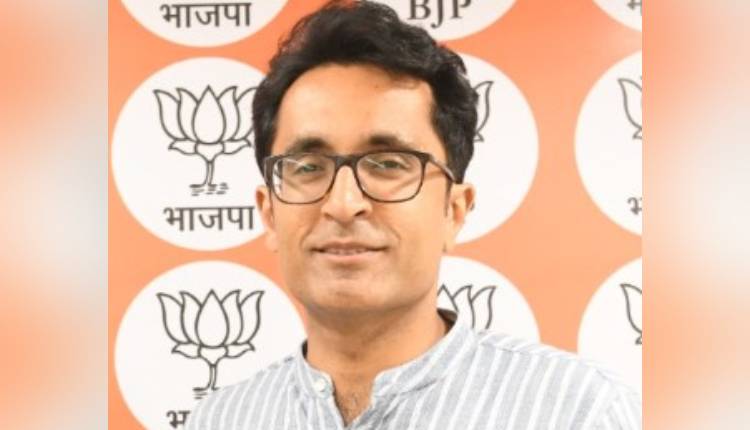
New Delhi: BJP National Spokesperson Pradeep Bhandari on Friday launched a sharp attack on the Congress party, accusing it of politicising fuel price trends and ignoring India’s relative stability in global energy markets amid geopolitical tensions.
Taking to X, Bhandari wrote, “The Congress Party should be ashamed of itself to politicise everything! Congress is a party which always looks at political opportunity in any global crisis; only to have egg on their face!
“Despite Brent crude staying above $100/barrel and fuel prices surging globally after the Strait of Hormuz crisis, India has seen only a 3.5 per cent increase in petrol and diesel prices after 76 days of stable prices!”
He further compared that to: “Pakistan: +55 per cent, Malaysia: +56 per cent, US: +45 per cent, UAE: +52 per cent, China +23 per cent, and France +31 per cent.”
“This is a time for economic patriotism. 140 crore Indians are with PM Narendra Modi and the Congress yet again is getting exposed because of its desperate politics!” he claimed.
His remarks came amid a broader political debate over fuel pricing and India’s response to global crude oil volatility triggered by the West Asia crisis and disruptions around the Strait of Hormuz.
Separately, BJP IT Cell incharge Amit Malviya shared a detailed analysis on X, highlighting how India has managed to keep fuel price increases significantly lower compared to other major economies during the global oil shock.
Malviya said the surge in global fuel prices following the West Asia conflict and Brent crude crossing $100 per barrel had impacted most countries, but India remained a “striking exception.”
He noted that between February 23 and May 15, countries across the world witnessed sharp fuel price increases, including Myanmar, Malaysia, Pakistan, UAE, the United States, Sri Lanka, the United Kingdom, Germany, and Japan, with rises ranging from single digits to over 100 per cent in some cases for diesel.
According to his post, India recorded a comparatively minimal increase: Petrol: +3.2 per cent and Diesel: +3.4 per cent.
He further said that only Saudi Arabia saw no change due to subsidy structures, while India among major market economies registered the lowest rise.
Malviya also stated that Indian public sector Oil Marketing Companies, which account for nearly 90 per cent of retail fuel sales, kept prices largely unchanged for about 76 days despite rising crude costs, absorbing significant under-recoveries estimated at nearly Rs 1,000 crore per day.
He added that the Rs 3 per litre revision announced on May 15 marked the first price change in nearly four years and represented only a modest 3.5 per cent adjustment on an approximately Rs 95 per litre base.
“India, however, managed to shield consumers from global volatility for over two months before implementing a calibrated increase. This matters because fuel prices do not remain confined to petrol pumps. They affect transport costs, food inflation, manufacturing, logistics and household budgets. Containing fuel volatility is also about containing inflation,” he said.
“The story here is not merely about a Rs 3 increase. The story is that while much of the world adjusted through increases of 10 per cent , 20 per cent, 50 per cent, and in some cases nearly 90 per cent, India limited the impact on its citizens to just over 3 per cent,” he added.
(IANS)