
New Delhi: Uttar Pradesh Chief Minister Yogi Adityanath, Delhi CM Rekha Gupta, and several other BJP Chief Ministers on Thursday remembered June 25, 1975, as a dark chapter in the history of Indian democracy, saying the imposition of the Emergency was an attempt to suppress constitutional values, civil liberties, and democratic institutions.
Taking to social media platform X, CM Yogi Adityanath wrote in Hindi (loosely translated), “June 25, 1975, marks a dark chapter in the history of Indian democracy – a time when an attempt was made to crush the constitutional soul of the nation by imposing the ‘Emergency’. The darkness of the ‘Emergency’, imposed by the Congress out of the arrogance of power, dealt a severe blow to freedom of expression and civil liberties. A million salutations to all the great ‘Democracy Warriors’ who struggled to safeguard democracy while enduring brutal torture during those trying times.”
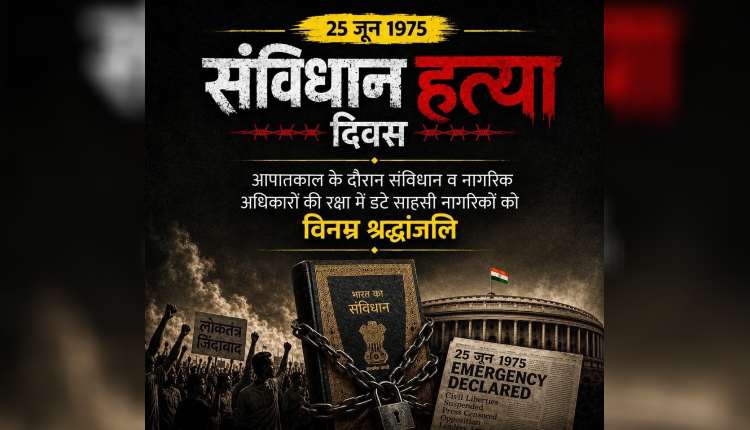
Delhi Chief Minister Rekha Gupta also termed June 25, 1975, as one of the darkest days in India’s democratic history and noted that the day is now observed as ‘Samvidhan Hatya Diwas’ (Day of the Murder of the Constitution).
“The Emergency was the most severe blow ever dealt to India’s democracy and Constitution. This decision by the Congress government, led by the then Prime Minister Indira Gandhi, inflicted deep wounds on democratic institutions. During that period, civil rights were violated, the freedom of the press was shackled, and freedom of expression was stifled,” she added.
Uttarakhand Chief Minister Pushkar Singh Dhami also recalled the Emergency, describing it as a dark phase in the nation’s democratic journey.
Uttarakhand CM Pushkar Singh Dhami also took to social media ‘X’ and said, “On this day in 1975, the then Congress government – intoxicated by the arrogance of power – imposed an Emergency on the nation, writing a dark chapter in the history of Indian democracy. During this period, freedom of expression was violated, the voice of the press was stifled, lakhs of citizens and political activists were imprisoned without trial, and the fundamental rights guaranteed by the Constitution were severely curtailed.”
CM Dhami said the Emergency was not merely a political decision but a serious assault on democratic values and constitutional propriety.
“The Emergency was not merely a political decision; it was a severe assault on democratic values and constitutional propriety. I offer my deepest salutations to all the guardians of democracy who steadfastly resisted this oppression even under such adverse circumstances; it is thanks to their indomitable courage that India remains a vibrant democracy today,” he said.
Rajasthan Chief Minister Bhajanlal Sharma said the Emergency remains one of the darkest chapters in India’s democratic history.
He said, “It was on this day in 1975 that the ‘Emergency’ – regarded as a dark chapter in India’s democratic history – was imposed upon the nation by the then Congress government. It was a period marked by the blatant suppression of freedom of expression, civil rights, and constitutional values, alongside attempts to weaken democratic institutions.”
CM Sharma paid tribute to the “Democracy Warriors” and patriots who endured repression and persecution while fighting to restore democracy.
“I offer my deepest salutations to all the ‘Democracy Warriors’ and patriots who, despite enduring immense suffering, repression, and persecution during that dark era, fought to protect and restore democracy,” he said.
Madhya Pradesh Chief Minister Mohan Yadav also remembered the day, describing it as the darkest day in the history of Indian democracy.
“June 25, 1975… the darkest day in the history of Indian democracy, when the arrogance of the Indira government led to the imposition of the Emergency. I respectfully salute the guardians of democracy who stood firm against this ordeal. Let us pledge to continue serving the nation with unwavering dedication to the cause of protecting democracy,” he said.
(IANS)