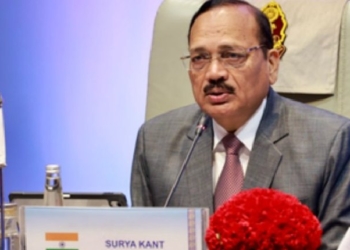






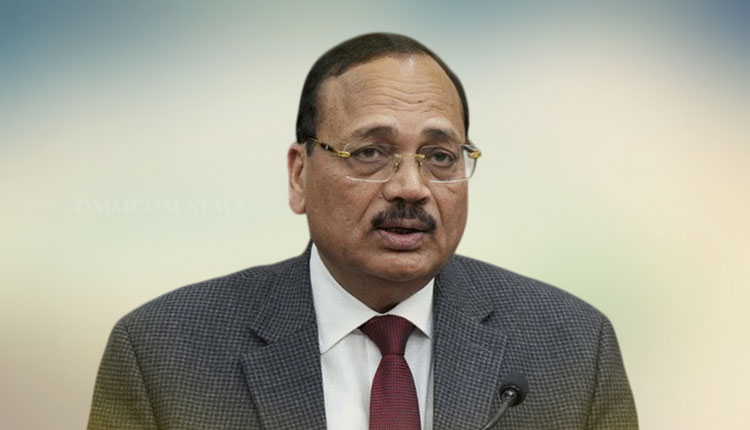
New Delhi: Chief Justice of India (CJI) Justice Surya Kant on Monday stressed that the government must build and maintain systems through which water reaches people, saying that access to safe and reliable water is central to human dignity and the fulfilment of constitutional rights.
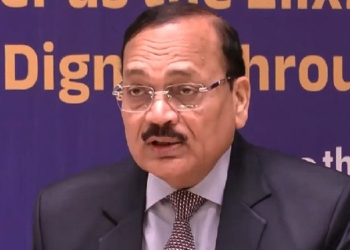
Addressing the 33rd Foundation Day function of the National Human Rights Commission (NHRC) at Vigyan Bhawan in New Delhi, the CJI said that the government’s responsibility extended beyond providing infrastructure to ensuring that water remained safe, reliable and available whenever people needed it.
“Government must build and maintain the systems through which water reaches people,” CJI Kant said, highlighting the need for a coordinated institutional response to address challenges concerning access to water.
Underlining the significance of water from a human rights perspective, he said it sustained health, made education possible, protected dignity and shaped the conditions in which families lived and worked.
“A community without reliable access to water cannot fully enjoy the dignity that our Constitution promises,” he said, adding that water was not an isolated entitlement but one of the conditions necessary for the fulfilment of other rights.
The CJI further said that the absence of access to reliable water had wider social and economic consequences, particularly for women who spent hours fetching water and for farmers whose livelihoods depended on irrigation.
Referring to the expansion of drinking water access in India, including through household tap connections in rural areas, CJI Kant said the progress deserved commendation but stressed that the focus must now extend to the quality and reliability of the supply.
“A mere tap is not the same as access to water. A pipe that runs dry cannot fulfil the promise that the pipe represents,” he said, cautioning that water contaminated with arsenic, fluoride, or other harmful substances posed a threat to life and health.
The CJI said that the constitutional understanding of the right to life had evolved to encompass conditions necessary for a dignified existence, including access to health, food, shelter, livelihood and a clean environment.
He also said the Supreme Court’s environmental jurisprudence had recognised that the right to life included the right to enjoy pollution-free water and air, making access to safe water an important dimension of the government’s constitutional responsibilities.
CJI Kant further underscored the role of civil society in highlighting ground realities and of international institutions in contributing scientific knowledge, experience and cooperation to address water-related challenges.
“Water itself teaches us something consequential: it crosses boundaries. Our response to it must do the same,” he said, calling for a collaborative approach to ensuring access to water.
In his address, the CJI stressed the need to protect water resources for future generations, warning that depleted aquifers, polluted rivers and compromised drinking water sources would impose a burden on those not yet born.
He said the right to water should be understood not merely as an entitlement of the present but also as a responsibility towards the future, stressing the need to preserve the conditions necessary for successive generations to enjoy their rights with dignity.
The CJI’s address came as the NHRC marked its 33rd Foundation Day with a national conference on the theme, “Water – The Elixir of Life”, focusing on the relationship between water, human dignity and the protection of human rights.
The function was attended by NHRC Chairperson Justice V. Ramasubramanian, Members Justice (Dr.) Bidyut Ranjan Sarangi, Vijaya Bharathi Sayani and Priyank Kanoongo, Secretary General Piyush Goyal, senior officers and other dignitaries.
(IANS)