





New Delhi: For nearly half a century, political rulers in West Bengal defied, challenged and even ridiculed those at the Centre while fiercely defending their fortress — much like the tiny Gaulish village imagined by Rene Goscinny and Albert Uderzo in the popular Asterix-Obelix series.
As depicted in the immensely popular comic books, the inhabitants often fought among themselves, but united whenever confronted by those they branded as “outsiders”.
Unlike the fictional Gaulish village, however, internal conflicts gradually weakened the shield bearers in West Bengal in their own ways, leading to the erosion of support for their own Chief Vitalstatistix. And eventually, the heavens truly fell — the very fear that constantly haunted the Chief.
First, it was the Left Front. Then came the Trinamool Congress government.
This time, the last major eastern bastion too appeared dented, with a surge of silent voices emerging from among those suffering amid factional feuds and administrative drift. They sought change.
Sensing the shield slipping from beneath his feet, Chief Vitalstatistix would perhaps have realised too late the importance of the magic potion prepared by Getafix, the village druid.
For West Bengal, that “druid” was Mukul Roy, who silently managed the organisation, especially during elections, while Trinamool Congress supremo Mamata Banerjee led the party from the front.
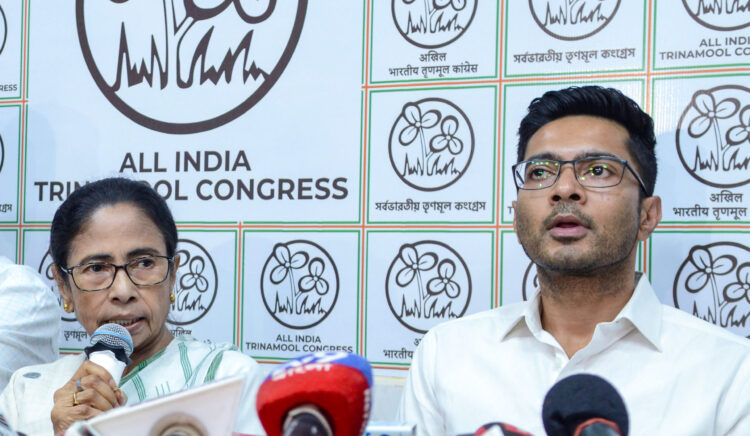
The subsequent rise of Mamata Banerjee’s nephew, Abhishek Banerjee, within the organisation, coupled with his no-compromise style and growing dependence on outside consultants, reportedly left leaders such as Mukul Roy, Saumitra Khan and Suvendu Adhikari feeling increasingly alienated.
The Nandigram movement, which helped Mamata Banerjee dethrone the Left Front government in 2011, was largely planned, coordinated and spearheaded on the ground by Suvendu Adhikari.
He steadily rose through the party ranks but was later believed to have felt sidelined.
Suvendu Adhikari shot into national prominence soon after joining the Bharatiya Janata Party (BJP), particularly after defeating his former political mentor in 2021, when Mamata Banerjee chose to contest against him from the Nandigram Assembly constituency.
His stature rose further this time when he not only retained Nandigram but also successfully defeated the Trinamool Congress supremo in her own stronghold of Bhabanipur.
Like Suvendu Adhikari, Saumitra Khan too shifted to the BJP, claiming he felt slighted within the Trinamool Congress and criticising the party over what he described as its lack of direction.
He alleged that the party was increasingly being run by Abhishek Banerjee and said he felt neglected despite his contributions to the organisation.
Perhaps the biggest blow was the exit of Mukul Roy, whose name is said to have figured in the documents submitted by the Trinamool Congress while registering itself with the Election Commission as a political party in 1997-98.
Insiders claimed that he too was unhappy with the younger Banerjee’s growing influence within the party.
The former Railway Minister passed away early last year while suffering from multiple ailments, including Parkinson’s disease.
Mukul Roy was known for his efficient election management skills and had long been regarded as one of Mamata Banerjee’s closest confidants, often seen as the party’s second-in-command.
He was also reportedly involved in strategising the BJP’s political expansion in West Bengal after joining the saffron camp.
However, both Mukul Roy and Suvendu Adhikari were believed to have faced the party’s wrath after being named in connection with the Narada sting operation.
Yet, several others who had also featured in the sting tapes continued to remain within the party leadership.
Meanwhile, Mamata Banerjee’s grip over both the organisation and administration appeared to weaken steadily, with several party leaders clashing publicly even as allegations of corruption and incidents of crime in the state continued to rise.
By then, two parallel centres of power had emerged within the party, at least in public perception.
One camp centred around Mamata Banerjee was referred to as the “Kalighat” or “Harish Chatterjee” group, named after the locality of her residence, while the other revolved around Abhishek Banerjee and was known as the “Camac Street” camp, after the location of its office.
The situation increasingly resembled the functioning of earlier Left Front governments, where the organisation and administration operated under distinct leadership structures, with the organisational leadership often prevailing during crucial moments.
Even at the peak of the RG Kar protest movement, the “Camac Street” camp appeared to favour a measured administrative response, while Mamata Banerjee was perceived by many as uncertain and under pressure.
Abhishek Banerjee took to social media to condemn the brutal rape and murder and publicly shared his instructions to the police seeking immediate action against those accused of attacking protestors.
That appeared to galvanise the administration into stronger action later.
Had Goscinny and Uderzo been around to chronicle “when the tiny Gaulish village fell”, their account might have featured an unhappy Obelix — upset with the druid for denying him the magic potion because he was already considered too powerful after falling into a cauldron as a child.
And their Asterix would perhaps have constantly looked over his shoulder to ensure that Obelix was still beside him during the “boar hunt”.
And then, the heavens fell.
(IANS)