





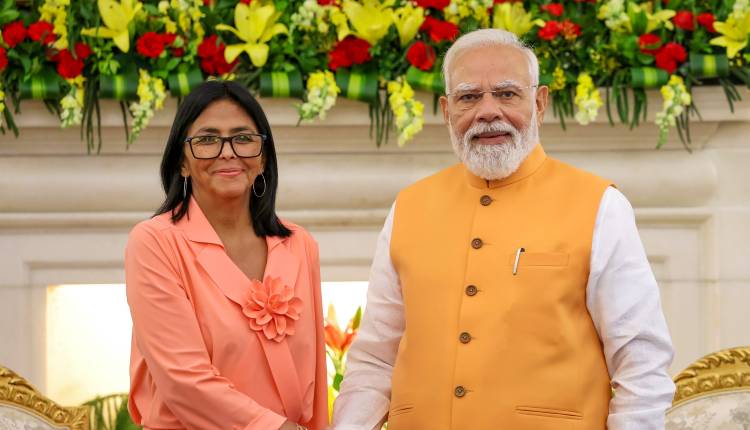
New Delhi: The visit of Venezuela’s Acting President Delcy Rodriguez to India from June 3-6 has opened up an opportunities for bilateral cooperation in energy, critical minerals as well as the automotive and pharma sectors between the two countries, according to a new report.
Venezuela has among the world’s largest oil reserves and with India importing as much as 88 per cent of its oil requirements and looking to new sources, it is eyeing Venezuelan oil.
According to an article in The Diplomat, in 2012, India raced ahead of China to emerge as the largest Asian importer of Venezuelan crude oil. The US sanctions on the Venezuelan economy, first imposed in 2005, forced India to cut its purchase of Venezuelan crude in 2019-2020, and then again, in 2025, under pressure from the first and current Trump administrations.
Following the removal of Nicolas Maduro from power as Venezuelan president, the Trump administration’s taking control of Venezuela’s oil industry and the lifting of economic sanctions, the Latin American country has opened up for business.
Until last year, India’s major suppliers were Russia, Iraq, Saudi Arabia and the United Arab Emirates. However, Delhi’s purchase of discounted crude from Russia ran into opposition from the US and western countries.
While India did reduce its oil purchases from Russia to step up oil imports Iraq, Saudi Arabia and the UAE, this supply chain was disrupted due to the Iran war leading to the choking of the Strait of Hormuz crisis, through which 20 per cent of the world’s oil and gas exports transited.
After a gap of five years, India and Venezuela are looking to rebuild ties, and crude oil are top-most on their agenda. Even before Rodríguez arrived in Delhi, India’s purchase of Venezuelan crude surged. In fact, in May, Venezuela had already emerged as India’s third largest supplier of crude oil.
During her time in India, Rodríguez visited the privately run Jamnagar refinery in Gujarat that refines crude imported from Venezuela. The idea is to expand cooperation into exploration, production and refining, the article states.
India is also looking for partners in the critical minerals sector as it seeks to reduce dependence on China, which exercises a monopoly in the mining and refining of these metals that are required as inputs in hi-tech electronics, electrical vehicles and defence hardware. The issue of Venezuela paying up money owed to Indian oil and pharma companies also came up during the talks.
The overseas arm of Indian oil giant ONGC is yet to receive over $500 million from its Venezuelan investments, while outstanding dues to Indian pharmaceutical companies are estimated at $700-$800 million. ONGC Videsh operated the San Cristobal onshore oilfield in partnership with Venezuela’s national oil company Petroleos de Venezuela SA (PDVSA), since 2008.
Though the fields hold commercially attractive reserves, production collapsed as sanctions cut off access to drilling rigs, spare parts, services and financing. Rodríguez also toured a pharmaceutical unit and an auto-components manufacturing facility, pointing to potential areas where India would like to make forays into Venezuela, The Diplomat pointed out.
(IANS)