





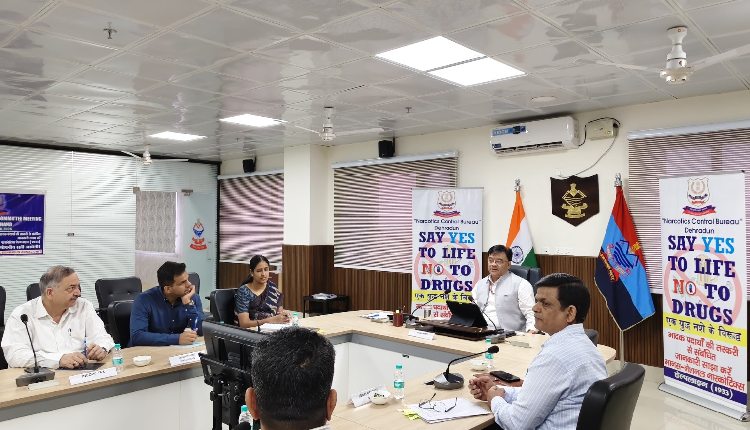
Dehradun: The NCB’s quarterly state-level Joint Co-ordination Committee (JCC) meeting for Uttarakhand, held in Dehradun, discussed strategies to further enhance inter-agency coordination to combat drug trafficking, an official said on Saturday.
The meeting, chaired by Deputy Director General, NCB (Northern Region), was joined by representatives of NIA, DRI, ED, Income Tax, SSB, IB, Uttarakhand ANTF and FDA, said the official in a statement.
The discussions focused on drug-trafficking hotspots, Nepal-linked trafficking routes, border interdictions, emerging modus operandi and pharmaceutical and precursor diversion, it said.
The participants also focused on clandestine laboratories, financial investigations, PIT-NDPS and efforts being undertaken for effective implementation of Vision Document on Narcotics Control (2026-29), said the NCB.
The meeting also reviewed the establishment of NDPS courts, capacity building in darknet and cryptocurrency investigations and mechanisms for improved intelligence sharing among agencies, said the NCB statement.
Uttarakhand ANTF was urged to compile major ganja cases from the past five years involving Odisha as a source and coordinate with Odisha authorities to target supply networks at source, it said.
At the 3rd national conference of Anti-Narcotics Task Force (ANTF) heads of states last month, Union Home Minister Amit Shah stressed the need to deliver a decisive blow against narcotics.
He described drugs as one of the most serious threats facing the country and the world, expressing determination to uproot the trade from India by December 31.
The Home Minister said a “Drug-Free India” was essential for building a Viksit Bharat by 2047, protecting future generations and connecting youth with national development.
Organised by the Narcotics Control Bureau (NCB) under the theme “United Resolve, Shared Responsibility”, the two-day event brought together ANTF heads from 36 states and J&K along with stakeholders from various government departments.
Home Minister Shah said a “Drug-Free India” was essential for building a Viksit Bharat by 2047, protecting future generations and connecting youth with national development.
The conference featured technical sessions on institutional mechanisms to achieve the Vision Document’s targets, demand reduction, prevention and rehabilitation, and dismantling drug trafficking networks. Discussions highlighted the Vision Document’s four strategic pillars, with defined responsibilities, timelines and monitoring mechanisms.
–IANS–