




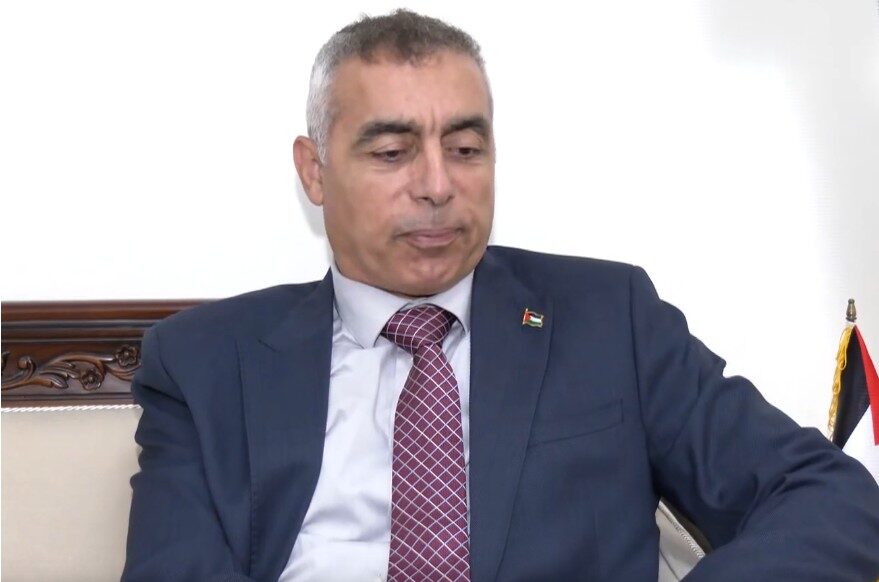
New Delhi: Palestinian Ambassador to India, Abdullah Abu Shawesh, on Thursday, expressed confidence that India will send medical assistance “very soon” as the healthcare system has collapsed in Palestine.
In an interview with IANS, Abdullah Abu Shawesh stated that the humanitarian situation in Gaza is “miserable” with only 17 out of 36 hospitals partially working in Gaza. He said that more than 1,000 Palestinians have been killed since the declaration of the ceasefire last October.
Accusing the international community of not making enough efforts to address the Palestinian issue, he also spoke about India’s support for the two-state solution and mentioned New Delhi’s efforts in the peace process.
The following are the excerpts of the interview:
IANS: About Palestine’s request for medicines and medical equipment from India?
Abdullah Abu Shawesh: When it came to the medical and medicine help that we used to receive and still receive from India, we have a lengthy history behind that since the beginning of the Israeli genocidal war. India … sent a lot of medicine and medical supplies to Palestine. I convened a press conference in the Embassy of the State of Palestine last Friday, and I called for the international community… of course, for the Indian people and for the Indian government to start helping the Palestinian people.
My recent press conference was regarding the collapse of the Palestinian health system. A few days before I even convened the press conference, I had been in a good discussion with the Minister of Foreign (External) Affairs, and they promised me they would do their ultimate best, and to be very frank, I’m pretty sure that India or the Indian government gonna do something very significant and very soon. I received a call from the Minister of Foreign Affairs just two days ago. The process is ongoing, and it seems that we are very close to having a lot of help from the Embassy or from the Minister of Foreign Affairs. The other issue is it’s not only the official, I mean not only the government of India, many of the Indian people, many of the Indian institutions, have been reaching out to me, and we are already, or we are very close to receiving a lot of supplementary medical equipment, medical supplies and other material even from the Indian people themselves.
IANS: How do you assess the current humanitarian situation in Gaza, and what is the biggest challenge facing Palestine today?
Abdullah Abu Shawesh: When it comes to the humanitarian situation, you cannot say there is one type of humanitarian situation, one type of humanitarian challenge is more than the other… has urgency more than others. When we talk, we are very close to 1,000 days of Israeli genocidal war; Israel destroyed everything in Gaza, infrastructure, and the medical system itself. Only approximately 17 out of 36 of the hospitals in Gaza are partially working. Approximately 700,000 Palestinian students in Gaza have already lost two schooling years. Just two days ago, the United Nations Human Rights Council issued a very shocking report to the international community that tackles the issue of the children or the destruction of the childhood, children itself by the Israelis.
So, that when it came to the humanitarian situation, everything is in a miserable situation, and if you want to classify it or to divide it to tackle some points of it, starvation is still there in Gaza, it’s not in the same exact size as a few months ago, but starvation is there. People are still being targeted. More than 1,000 Palestinians have been killed since the declaration of the ceasefire last October, 250 of them are children. We are talking about 5,000 children, according to Save the Children. According to the recent UN report, (the bodies of) 5,000 children in Gaza are still under the rubble… We are talking about a miserable humanitarian situation that we are enduring and facing in Gaza, but this is not the end of the story. Even in the occupied West Bank, the humanitarian situation is very catastrophic, and I have already shed light on the collapse of the health system in Palestine.
IANS: What does Palestine expect from the UN and other international organisations?
Abdullah Abu Shawesh: At this stage, the main issue that we would like to stress on it it’s not only the United Nations, United Nations entities but also all the international organisations that are dealing and monitoring and working when it came to the humanitarian subsidiary, when it came to the international law, our expectation from the United Nations itself is to continue producing all the sophisticated reports that is documented the humanitarian or the catastrophic situation that we are enduring in Palestine. The United Nations General Assembly has to take very significant steps and a resolution to require Israel to abide by international law. From the Security Council, the United Nations Security Council, we expected a clear cluster resolution that calls for anyone who conducted or who I mean conducted the war crime and the crimes against humanity to stand to trial and to face justice, international justice. But, this is not the end of the course, we expect also from the international community at large to stand strong, not only in this very critical time to make sure that the humanitarian situation in Palestine is resolved, and at least the health sector in Palestine to be supported to save thousands of Palestinian lives.
IANS: Do you believe the international community is doing enough to protect Palestinian civilians and address their humanitarian needs?
Abdullah Abu Shawesh: No, I did not believe of that because according to the recent investigation report that had been issued or had been prepared by Al Jazeera channel, 51 countries-states from all around the world used to supply Israel with different type of weapons so that the international community, unfortunately instead of a stop, supplies Israel with killing machines and killing weapons and all of this stuff unfortunately during the genocidal war. …they supported Israel and supplied Israel. This is far second when it came to the humanitarian aid… I’m pretty sure that the international community at large have not put enough pressure on Israel to allow the humanitarian aid to enter Gaza, and to date, the humanitarian aid is not entering Gaza as much as it is needed. So, that’s no… the international community, unfortunately, I can’t reassure you that they did not do their homework when it came to the Palestinian issue
IANS: How do you see the future of the two-state solution in the current geopolitical scenario?
Abdullah Abu Shawesh: The only way, the only bet, the only way out for all the crises that we are in enduring in the Middle East since November 2nd, 1917. I mean, when I say 1917, I mean the issuing of the Balfour Declaration at that time by the British themselves. Since that time, the only bet for this is to sit at the negotiation table and to abide by international law and to implement the two-state solution. The only one who are refusing, of course, the two-state solution is Israel and some of its allies. Of course, we, the Palestinians accept to build our state in only 22 per cent of our historical land which mean that we are fully confident we fully abide, we are fully agree in agreement with that two-state solution but unfortunately again and again and again the only one who stand strong…and denying and refusing the two-state solution is Israel not only the current government but even from the opposite political parties in Israel, they are still refusing the two-state solution.
IANS: Do you think the recent crisis in West Asia has pushed down the Palestine issue on the international agenda?
Abdullah Abu Shawesh: Absolutely, the war that had been launched by America and Israel from one side against Iran had put our issue, our file, was not the priority. Just three months ago, before the war, the main file that occupied and dominated the discourse worldwide was the Palestinian fight, the Gaza file. Today, the only or the main file that dominates the issue of course is the American-Israeli-Iranian file.
IANS: How do you see India-Palestine ties?
Abdullah Abu Shawesh: We strongly believe that India stands strong to support the two-state solution. India used to support the Palestinian people when it came to the United Nations resolutions, voting in favour of the resolutions and even on the ground, India is heavily invested in the peace process and has implemented a lot of projects on the ground in Palestine. One very important issue we are very close to starting a new project, or India is starting to implement in a very important project, which is building a hospital in Palestine, particularly in the West Bank.
(IANS)