






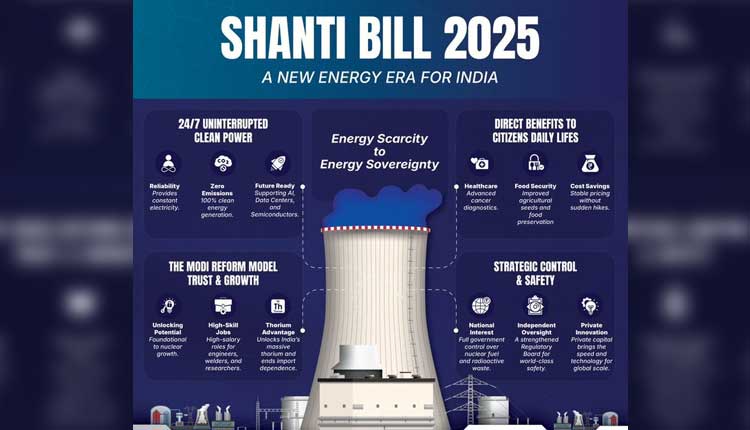
New Delhi: The Sustainable Harnessing and Advancement of Nuclear Energy for Transforming India (SHANTI) Bill, 2025, passed by both Lok Sabha and Rajya Sabha, aims to achieve self-reliance in the nuclear sector and meet India’s 2047 clean energy goals.
The proposed law aims to create an enabling ecosystem for clean, reliable energy, while also upholding the long-standing commitment to the peaceful use of atomic energy.
It is also a reflection of India’s commitment to global best practices in nuclear governance.
The Bill enables responsible private and joint venture participation to bridge resource constraints, shorten gestation periods, and support the national goal of 100 GW nuclear capacity by 2047, without compromising national security or public interest.
What are the provisions under the Bill?
The Bill consolidates and rationalises provisions from the Atomic Energy Act, 1962, the Civil Liability for Nuclear Damage (CLND) Act, and now accords statutory status to the Atomic Energy Regulatory Board, making it part of the parent legislation.
The Bill opens up the nuclear sector to privatisation, a move aimed at achieving self-reliance and meeting India’s 2047 clean energy goals. It comes after the privatisation of the space sector, which saw significant growth.
However, the new Bill will involve private partners under defined conditions for the exploration activities. The uranium mining beyond specified thresholds will continue to remain exclusively with the government.
Similarly, spent fuel management will always remain under government custody, following a clearly defined, long-term storage and handling protocol. Strategic materials such as source material, fissile material, and heavy water will continue to be under strict government control.
The Bill also explicitly recognises environmental and economic damage within the definition of nuclear harm. With dedicated investments announced for small modular reactors and research and innovation, the proposed law aims to create an enabling ecosystem for clean, reliable energy.
Nuclear energy has applications beyond power generation, including cancer care, agriculture, and industry. The Bill will help scale up the industry to meet rising demand from sectors such as data processing, healthcare, and industry, alongside renewables.
How the Bill addresses safety concerns
Union Minister of Science and Technology Dr. Jitendra Singh in the Lok Sabha said that nuclear safety standards remain unchanged and uncompromised, governed by the same stringent principles enshrined in the Atomic Energy Act of 1962 – “safety first, production next.”
The safety standards include a rigorous inspection regime, including quarterly inspections during construction, biannual inspections during operation, five-yearly licence renewals, enhanced powers to the now-statutory Atomic Energy Regulatory Board, and oversight aligned with International Atomic Energy Agency parameters.
Notably, as India’s nuclear plants are geographically located far from seismic fault zones, the radiation levels at Indian reactors are many times below prescribed global safety limits.
How the Bill will work
The proposed law is closely linked to India’s long-term energy and climate goals and outlines the country’s roadmap for decarbonisation by 2070.
At the operational level, the Bill lays down provisions for licensing and safety authorisation for specified persons involved in the production or use of nuclear energy, along with clear grounds for suspension or cancellation.
It seeks to bring under regulation the use of nuclear and radiation technologies in areas such as healthcare, food and agriculture, industry and research, while exempting research, development and innovation activities from licensing requirements.
The Bill also proposes a revised and pragmatic civil liability framework for nuclear damage, confers statutory status on the Atomic Energy Regulatory Board, and strengthens mechanisms related to safety, security, safeguards, quality assurance, and emergency preparedness.
It provides for the creation of new institutional arrangements, including an Atomic Energy Redressal Advisory Council, designation of Claims Commissioners, and a Nuclear Damage Claims Commission for cases involving severe nuclear damage, with the Appellate Tribunal for Electricity acting as the appellate authority.
The proposed legislation seeks to balance the expansion of nuclear energy with safety, accountability, and public interest, placing nuclear power within the broader national effort towards energy security and a lower-carbon future.
(IANS)





![ÁÖÇѹ̱º»ç·É°ü, ±âÀÚ°£´ãȸ
(¼¿ï=¿¬ÇÕ´º½º) Á¦À̺ñ¾î ºê·±½¼ ÁÖÇѹ̱º»ç·É°üÀÌ Áö³ 8ÀÏ °æ±â ÆòÅýà ķÇÁ ÇèÇÁ¸®½º¿¡¼ ±âÀÚ°£´ãȸ¸¦ ÇÏ°í ÀÖ´Ù. 2025.8.10 [ÁÖÇѹ̱º »ç·ÉºÎ Á¦°ø. ÀçÆǸŠ¹× DB ±ÝÁö]
photo@yna.co.kr/2025-08-10 12:00:10/](https://ommcomnews.com/wp-content/uploads/2025/12/202512193612739-1-scaled-e1766136180293-75x75.jpg)